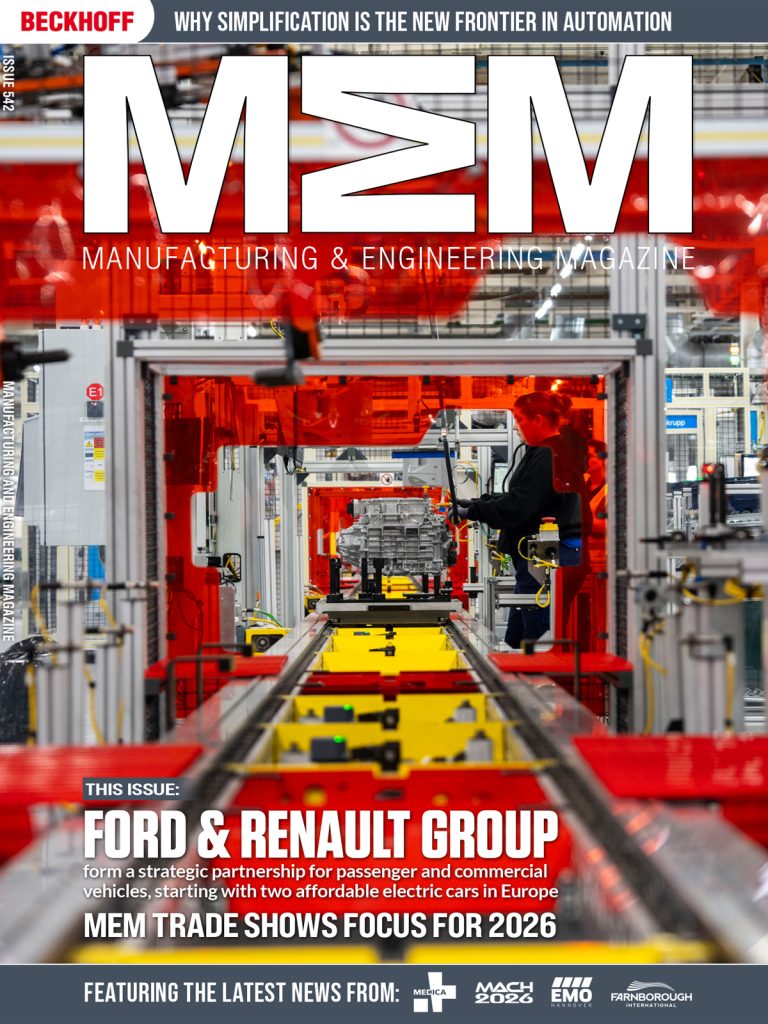



Manufacturers today face greater pressure to adapt quickly. Product variation is rising, schedules shift often and machines must deliver increased performance with less downtime. As automation becomes increasingly software-driven, engineering teams are looking to the IT department for guidance. One methodology in particular, DevOps, is beginning to shape how automation systems are developed and maintained. Here, Beth Ragdale, software business manager at automation and control specialist Beckhoff UK, explains how DevOps can transform industrial environments and why the openness of the underlying control platform determines its success.
At its core, DevOps is a cultural and technical approach that breaks down the traditional divide between software development and operational teams. In the IT world, DevOps enables rapid iteration, continuous testing and smooth deployment. These practices have changed how digital products are built and maintained, allowing teams to release updates frequently and improve quality with automated validation.
Industrial automation is now facing many of the same pressures that originally led to the emergence of DevOps. Machines are expected to evolve faster, integrate more advanced functions and operate more reliably. However, the engineering workflows behind them often remain siloed and heavily reliant on manual intervention.
The challenge is that industrial environments cannot simply copy and paste the IT model. Traditional PLC-based systems tend to be closed and proprietary, limiting the ability to integrate tools such as version control, automated build systems or virtual testing environments. When engineering teams cannot access these, processes become slower and less collaborative. A small modification to a machine might require manual code merging, extensive on-site testing and prolonged shutdowns. In these circumstances, the principles behind DevOps — continuous improvement, reliable iteration and rapid deployment — become difficult to achieve.
This is why openness is so important for DevOps. To benefit from DevOps, automation systems need an architecture that welcomes integration with mainstream IT tools. Standard communication protocols, open development environments and support for common programming languages all play a crucial role. When machine control is built on open foundations, engineering teams can work with familiar tools, share code more easily and establish repeatable processes for building and testing automation software.
Beckhoff’s PC-based control platform is designed with exactly this in mind. Because TwinCAT runs on standard PC technology and supports a wide range of languages and interfaces, it naturally aligns with DevOps-style engineering.
The benefits of this openness can already be seen across a range of industries. In packaging, for example, software-defined motion has replaced rigid mechanical designs, allowing systems to adapt instantly to changing formats. Tetra Pak, a Swedish multinational food packaging and processing company, uses capping technology that demonstrates this clearly. It uses software-driven control and modular motion systems, which have enabled exceptional flexibility, reliability and throughput.
In the energy sector, open control architectures have proven essential for managing the demanding conditions of hydrogen production, storage and fuelling, where real-time data, safety functions and connectivity must operate as a single, integrated environment.
In both cases, the ability to develop, test and update control software rapidly has been instrumental in meeting complex performance requirements.
When DevOps practices are combined with an open automation platform, development cycles become faster and more predictable. Engineering teams can trial changes in simulations rather than using live equipment, reducing commissioning time. Operators can receive regular improvements without lengthy shutdowns because deployments follow established, well-tested procedures. Quality improves as issues are identified earlier in the development cycle, rather than during commissioning. Collaboration becomes smoother because every team works from a single, controlled codebase. Even cybersecurity can be improved, as updates and patches can be applied consistently and transparently throughout a facility.
Perhaps the most significant shift is cultural. Instead of viewing automation software as something that remains static once commissioned, engineers can approach it as a living system — one that evolves throughout the lifetime of a machine. This mirrors trends in software-intensive industries and offers manufacturers a powerful new way to compete. Machines no longer need to be replaced or mechanically reworked to support new production requirements. Instead, they can be enhanced and optimised using iterative software updates.
DevOps is set to play a much greater role in how automation systems are engineered. However, its true impact depends on the technology beneath it. An open, PC-based architecture provides the foundation upon which DevOps can thrive, giving manufacturers the flexibility to innovate continuously without compromising reliability or safety.
For companies looking to improve responsiveness, reduce engineering bottlenecks and build smarter, more adaptable machines, industrial DevOps offers a compelling path forward. And with an open platform at the centre of their automation strategy, that path becomes far easier to follow.
Manufacturing & Engineering Magazine | The Home of Manufacturing Industry News