


– A Practical Guide to Matching Drive Technology to Your Machine –
The instinct to over-specify drive technology is understandable, but it carries hidden costs, says Karl Walker, market development manager at industrial motion control specialist Beckhoff UK. Here, Karl offers advice to machine builders on matching drive performance to real application requirements, from basic conveyor axes through to high-dynamic multi-axis systems.
When a single vendor offers a coherent, scalable range, it’s tempting to start at the top and work down only if the budget demands it. But over-specification has real costs, and they’re not always visible at the point of selection. For example, we often see cabinet space consumed by drives running at a fraction of their rated current and thermal management requirements that wouldn’t exist with a lighter-duty solution, not to mention the additional commissioning complexity that doesn’t add useful performance.
I would argue that the first question isn’t which servo drive to use, but whether a servo drive is the right answer at all. If it is, then ask which tier of performance the application genuinely requires.
Minimum requirements
There are three questions that will narrow down the drive tier most suitable for each axis.
Firstly, does this axis require closed-loop feedback? If speed regulation under a variable load isn’t critical and position accuracy isn’t required, a variable frequency drive (VFD) is probably sufficient. A VFD would be simpler to commission and significantly reduce cost per axis.
Secondly, what are the real dynamic requirements? An axis that runs at moderate speed with gentle acceleration for 95 per cent of its cycle doesn’t need the same drive as one synchronising with four others at high throughput. Peak torque requirements and continuous RMS (root mean square) torque are both important, but it’s the ratio between them and how often the peak is actually reached that determines the appropriate drive tier.
Finally, what does the control architecture require? The communication protocol, cycle time requirements and whether the drive needs to close its own position loop or receive setpoints from a central controller all affect the appropriate specification.
A scalable drive portfolio also provides flexibility as machine requirements evolve, allowing higher-performance drives to be introduced later without requiring a complete redesign of the motion system.
Three tiers
These questions tend to sort axes into three groups, and a well-designed drive portfolio gives each group a natural home. Consider a packaging line with eight axes. Two axes are the primary pick-and-place arms, which are high-speed, tightly synchronised and running complex motion profiles with fast settling times. Two more axes are infeed and outfeed conveyors that simply need to run at a set speed. The remaining four axes are positioning axes like labellers, pushers, perhaps a reject gate, that need repeatability but aren’t dynamically demanding.
Specifying all eight axes identically would be simple but provide unnecessary capacity. A more tailored approach would significantly reduce cost, especially for a machine built at volume.
For the conveyor axes, where there’s not really the justification for servo-grade current control, a VFD such as the Beckhoff AF1000 is likely most suitable. The AF1000 runs synchronous, asynchronous and reluctance motors without a feedback system, handles outputs from 370 W to 5.5 kW and integrates into TwinCAT via EtherCAT alongside the rest of the machine.
For the four positioning axes, the traditional choice was essentially between a full-spec servo drive and something less capable. Now, there’s a third option that sits between the VFD and the premium servo, Beckhoff’s AX1000 economy servo drive.
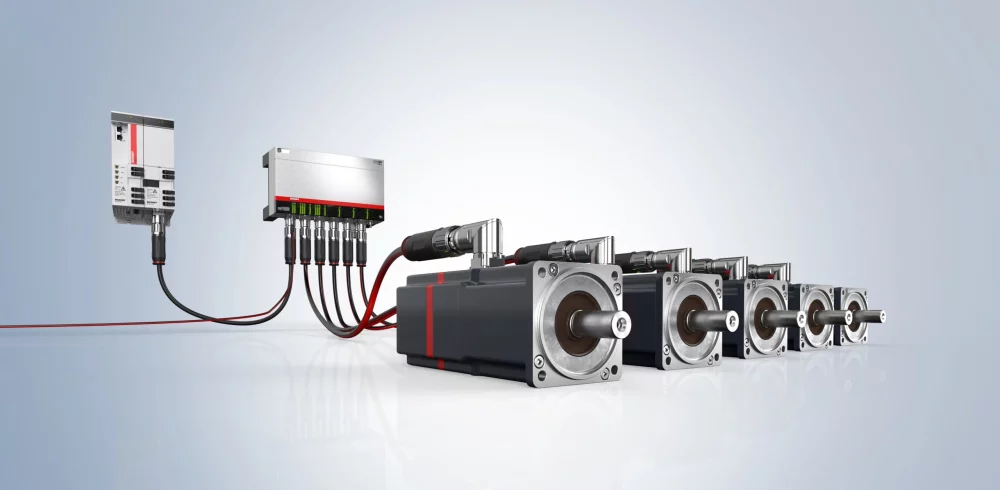
The economy servo system, pairing the AX1000 with the AM1000 servomotor, covers dynamic positioning tasks up to 1.7 kW with a compact footprint, integrated 24 V generation (eliminating an external power supply), and One Cable Technology that reduces cabling to a single connection per axis.
For the two high-performance arms, mid-to-high performance servo drives like the AX5000 or AX8000 would be the answer, and now the engineer can justify them, because they haven’t spent the budget getting there.
Where a central control cabinet isn’t practical, distributed drive systems like the AMP8000 and AMI8100 integrate the servo drive directly into the motor, eliminating the need for drive hardware in the cabinet altogether.
Specify confidently
Ask whether closed-loop feedback is actually needed, understand the real duty cycle rather than the theoretical peak and select the drive tier that fits the application. On a typical machine build, that process will identify axes that don’t need a servo, axes where an economy servo is the right answer and axes where the full-performance range is genuinely justified. If the drives share the same EtherCAT communication and TwinCAT environment, machine builders can start with a lower-tier drive and upgrade later without redesigning the entire control architecture.
The result is a machine that costs less to build and leaves room, both in the cabinet and in the budget, for the engineering challenges that actually demand high-performance drive technology.
For more information on Beckhoff’s economy drive system, including the AX1000 economy servo drive, AM1000 servomotor, and AF1000 variable frequency drive, visit Beckhoff.com.
Manufacturing & Engineering Magazine | The Home of Manufacturing Industry News