

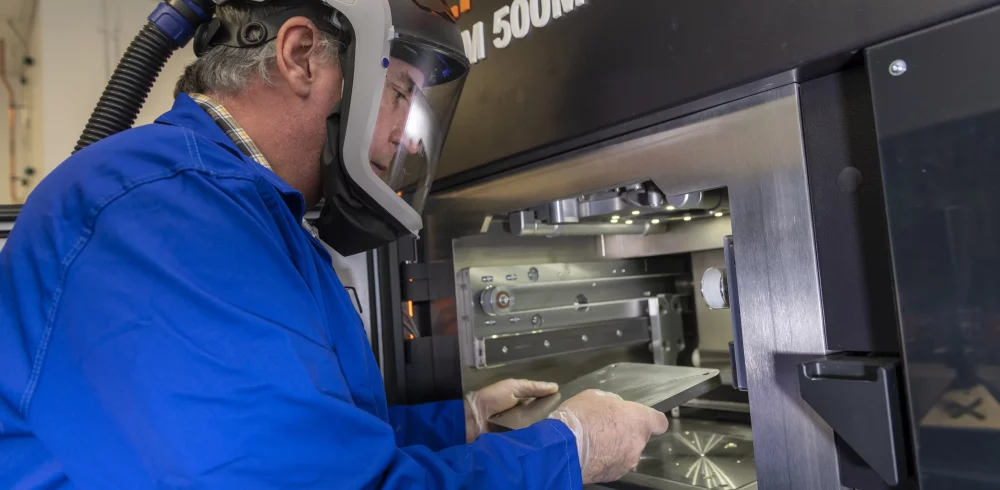
The University of Huddersfield is bridging the gap between academic research and industry, driving growth and resilience for West Yorkshire manufacturers.

The University of Huddersfield has established itself not simply as an academic institution, but as a crucial part of manufacturing growth in the north. “We are a partner in industrial innovation and adoption,” says Professor Parik Goswami, Director – Research and Innovation at the University. “Our role is to connect manufacturers with specialist expertise, advanced facilities, talented people and innovation funding, helping them turn industrial challenges into commercially viable solutions.”
Against a backdrop of rising costs, talent shortages and rapid technological disruption, regional manufacturers – particularly SMEs – face significant risk when attempting to modernise production without proven proof of concept. The University bridges this critical gap by connecting businesses with specialist expertise across precision engineering, metrology, technical textiles and digital innovation.
“The issue is not a lack of ambition. It is the cost, complexity and risk of adopting technologies that have not yet been proven in their own production environment,” notes Professor Goswami. “We help reduce that risk through applied research, technical evaluation, prototyping, materials testing, process development and industrial validation. We can also help businesses navigate the wider innovation landscape by connecting the right expertise, infrastructure, partners and funding around a clearly defined industrial challenge.”
The objective is not simply to introduce more technology. “It is to deliver measurable improvements in performance, quality, cost, resilience, sustainability and speed to market.” At the University of Huddersfield, the ambition is straightforward: “To help good ideas travel faster from discovery to deployment, creating stronger businesses, skilled employment and more resilient supply chains.”
Successful adoption of new technologies begins with understanding the industrial challenge, emphasises Professor Goswami. “Depending on the business need, the solution may involve machine learning, robotics, automation, additive manufacturing, advanced materials, technical textiles, simulation, prototyping or precision measurement. Our researchers and technical specialists work with companies to test feasibility, develop prototypes and demonstrators, improve process control, characterise materials and build the evidence required for industrial adoption.”
Metrology is particularly important. “Better, faster and increasingly in-process measurement can help manufacturers identify variation earlier, improve quality and reduce defects, waste and costly post-production inspection. This creates a more disciplined route from concept to manufacture: identify the need, test the idea, validate performance, demonstrate it at the appropriate scale, and build the evidence and confidence needed for commercial investment.”
Delivering Measurable Regional Growth
The University of Huddersfield continues to drive measurable regional growth through collaborative hubs like the Centre for Precision Technologies – partnering with over 150 industrial partners – and the 3M Buckley Innovation Centre (3M BIC).

Indeed, in its first decade, the 3M BIC supported over 500 businesses worldwide, produced nearly 3,000 3D metal and polymer prints, and saw 100% of its 55 spin-in/spin-out enterprises achieve business growth.
And by offering a “try before you buy” framework, the University grants smaller firms affordable access to R&D and prototyping while enabling larger manufacturers to test materials and refine processes prior to scaling, transforming university-led innovation into proven productivity, reduced risk and lasting commercial capacity.
To build seamless momentum, the institution offers diverse pathways to collaboration, ranging from consultancy, technical testing and contract research to licensing, placements, and doctoral projects. However, Knowledge Transfer Partnerships (KTPs) stand out. They are “particularly valuable because they bring together a company, an academic team and a graduate associate around a strategically important business project,” underlines Professor Goswami. “This enables new knowledge and capability to become embedded within the company rather than simply resulting in a one-off report.”
By tailoring its support to specific business needs – for example, in delivering a fast, focused technical intervention for an immediate challenge or nurturing a multi-year strategic relationship – the University ensures every partnership embeds sustainable knowledge, drives commercial opportunities, and equips local manufacturers for long-term growth.
Beyond facilitating partnerships, the University plays an active role in transforming lab-based innovation into viable, market-ready manufacturing processes. “Translation is the space between a promising research result and a solution that industry can confidently use,” notes Professor Goswami. “The University of Huddersfield can add significant value by combining independent evidence, specialist facilities, multidisciplinary expertise and the ability to investigate technically difficult problems.”
Translating Research into Application
Huddersfield is strengthening the pathway from intellectual property and proof of concept through prototyping, validation, licensing, spin-out formation and industrial adoption. “We involve manufacturers and end users as early as possible so that production constraints, market requirements, regulation and routes to scale can be considered before a technology becomes fixed. Research is not diminished when it is used. In many respects, adoption is the point at which research takes another form and begins creating value in the world.”
Manufacturers can access an extensive suite of specialist facilities through the University. 3M BIC, for instance, plays a crucial role as it acts as a practical testbed where businesses can experiment, validate, and scale products in a low-risk environment. Resources include additive manufacturing capabilities utilising over 40 metals, polymers, and resins alongside non-destructive testing and microscopy. This enables 3M BIC to work with companies to refine designs, explore small-batch production and adopt sustainable solutions while accessing dedicated office space and University experts.
Complementing these industrial engineering capabilities is the Health Business Innovation Centre (HBIC), situated on the National Health Innovation Campus to drive life sciences, health and wellbeing ventures. HBIC offers flexible lab and office facilities alongside a specialised maker space featuring 3D printing, prototyping and immersive technologies. Crucially, these state-of-the-art facilities provide more than just machinery; they connect manufacturers directly with researchers, technicians, and innovation specialists who help turn measurements and prototypes into confident, commercial decisions.
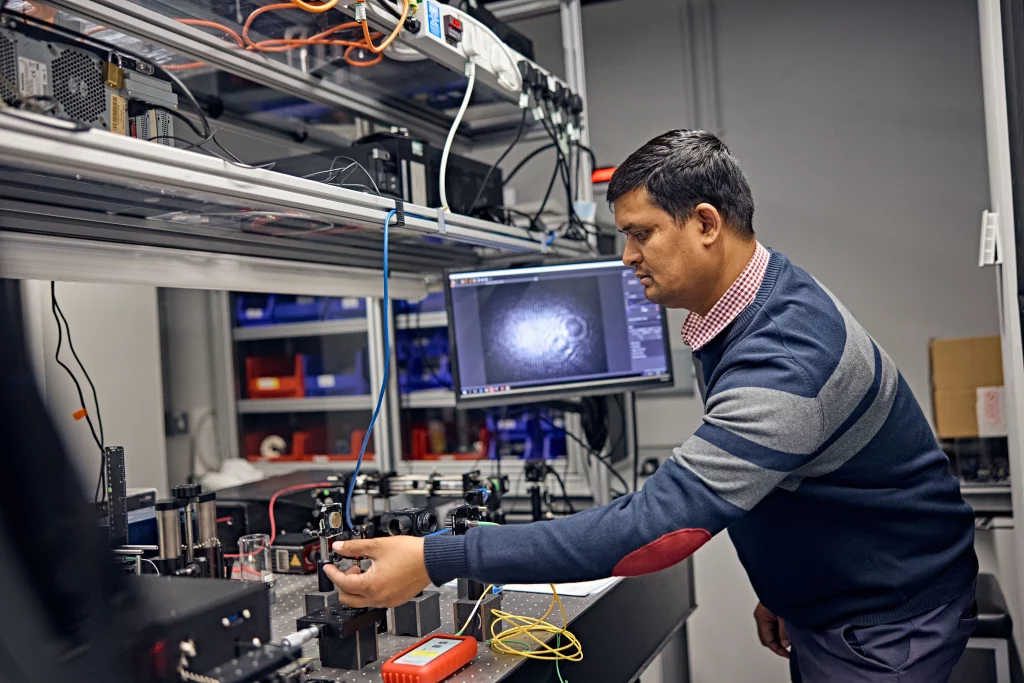
Professor Goswami believes the University offers manufacturers opportunities to develop, grow and disrupt successfully. He also emphasises the considerable potential to connect capabilities across institutions and organisations. “Manufacturers do not always need another building or initiative. They often need a more effective route through the expertise and infrastructure that already exist. The aim is to create a connected innovation environment in which a business can enter with a problem, find the right technical and commercial support, test a solution and progress towards industrial adoption.”
Manufacturing & Engineering Magazine | The Home of Manufacturing Industry News