

Government Thanks MEM for ‘Invaluable Support and Enthusiasm’

The Government would like to thank MEM for ‘all the invaluable support and enthusiasm’ that we offered in order to make the Year of Engineering campaign a success. Thanks to our efforts and support, together with those of the other partners, the campaign delivered more than five million direct experiences of engineering to 7-16 year olds across the UK, well exceeding the initial one million target. “It is vital we create a lasting and meaningful legacy for the Year of Engineering by continuing to show young people from different backgrounds what they can achieve in engineering. It is testament to the success of the campaign that the Department for Transport is going to be joined by partners across Government. We will work together across the Department for Business, Energy and Industrial Strategy, the Department for Education and the Department for Transport to build on the success of the campaign through a long-term engineering legacy campaign and through continued collaboration across industry.” Although the 2018 report by EngineeringUK estimated an annual shortfall of at least 22,000 engineering graduates to fill core engineering roles, the Year of Engineering gave government, partners and engineering institutions a unique opportunity to work together towards a shared goal – to create awareness of the industry and to attract more young people into it. Manufacturing & Engineering Magazine | The Home of Manufacturing Industry News Manufacturing & Engineering Magazine (MEM), is a the leading UK based monthly print & digital publication focused on promoting innovation in manufacturing and engineering available here in the UK. We cover : SUSTAINABILITY (Waste & Water Management, Recycling, Energy); INMOTION (Rail, Marine, Aerospace, Automotive, Defence); INFRASTRUCTURE (Oil & Gas, Nuclear, Construction); Healthcare (Medical), TECHNOLOGY(Printed, Connected, Software, Composite); MANUFACTURING (Chemical, Metals, Plastics, Electronics, Electrical); CONSUMER GOODS(Furniture, Electrical, Electronics, Food) to name but a few. We have over 50,000 views of each issue of MEM on average in 2022 and go to print monthly and also publish in our newsletter, (each issue is available free for 12 months digitally). Our focus is aligned across the next 12 months with our global media partnerships around Trade Events and also contains original content.
Plans for the UK Space Sector Announced

UK priorities for Space 19+ It takes place as the UK government prepares for Space19+, the European Space Agency’s (ESA) Ministerial level Council meeting, which will set out the ESA’s priorities and funding for its future work. The conference will be an opportunity to discuss the sector’s priorities, particularly in the area of how the ESA’s funding should be set to best support the UK sector. Included in the agenda are keynote addresses from: Chris Skidmore MP, Minister of State for Universities, Science, Research and Innovation, and Magali Vaissiere, Director, Telecommunications and Integrated Applications and Head, ECSAT, Harwell UK, European Space Agency. The National Space Programme and a Sector Deal for space The seminar also comes as industry and Government work towards a National Space Programme, with ambitions for launch in April 2020, as part of a Sector Deal. It also follows the Prosperity from Space strategy which sets out the sector and government priorities for earth observation, global connectivity, in-space robotics and access to space. Sessions will consider how best the Programme and a Sector Deal can support the continued growth of the sector and what more needs to be done to reduce the skills gap, support access to finance and utilise the regulatory framework to enable the sector to grow. Sector developments and the future of international collaboration The discussion takes place as work continues on the development of spaceports within the UK and the Government announces new funding to support the development of horizontal spaceflight in the UK and delegates will discuss what more the Government should do to support the funding, customer base and the delivery of infrastructure needed to enable the UK’s own launch capabilities. The agenda also discusses the UK’s future relationship with Europe and other key international clusters and options for both ensuring UK companies can expand into other markets and are able to attract international investment and talent post-Brexit – and with the development of the UK’s own Global Satellite System following its withdrawal from Galileo still on the table. The Defence Space Strategy We also expect discussion on the Defence Space Strategy which is expected before the seminar, and is due to set out the Government plans to tackle emerging space-based threats to commercial and military satellites. Delegates will discuss the feasibility of the plans set out in the strategy and the role that the MoD and other government and public bodies can play as an anchor customer to the industry to utilise government procurement as a leaver to support industry growth. Manufacturing & Engineering Magazine | The Home of Manufacturing Industry News
Green Light to New Automotive Initiative
The selection of the National Manufacturing Competitiveness Levels (NMCL) programme, which will deliver the government’s national supplier competitiveness and productivity improvement initiative, has been announced by the Department for Business, Energy and Industrial Strategy (BEIS). Designed to improve competitiveness, raise workforce capacity and increase productivity of UK manufacturers, NMCL will be boosting the nation’s exports and economic growth. Led and match-funded by industry, and with the backing of 25 of the UK’s largest manufacturers, NMCL has been jointly developed by the automotive and aerospace sectors for application across all areas of manufacturing. Delivered by SMMT, NMCL Automotive is designed for the automotive sector and will make use of the £16 million of government funding to develop sustainable and internationally competitive UK supply chains. The new NMCL approach has already been successfully piloted by companies in the North West of England. NMCL is designed to help manufacturers of all sizes and stages of development understand how competitive they currently are and develop the specific business capabilities they need to boost their performance. The programme includes an in-depth competitiveness assessment based on company capabilities and the views of key customers. This data is then applied to investment decisions across six areas of competitiveness; quality, cost, delivery, flexibility, products/technology and customer experience. Projects are tailor-made for each manufacturer and focus on boosting competitiveness, increasing ‘value-add’ and winning more orders. “This announcement is a shot in the arm for the UK’s automotive industry in general and the supply chain in particular. NMCL is a central part of the Government’s Industrial Strategy and the sector deal for the industry, offering a proven way for business to achieve competitiveness. Coming at a time of considerable upheaval, it is important that all manufacturers are alert to the technological, market and trading changes that are occurring and take the right steps to ensure they are not just viable but globally successful in the future,” said Mike Hawes, SMMT Chief Executive. NMCL projects will typically last from six months for smaller initiatives to up to three years for entire business transformations. NMCL’s approach is also ideally suited to other manufacturing sectors such as rail and defence. Companies are invited to declare an initial expression of interest in participating in NMCL by completing a short form on the NMCL website.
Data Protection and Brexit – Is your organisation prepared?
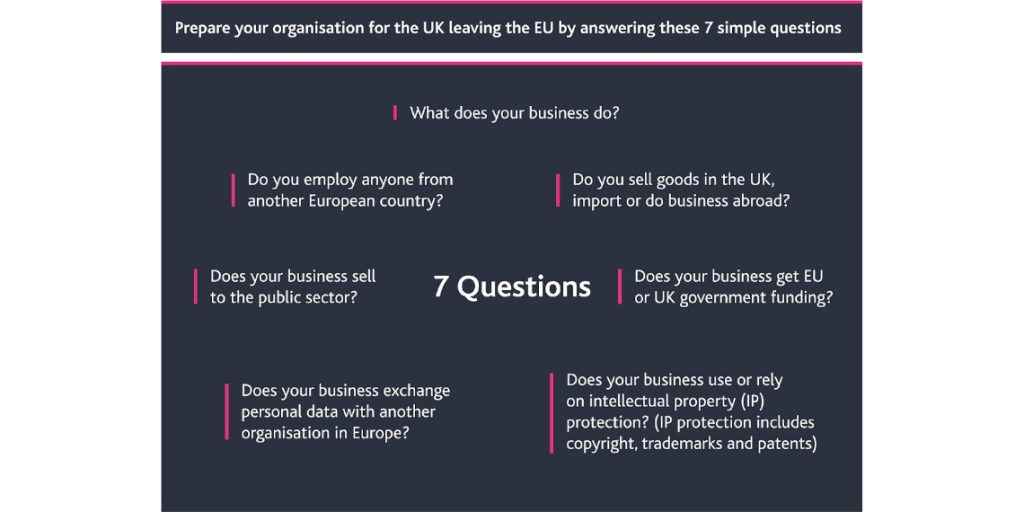
If your organisation shares personal data with businesses or organisations in the European Economic Area (EEA), you will need to take steps to ensure you continue to comply with data protection laws if the UK leaves the EU without a deal. Personal data refers to any information that can be used to identify a living individual, including a customer’s name, their physical or IP address, or HR functions such as staff working hours and payroll details. Although the UK’s own data protection standards would remain the same, there would be changes to how personal data transfers from the EU/EEA to the UK. This could affect your organisation. Therefore, if your organisation receives personal data from organisations in the EU you should consider, with your EEA partners, what changes you may need to make to ensure that data can continue to flow after the exit date. These changes will affect organisations both large and small. It is important for organisations, as a priority, to review whether they would be affected. Practical advice and support is available at ico.org.uk, including ‘Six Steps to Take’ to help you understand the implications and prepare. Minister calls on SMEs to prepare data ahead of EU exit Digital Minister Margot James has issued a reminder to SMEs to ensure that they’ve got plans in place so that they don’t lose access to vital data flows if the UK leaves the EU without a deal. Digital Minister Margot James said: “I know that personal data plays a hugely important role in day to day business. The current uncertainty around Brexit is of great concern and businesses need to take action to limit the risk of potential disruption if a no deal were to happen. I would urge all companies to check the Information Commissioner’s Office guidance on their website, and make sure that they are as prepared as possible.” The Government has already introduced robust new data laws through the 2018 Data Protection Act. This included giving people more power and control over their data and strengthening the powers of the ICO. In the event of a deal, through the Withdrawal Agreement, the government has made plans to secure ‘data adequacy decisions’ from the EU. This will ensure UK and EU firms can carry on exchanging personal data like they do now. For more information you can call the ICO helpline on 0303 123 1113. Prepare your organisation for the UK leaving the EU by answering these 7 simple questions. What does your business do? Do you sell goods in the UK, import or do business abroad? Do you employ anyone from another European country? Does your business exchange personal data with another organisation in Europe? Does your business use or rely on intellectual property (IP) protection? (IP protection includes copyright, trademarks and patents) Does your business get EU or UK government funding? Does your business sell to the public sector? Find out more here: https://www.gov.uk/guidance/using-personal-data-after-brexit
New Government Strategy to Tackle Air Pollution

An ambitious new strategy to clean up the air has been launched by the government. This includes a commitment to support farmers’ efforts to tackle air pollution, as agriculture is responsible for 88% of UK emissions of ammonia gas. The ammonia gas travels long distances and can be damaging to the environment and combine with other pollutants to form fine Particulate Matter pollution, which are harmful to human health. “Ammonia emissions can have a significant impact on the environment and on our health, and as custodians of the land, farmers have an important role to play in reducing them. Our future agriculture policy will involve financial rewards and incentives to help farmers reduce their ammonia emissions,” said George Eustice, Farming Minister. By 2020, the measures set out in the Clean Air Strategy will help cut the costs of air pollution to society by £1.7 billion every year and rising to £5.3 billion every year from 2030. Farmers will benefit from support to invest in infrastructure and equipment to reduce emissions, as well as work with the industry to encourage low emission and holistic farming techniques. Through the Countryside Productivity Scheme, funding has been available so that farmers could purchase manure management equipment, including low-emission spreaders. Funding is also available through the Countryside Stewardship Scheme for slurry tank and lagoon covers for farmers in priority water catchments.
Government Invests in Aerospace Sector

A multi-million-pound Aerospace Sector Deal has been announced by t he government, building on the UK’s excellence and heritage in aerospace. The Deal aims to transform the future of flight through electrification and autonomy, and commits to increasing gender equality in the sector. The defence and aerospace industry recorded a £10 billion increase in deals over the last 12 months, with the total deals valued at £31 billion. The industry has achieved annual revenue growth of 7% over the last five years, account for 7% of UK exports and employ 338,000 people, according to trade organisation, the ADS Group. The announcement comes as the Business Secretary Greg Clark makes a speech in Bristol today outlining a new Aerospace Sector Deal between the industry and the government. Among the proposals mentioned in the deal, which is part of the government’s Industrial Strategy, are the £250 million Future Flight Challenge. This will go towards developing new ground infrastructure and aircraft technology that will hopefully make the industry more environmentally-friendly. It will also be spent on developing autonomous air vehicles and better airspace management. The programme will receive £125 million funding from the Industrial Strategy Challenge Fund with the other half being match-funding by the aerospace industry. Aerospace giant GKN will also receive £15 million in government funding for a new Global Technology Centre. The centre will be dedicated to a variety of processes, including additive manufacturing (AM), advanced composites, assembly and industry 4.0 processes. Other proposals outlined in the Deal include an expansion of the National Aerospace Technology Exploitation Programme. Like the Future Flight Challenge, it will be joint-funded by government and industry and centre around R&D projects. Supporting SMEs in the UK aerospace supply chain to boost their competitiveness through a new productivity improvement programme. ` Finally, the Deal commits the industry to increase diversity and inclusion by embedding the Women in Aviation and Aerospace Charter. Earlier in the year, 50 companies in the aerospace and aviation sector signed up to the Charter to work towards gender equality in the industry. Virgin Atlantic, BAE Systems, and Bombardier were just some of the signatories. Manufacturing & Engineering Magazine | The Home of Manufacturing Industry News
£1M Government Grant to Revolutionise Digital Medicines

A £1 million government grant has been awarded to Arcinova, a multi-service CRDO, for its £2 million Fill-Inova project. The grant will be used to develop a digital manufacturing platform to accelerate the production time of patient-specific medicines. The Fill-Inova Project aims to create a more responsive and economical method for producing complex formulations in smaller volumes. By employing digital technologies with automation and machine learning, Arcinova will be able to produce on-demand, specific therapies for small patient populations. UK Research and Innovation (UKRI) will provide £1 million as part of the Industrial Strategy Challenge Fund, a government initiative to raise productivity and earning power in the UK. The Fill-Inova Project will increase the UK’s capacity to manufacture small-molecule and high potency medicines, with patients set to benefit from accelerated access to targeted drug therapies. “It is fantastic news that our innovative platform for digital medicines manufacturing has been awarded funding by UKRI. The grant will accelerate our Fill-Inova Project by 18 months, allowing us to quickly address a pressing patient need,” commented Gareth Jenkins, CSO at Arcinova. The current manufacturing method for patient specific drug products involves a non-automated procedure with a production rate limited to 200 units per hour. The Fill-Inova project will utilise state-of-the-art robotics to increase production to 1000 units per hour, while maintaining the same level of operator labour. This novel robotic capsule handling system has been designed to provide Arcinova with an agile manufacturing procedure with traceable weight recordings for each individual capsule. “We are delighted to receive this substantial award. Adding digital manufacturing to our capabilities will help us further realise our vision of improving patient care through transformative technology and integrated solutions,” said Ian Shott, CEO and Chairman at Arcinova. The creation of this new manufacturing methodology will involve a partnership with 3P Innovation Limited and its patented, fully automated system for the precise dosing and filling of powders.
What Does A ‘Hard’ Brexit Mean for UK Manufacturing?

Brexit means Brexit and, following the Prime Ministerâs speech in late January where she set out what this will entail, Brexit means a âhardâ Brexit. While the Supreme Court has now ruled that Westminster will need to approve the Governmentâs Brexit plans, the intention of leaving the Single Market could have direct implications for the UK Manufacturing sector, especially those companies which currently export to other EU markets. UK manufacturing is currently robust, with the sector ranked 11th in the world, responsible for 54 per cent of Britainâs exports and 2.6 million jobs. Following the referendum weâve seen a significant fall in the Pound against key currencies like the Euro and US Dollar which has played havoc with the markets. The British manufacturing sector has, however, dealt with this fallout amid waves of growth speculation and revised forecasts, not to mention this new found weakness in the currency. The sector performed well in the second half of 2016, with a number of indicators showing growth across many aspects of UK manufacturing. While this has been positive news, UK economic growth in 2017 is expected to slow. The manufacturersâ organisation EEF has stated that only 23 per cent suggesting that opportunities will outstrip risks. The Poundâs exchange rate has been deemed largely responsible for the upswing in manufacturing as overseas buyers take advantage of the weaker currency, but itâs brought with it another problem â cost. Manufacturers have voiced concerns about Brexit talks dragging the pound down further and prolonging a period of profit pressure as import prices increase. Following the Brexit vote, the Confederation of British Industry (CBI) noted that although the weaker exchange rate may have boosted overseas purchases, domestic orders had been dented. Likewise, as Sterling begins to eventually ramp up import costs and businesses have their profit margins squeezed, consumers are likely to witness price increases which could potentially cause a decline in domestic spend. Looking forward, the prospect of a âhardâ Brexit creates some exciting opportunities as well as real threats for UK manufacturing. In the longer term, if the UK Government is successful in securing structured trade deals with key countries outside the EU, British manufacturing businesses could thrive in a new and favourable global trading landscape. This optimistic view is supported by some positive developments with plans to launch some high-end designed products including specialty bicycles in the UK and the commitment from companies such as Rolls-Royce to continue their manufacturing in the UK. Indeed, While the potential of securing positive trade deals outside the EU could provide some great opportunities for the sector, the concern is that if this process is dragged out it could affect confidence and lead to UK manufacturers moving operations overseas. These global trade negotiations will be especially critical for the automotive manufacturing industry as the UK exports over 1.2 million cars every year and half of those make their way to the EU. Although the weak Pound may be contributing towards an upswing in UK-based car manufacturing now, some industry experts are concerned that investments in the latest technical advances such as autonomous and electric vehicles may be impacted post Brexit. As we enter 2017, thereâs likely to be a lot of currency fluctuations as markets adjust to new developments. It is therefore vital that exporting manufacturing businesses in Britain put in place a strategy to mitigate this uncertainty and the possible impact on revenues. The trade deals with the EU are likely to cause an elevated level of volatility with the Pound as it will determine the price of manufactured products for British people, and also impact on the profit margins of businesses. Manufacturing has stood strong in the face of Brexit but the negotiations which will follow the triggering of Article 50 could very likely bring more uncertainty. While the sector could see some short term benefit, especially through further fluctuations in the Pound, its longer term prospects will be determined by the success of Government negotiations with both the EU and other potential global trading partners. Greg Smith, Head of Trading at foreign exchange specialists Global Reach Partners Manufacturing & Engineering Magazine | The Home of Manufacturing Industry News
Challenge to Government to Strengthen Industrial Strategy

Challenge to Government to Strengthen Industrial Strategy : A report published by manufacturersâ organisation EEF and banking group NatWest calls on government to set out its long-term industrial strategy to ensure business growth ambitions are supported across the pre- and post-Brexit divide. The report, which surveyed 2,000 adults during August, reveals 90% agree that the UK needs a comprehensive, long-term industrial strategy, while 86% want government to promote a stronger manufacturing base in the UK. In terms of manufacturers, the report found 76% were aiming for growth, while 71% have a three to five-year business plan in place to back up their ambitions. Meanwhile, almost two thirds of firms (63%) are focused on driving up productivity, while margins (71%) and sales (64%) are also key targets in manufacturersâ growth plans, the report shows. Supply chain collaboration is seen as crucial to growth, with over half of manufacturers (52%) already enhancing cooperation in areas such as production, design and development, and a further quarter (26%) planning to do so, the report adds. Despite the optimistic outlook, however, the report also points out that the current trajectory of manufacturersâ business plans falls short of where the sector needs to be by 2026. Terry Scuoler, chief executive officer of EEF, said: We need to get this right and we need to get this in place now so that manufacturersâ growth ambitions are supported across the pre- and post-Brexit divide. It is not enough to talk about an industrial strategy â it is time for the government to draw a line under the stop-go efforts of the past and to demonstrate its commitment to industry by putting some much-needed flesh on the bones. Manufacturers are not just talking about future growth â they have firm plans in place to make it happen. Their ambition and drive will help get the sector and our economy on the road to stronger, better-balanced growth, but this must be matched by government. If we are to stay the distance and realise the full benefits for the UK then complacency is not an option. Manufacturing & Engineering Magazine | The Home of Manufacturing Industry News
Government to Pull Plug on Help to Buy Scheme

As previously advertised, the Government has confirmed that the Help to Buy mortgage guarantee scheme will close to new loans on December 31, 2016. The programme was introduced three years ago to raise the availability of high loan to value mortgages. According to the Government, confidence has now come back to the market with a rising number of lenders offering 90-95% loans away from the scheme. The government will continue to offer the very popular Help to Buy equity loan and ISA schemes. In a letter to the Bank of England on September 29, the Chancellor Philip Hammond confirmed that the scheme would not be extended. Paul Smee, Council of Mortgage Lenders Director General, commented: “Help to Buy continues to give a welcome leg-up to many creditworthy buyers who may not otherwise have been able to get a foothold on the property ladder. The scheme has helped buyers right across the country, including a high proportion of younger borrowers and first-time buyers. Stewart Baseley, executive chairman of the Home Builders Federation, added: “Help to Buy continues to drive demand for new build homes by making home ownership more affordable and realistic. Its success is directly leading to more homes being built as it provides the confidence developers need to invest in the land and people required to increase their output.” Meanwhile, Richard Sexton, Director at e.surv, said that to date, the government has shown enthusiasm supporting the housing market, however this U-turn by the Chancellor begs the question of whether a change of emphasis is in the offing. The schemeâs early success resulted in a number of high street lenders including higher LTV products in their offerings. With this in mind, the withdrawal of Help to Buy may not have a dramatic an impact on the market. However, lenders who made plans to include the scheme as part of their product range may now have to revise their strategies. Manufacturing & Engineering Magazine | The Home of Manufacturing Industry News