


3D Printing Helps Build Wind Tunnel
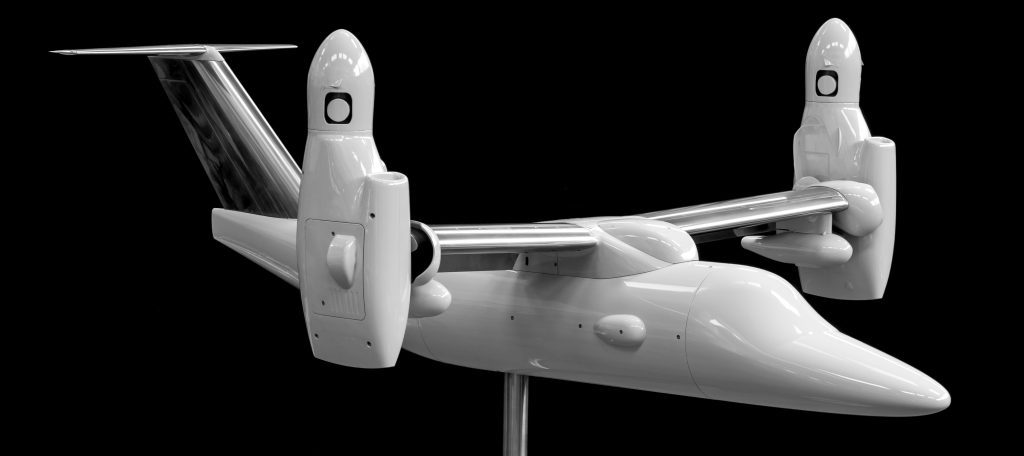
The new wind tunnel model of the LEONARDO tiltrotor AW609 manufactures developed by CRP Technology for Leonardo Helicopter Division (Leonardo HD, formerly known as Agusta Westland) is among the most interesting and significant applications in the aerospace sector. This project allowed CRP Technology, once again, to highlight the perfect union between advanced 3D printing technology (Selective Laser Sintering) and Windform® high-performance composite materials. Thanks to the Windform® materials, it was possible to complete and test the model in the wind tunnel within a very short time, with excellent results and with high-performing mechanical and aerodynamic properties. The project related to the manufacturing of some external parts (nose and cockpit, rear fuselage, nacelles, external fuel tanks, fairings) of the wind tunnel model (1:8.5 scale) for the prototype of the new LEONARDO HD tiltrotor AW609, made by Selective Laser Sintering technology and Windform® XT 2.0 Carbon-composite material, both supplied by CRP Technology. This model was designed, manufactured and assembled under the supervision of Leonardo Helicopter Division by Metaltech S.r.l. for a series of dedicated low speed wind tunnel tests. The tests were intended to cover a standard range of flight attitudes to be performed at Leonardo HD wind tunnel facility and at Politecnico of Milan for the high angles of flight envelope. During the different test sessions various external geometries have been changed and checked in order to understand all the aerodynamic phenomena. The external main components redesigned and manufactured include: fuselage and nose components, fairings, nacelles and spinner shapes, empennage, wings and flaperons. As part of a thorough review of the aircraft behavior, Leonardo Helicopter Division has performed a high speed test campaign at NASA Ames Unitary Plan 11 by 11 foot transonic wind tunnel.
Ego Corsa’s Updated 3D Printed Fairing

At the last series of tests carried on at the road to the first edition of the FIM Enel MotoE World Cup, the 2019 Ego Corsa prototype was on track with a new 3D printed fairing with improved aerodynamics. The 3D printed fairing was manufactured by CRP Technology via Laser Sintering using Windform XT 2.0 Carbon-fiber reinforced composite material. “We have had the fairing available in short time,” said the Energica technical staff. “Thanks to the professional 3D printing and CRP Technology’s Windform composite materials, it is possible to modify motorcycle components – even large ones – from one race to the next ones, in order to test different solutions directly on the track.” “This fairing”, the Energica technical staff added, “is not only more aerodynamic, but it also has a smaller frontal and lateral section. These improvements led to achieve increase in terms of performance and they led to achieve greater manageability in fast corners. The Windform XT 2.0 has once again proved to be a high performance composite material. We are very happy how the 3D printed new fairing behaved during the tests.” The road to the 2019 FIM Enel MotoETM World Cup has been busy this summer, with the Energica Ego Corsa undergoing an intense schedule of testing at the MotoGP venues, but also away from prying eyes. Earlier this year, the 2019 version of the all-electric Superbike machine by Energica began an extensive developmental programme. Since the end of March 2018 the Energica Ego Corsa has completed an average of 60 laps per day, covering a total distance of 4000km. These impressive numbers show the ultimate commitment of Energica to this new, exciting chapter of two-wheeled motorsport.