

“Installing automation is all about fixing bottlenecks. There’s no point having automation if there isn’t a problem.” That is the starting point for Phil Cattaneo, NCMT’s Business Development Manager – Automation, when he talks to manufacturers considering their next investment.
It is a refreshingly pragmatic stance in a market often dominated by headline technology. For NCMT, automation is not about robots for robots’ sake, nor about chasing the latest trend. It is about understanding where productivity is being lost and then designing a solution that delivers real, measurable improvement.
There is no one-size-fits-all approach. In fact, one of the most uncomfortable truths in manufacturing is that many machines are productive for far less time than businesses believe. Unautomated machines typically achieve just 25–30 per cent spindle uptime, with lost capacity absorbed by non-value-adding activities such as waiting time, part setting, tool changes, human error and simply being out of shift.
Identifying the real issue
This is often where NCMT automation projects begin with a walk around the shopfloor rather than a discussion about equipment.
“One of my favourite things to do when I visit a new customer is just to let them take me around the shopfloor,” Phil explains. “The light towers on top of the machines tell you everything you need to know about how productive the factory really is.”
He continues: “Typically customer will tell you they’re running at about 60 per cent capacity. But when you actually look, one or two machines are running out of ten. That’s when the conversation really starts.”
This practical, evidence-led approach helps manufacturers see the gap between perceived and actual utilisation. From there, NCMT works backwards to identify what is really constraining output whether that is manual machine tending, long set-ups, inconsistent processes, material flow issues or the inability to run unattended.
“It can be daunting knowing where to start with automation,” Phil explains. “There are so many solutions available. Our role is to strip it back and focus on what will make the biggest difference for that business.”
Three ways to start your automation journey
Drawing on decades of hands-on experience delivering everything from single-machine robot cells to complex, multi-million-pound flexible manufacturing systems, NCMT has developed a clear set of guiding principles for manufacturers beginning an automation project in 2026. These principles are shaped by real-world implementation, not theory, and are designed to help businesses invest with confidence, avoid common pitfalls and unlock sustainable productivity gains.
1. Start with problems, not technology
The temptation to begin an automation journey by specifying a robot, pallet pool or transfer system is understandable, but it is often the wrong place to start. At NCMT, automation is viewed first and foremost as a way to resolve specific production constraints, not as a technology exercise.
The most effective projects begin by identifying where time, capacity or consistency is being lost. That may be excessive waiting time between cycles, lengthy set-ups, inconsistent quality, or the inability to run unattended outside normal shifts. Once those issues are clearly understood, the appropriate automation solution naturally follows.
This problem-led approach often requires challenging assumptions. In one project, a manufacturer was intent on fully automating every step of a process, including the installation of a very small, intricate pin. Automating that single operation would have added around £1 million to the system cost. By stepping back and reassessing the true value, it became clear that a simple manual operation at the end of the line achieved the same output without affecting throughput or return on investment.
The lesson is simple: almost anything can be automated, but not everything should be. The focus must remain on whether automation genuinely adds value to the overall process.
2. Think modular and build confidence
Another common pitfall is trying to automate too much, too quickly. NCMT advocates a modular approach, targeting low-risk, high-return opportunities first and building capability over time.
Rather than attempting a fully automated factory from day one, manufacturers can start by addressing a single bottleneck. For example, automating machine tending on a constrained asset or introducing a pallet system to eliminate waiting time. Once that initial step is proven, the solution can be expanded incrementally.
This staged strategy improves return on investment while also building internal confidence and skills. NCMT has supported customers who began with a single automated cell and later expanded into multi-machine lines supported by advanced production management software, all without disrupting existing operations.
One recent project involved a transport-sector manufacturer that invested in an automated line with two machines, designed from the outset to accommodate a third machine as demand grows. NCMT decommissioned the existing layout, reconfigured the shopfloor and installed a flexible automation system that can scale over time. It is a clear demonstration of automation as a long-term investment, not a one-off cost.
3. Design for stability, not headline speed
In lights-out production, reliability consistently outperforms raw cycle time. A common misconception in manufacturing is that faster is always better. In reality, an aggressive process that stops overnight can wipe out hours of potential output.
Automation fundamentally shifts priorities. A slightly slower but highly stable process, capable of running unattended for long periods, will always deliver more value than an unstable high-speed process. This is particularly important in transfer lines and multi-machine systems, where each station is designed for repeatability and consistency rather than maximum flexibility.
Consistency underpins everything: predictable quality, controlled tool wear and reliable output. Automated systems excel at performing the same task, in the same way, every time. That repeatability is what enables manufacturers to achieve dependable lights-out production and maximise the return from their automation investment.
A solutions-led approach
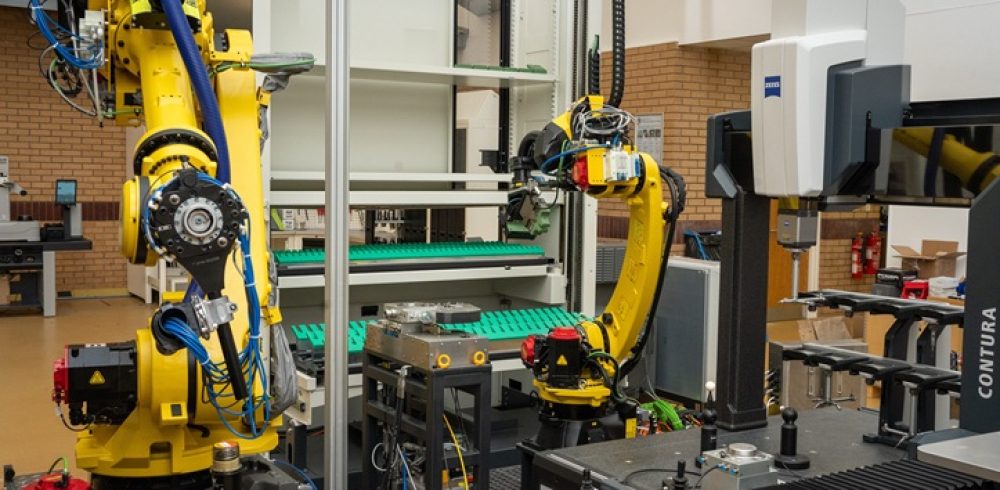
A defining feature of NCMT’s automation offering is its neutral approach to equipment. As a solutions provider, NCMT is not tied to a single robot brand, pallet system or software platform. Instead, it focuses on what will deliver the best outcome for the customer.
“We can provide anything from an off-the-shelf robot cell to a fully bespoke, multi-robot flexible manufacturing system,” Phil Explains. “The key is matching the solution to the application, the budget and the long-term strategy.”
Crucially, NCMT does all the groundwork. From sourcing third-party equipment and managing suppliers, to installation, commissioning and training, customers work with one specialist team. Dedicated project management ensures systems are delivered on time, integrated properly and ready to perform from day one.
“Automation projects are complex,” He notes. “Someone has to put the pieces together. That’s what NCMT prides itself on and the customer benefits from this approach.”
Through-life support that protects the investment
Automation does not end at handover. Running machines harder and longer places greater demands on both equipment and support. NCMT’s through-life service model is therefore a cornerstone of its automation offering.
“Automated machines are working 24/7,” Phil says. “That changes everything from maintenance strategies to machine selection.”
By pairing automation with high-quality machine tools and ongoing service support, NCMT helps manufacturers protect uptime, quality and return on investment. Predictive maintenance, condition monitoring and data-led decision-making all play a role in ensuring systems continue to deliver year after year.
Automation as an investment, not a cost
Ultimately, NCMT’s message to manufacturers is clear: automation is not an expense to be justified in isolation, but a strategic investment in productivity, capacity and resilience.
“When you move from 25 per cent spindle utilisation to 85 or 95 per cent, the numbers speak for themselves,” Phil concludes. “You’re making money while you sleep. That’s the real power of automation.”
By providing individualised plans, remaining technology neutral and supporting customers through the entire lifecycle of a project, NCMT is helping manufacturers move from bottlenecks to lights-out production with confidence that their automation investment is built to last.