


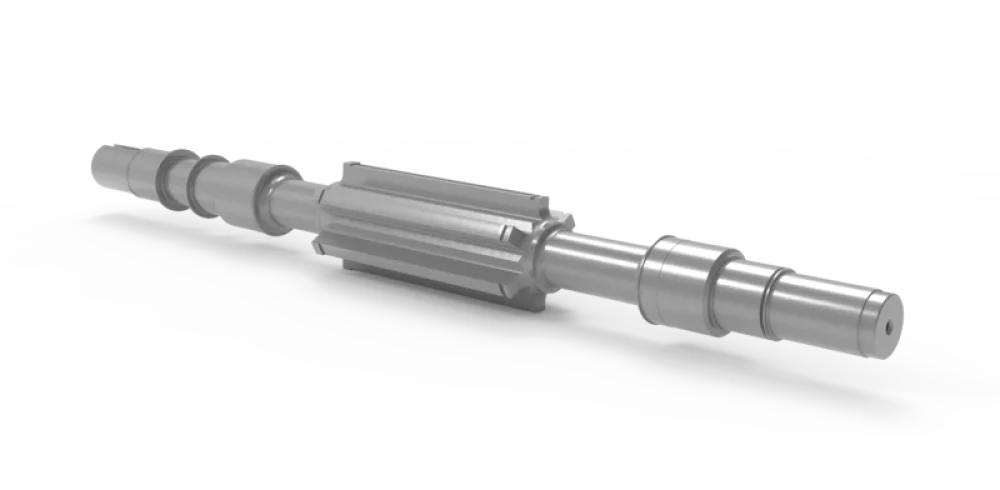
Nothing works without them: generator shafts are key components in modern energy and drive systems. Whether in wind turbines, power stations or sophisticated machines – they are subjected to immense stress, must demonstrate the highest precision and function reliably under extreme conditions. But how are these complex shafts produced, what demands do industry and technology place on their manufacture, and what role does complete machining play in modern production technology? In this article, we take you on a journey from material selection through high-precision manufacturing processes to the finished product, which delivers top performance day in, day out.
Complete machining of generator shafts is used wherever there are high demands on dimensional accuracy, concentric running, operational reliability and cost-effectiveness. Typical applications are found primarily in power generation, such as generator shafts for wind turbines, hydroelectric power stations, and steam, gas and diesel power stations. Here, the shafts must transmit high torques and operate reliably under constantly changing loads.
Furthermore, complete machining is used in mechanical and plant engineering, particularly for industrial and emergency power generators, test bench applications and special-purpose generators. This manufacturing method is also widespread in marine and offshore technology, for example in ship generators or offshore wind turbines, as it ensures high process reliability and reproducible quality in addition to cost-effectiveness.
How does the application work?
The stress-relieved blank for generator shafts is often delivered to the MILLTURN pre-turned and with welded-on webs. It is particularly important during the application of the welded-on webs that the blank is aligned circumferentially so that the allowance for the welded-on webs is centred as effectively as possible. Using the WFL measuring cycles, this blank measurement is carried out fully automatically, whereby even welding defects can be corrected. In the shaft area, angled holes must be placed, which meet the deep-hole hole in the centre. All holes can be placed in the MILLTURN without a fixture, whilst the rounding of the hole edges is also carried out very quickly and with high repeatability. The outside diameter of the webs, which must be machined with precision, is finished to IT7 fit quality using turn-milling and milling. Bearing seats on the journals are turned to the finished dimensions with the highest precision, and the surface finish is then brought up to the required drawing specifications using finishing processes, e.g. roll finishing. WFL in-process measuring guarantees process reliability even with the tightest manufacturing tolerances.
However, it is not only welded generator shafts that can be produced economically on the MILLTURN; some customers prefer to apply a saw-cut section to solid stock for the application of the shafts. The heavy and torsionally rigid machine bed, the generously dimensioned guide systems and the powerful drives offer optimal conditions for efficiently handling this task as well.
Advantages of the MILLTURN
Production on the MILLTURN offers numerous advantages, as multiple machining steps can be carried out on a single machine. This significantly reduces machining operations, minimises set-up time and reduces space requirements. At the same time, labour costs are reduced, whilst shape and position tolerances can be maintained more accurately than with separate machining operations. The labour- and time-intensive re-clamping and aligning of the workpiece between the various machining steps is largely eliminated; furthermore, continuous process monitoring with WFL iControl, as well as in-process measurement and closed-loop corrections, ensure high process reliability, consistently high quality and prevent costly scrap.
Limitless possibilities
The blank is pre-turned and then, after welding, placed into the MILLTURN, where automatic circumferential orientation is carried out during the programme run using a probe via WFL measurement cycles. Alternatively, solid stock is used. The bearing seats in the shaft areas are rough- and finish-turned, or turn-milled. Where necessary, subsequent finishing processes are used to improve the surface finish. Similarly, the outside diameter at the welded ribs and the longitudinal grooves are rough- and finish-turned and milled in interrupted cuts, achieving the highest angular accuracy of the ribs relative to one another. The groove widths are machined to exact dimensions, supported by integrated workpiece measurement using the WFL measurement cycle package.
Manufacturing & Engineering Magazine | The Home of Manufacturing Industry News