

As automotive manufacturers respond to increasing volatility in demand, regulation and powertrain strategy, flexibility has moved from competitive advantage to operational requirement. Production systems are no longer being optimised solely for efficiency or volume stability, but for their ability to absorb uncertainty. Here, Josh Scanlon, Area Sales Manager at automotive assembly tools manufacturer Desoutter Tools, explains how connected fastening systems can help manufacturers maintain process control as production environments become increasingly complex.
Automotive manufacturing is undergoing its most significant change since the introduction of the original assembly line, as predictable multi-year cycles give way to shorter timelines and greater variation. This is most visible in the rise of mixed-model manufacturing: where ICE, hybrid and electric vehicles are built on shared or rapidly reconfigurable assembly lines.
A system of controlled variability
On today’s assembly lines, the process is no longer identical from one vehicle to the next. ICE, hybrid and electric models pass down the same line, with operators and tools adjusting to different parts, structures and electrical systems as each vehicle or component is built.
This reflects a market still in transition, where manufacturers must support multiple powertrain types in parallel because demand has not settled around a single technology. As of May 2026, the “battery electric car market share had crept up by just half a percentage point to 23.1 per cent”, still below the 33 per cent share required under the ZEV mandate, underlining the gap between regulatory targets and current demand.
This uncertainty extends beyond vehicle manufacturers. Tier suppliers must increasingly support multiple platforms, shorter programme cycles and changing specifications without compromising process control.
Where variability becomes risk
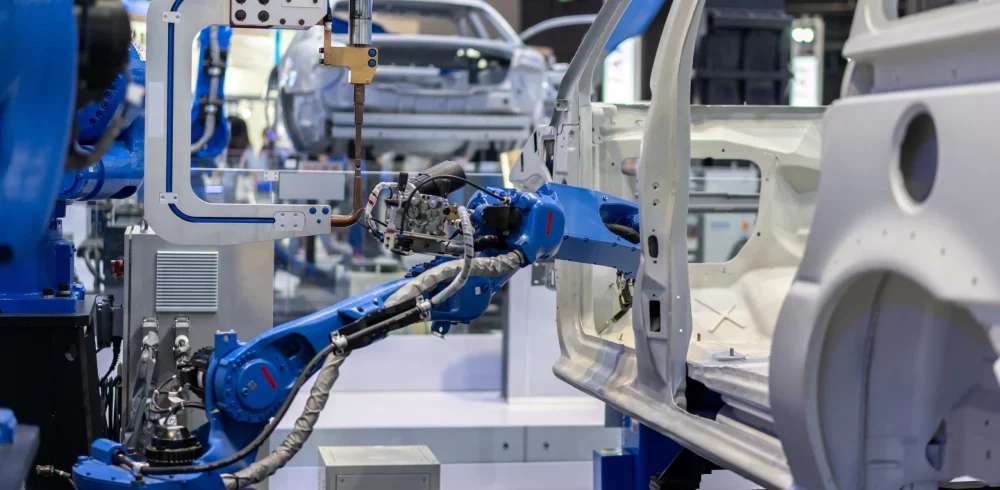
Nowhere is this shift more pronounced than in fastening operations. Fastening sits at the intersection of structural integrity, electrical safety and production execution. Its importance is heightened in electric and hybrid platforms, where it governs battery enclosures, high-voltage systems and lightweight structures. In mixed-model environments, fastening complexity increases significantly, since different vehicle variants require different torque specifications, tightening sequences and joint strategies.
Recent recalls have shown how even small deviations in fastening integrity can have significant consequences. In May 2026, Ford recalled almost 180,000 Ranger and Bronco vehicles after identifying that a front seat frame bolt could become loose or dislodged, reinforcing how critical accurate fastening and verification remain.
Fastening has become a point of process control where manufacturing variability is either contained or allowed to spread through the rest of the production system. For UK manufacturers operating in high-value, lower-volume environments, maintaining fastening quality while increasing production flexibility is therefore becoming a defining operational challenge.
Connected fastening as a process control layer
As production environments become more variable, fastening systems must do more than just deliver a specified torque. They must help ensure that the correct fastening process is applied to the correct vehicle, at the correct stage of assembly, every time.
This requires connected fastening systems that integrate tooling, process control and production data within a closed-loop manufacturing architecture. Desoutter’s connected assembly ecosystem brings together intelligent tools, controllers and software platforms to support tightening execution, process control and production traceability within a single mixed-model manufacturing environment.
Within this model, tightening parameters are defined at system level and assigned according to production inputs, including vehicle variant identification. Connected tools can automatically apply the correct fastening strategy for each application, enabling multiple vehicle configurations to be managed within the same production environment. This enables manufacturers to adapt to production variability while reducing reliance on manual process selection and ensuring the right settings and quality checks are applied.
Crucially, each fastening operation is validated at the point of execution through real-time feedback and process confirmation, ensuring deviations are identified immediately rather than retrospectively. This prevents non-conforming assemblies from progressing downstream and creates a traceable record of critical fastening operations.
Tightening data can be captured and analysed to support process verification, traceability and continuous improvement across production runs. Within this framework, fastening becomes a connected process control function embedded within the wider manufacturing system.
Flexibility has become a prerequisite as manufacturers continue to balance ICE, hybrid and electric vehicle production. The ability to control variability at the point of assembly will determine how effectively they can scale changing production strategies while maintaining quality.
Fastening sits at the centre of this challenge. By connecting execution, verification and production data, manufacturers can turn a traditionally fixed assembly operation into an adaptable process control point, enabling greater flexibility without compromising consistency.
For a live demonstration of how Desoutter’s connected assembly ecosystem supports mixed-model automotive manufacturing, schedule a visit to the Innovation Centre in Congleton, Cheshire.
Manufacturing & Engineering Magazine | The Home of Manufacturing Industry News