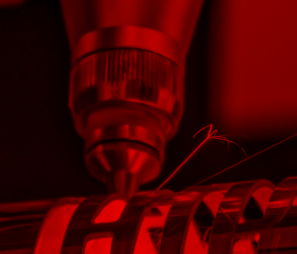


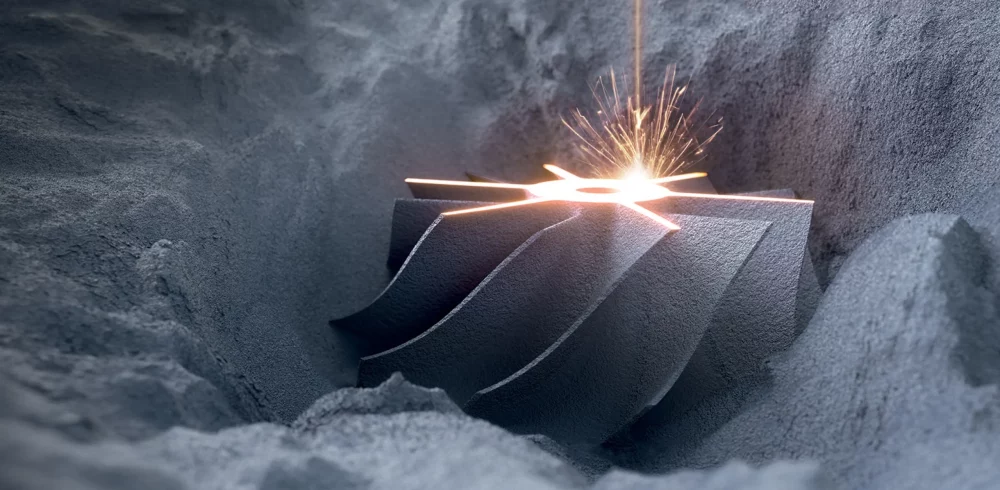
With selective laser melting (SLM) for high-precision manufacturing and laser deposition welding (DED) for the repair and coating of components, DMG MORI brings together two of the leading technologies in metal 3D printing under one roof. With this holistic approach, the machine tool manufacturer underscores its commitment to innovation and sustainability.
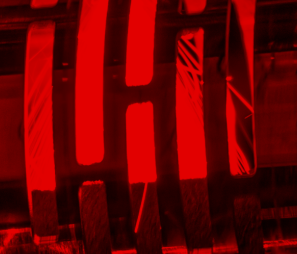
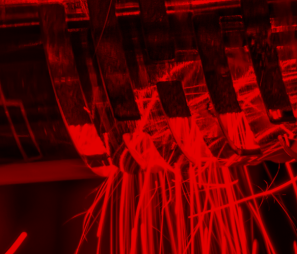
At this year’s Formnext in Frankfurt, from November 17th to 20th, DMG MORI will demonstrate how these additive processes and machining complement each other effectively in end-to-end manufacturing processes and advance the Machining Transformation (MX). In Hall 12 at Booth D139, DMG MORI will demonstrate to industry professionals laser metal deposition welding using a powder nozzle on the LASERTEC 65 DED hybrid 2. Generation and the powder bed process on the LASERTEC 30 SLM 3. Generation. Both solutions combine many years of experience in machine tool manufacturing with innovative features for future
oriented approaches to manufacturing. Through reproducibility, precision, and cost effectiveness, they actively contribute to industrialization. As a reliable partner throughout the entire lifecycle, DMG MORI supports the rapid adoption of these technologies and a smooth production ramp-up with comprehensive consulting through ADDITIVE INTELLIGENCE. Here, experienced experts pool their extensive know-how for the industrial application of additive manufacturing processes.
LASERTEC 65 DED hybrid 2. Generation: Six processes in a single workspace
Combining laser metal deposition and 5-axis simultaneous milling in a single setup, the 2. Generation LASERTEC 65 DED hybrid is a versatile machining solution that DMG MORI has consistently developed in line with the Machining Transformation (MX). The hybrid machine sets new standards in process integration and operates so productively that it elevates additive manufacturing to an industrial and series-production-ready level. This applies both to the production of highly complex geometries and to the of heavily stressed components and the coating of workpieces with hard or wear-resistant materials.
The LASERTEC 65 DED hybrid 2. Generation represents a comprehensive 6-in-1 process. In addition to subtractive processes such as milling, turning, and grinding, it also includes additive manufacturing using a powder nozzle. Laser-based preheating and the DMG MORI scan3D complement these technologies, creating a unique process that enables, for example, highly cost-effective repair of wear parts in a single setup. The point cloud generated by the scan3D is first compared with the target data set to identify damaged areas. The worn area is then precisely milled away, creating a clean base for the welding process. In the next step, the workpiece is preheated using the laser. Preheating minimizes the risk of stress cracks during material deposition. During laser metal deposition welding, the machine monitors key parameters using sensors and cameras to ensure a reliable process. The subsequent millingof the final contour on the built-up workpiece zone is also performed on the LASERTEC 65 DED hybrid 2. Generation without the need for reclamping. This allows for tight form and position tolerances to be maintained and reduces throughput time compared to a conventional manufacturing process. If particularly high requirements for geometry and tolerance ranges apply, the process can be supplemented with grinding. Finally, the DMG MORI scan3D scans the repaired component again and verifies its conformity with the specified target contour to ensure and document a perfect result.
The performance of the LASERTEC 65 DED hybrid 2. Generation sets new standards for industrial use. Its multi-jet nozzle enables 5-axis material deposition with uniform powder distribution at the working point. DMG MORI was able to increase the deposition rate by 35 percent compared to the first generation, which reduces workpiece costs by 47 percent. Compared to the previous model, the work area can now accommodate workpieces up to 170 percent larger. Dimensions of ø 840 x 350 mm or ø 680 x 400 mm are possible. Calculated based on build volume, this reduces costs by over 70 percent.
LASERTEC 30 SLM 3. Generation: Powder Bed Fusion for Series Production
The LASERTEC 30 SLM 3. Generation from DMG MORI was specifically designed to meet the demands of industrial series production. The focus is on the ability to produce components not only productively but, above all, with reproducible, consistently high quality. For industrial users, it is not the quality of a single reference component that is decisive, but the ability to achieve consistently identical results across numerous build jobs, machines, and production periods.
Extensive validation testing and feedback from industrial applications confirm that the LASERTEC 30 SLM 3. Generation delivers exceptionally high dimensional accuracy and repeatability for the manufactured components. The low variation in critical features reduces scrap and rework, increases process reliability, and lays the foundation for cost-effective additive series production.
This is based on a thermosymmetric machine concept that consistently builds on the proven design principles of DMG MORI’s milling and turning machines. The targeted control of thermal influences ensures reproducible component properties and exceptional process stability. Users benefit from reliable production processes, a high degree of planning certainty, and the ability to that they can manufacture quality-critical components with consistent quality at all times. This makes additive manufacturing a robust production solution for industries such as aerospace, medical, and semiconductor.
At the same time, the LASERTEC 30 SLM 3. Generation significantly boosts productivity. Up to four fully overlapping lasers enable highly productive manufacturing without compromising quality or repeatability. The interchangeable build container reduces downtime and setup times, as subsequent jobs can be prepared in parallel with ongoing production. The closed-loop handling concept also reduces inert gas consumption and increases system availability. Combined with the build volume, which has been expanded to 325 × 325 × 400 mm, this creates a manufacturing solution that combines productivity, cost-effectiveness, and reproducible part quality in a single machine.
ADDITIVE INTELLIGENCE: From Component Idea to Series Production
Through its ADDITIVE INTELLIGENCE consulting unit, DMG MORI brings together comprehensive expertise in the industrial application of additive manufacturing processes. This expertise is also grounded in the company’s own production. In fact, DMG MORI’s Additive Manufacturing Reference Factory already produces more than 3,000 machine components per year using additive manufacturing processes. Armed with this knowledge, experts guide companies through the entire process. They assist with evaluating an initial component concept and its design, as well as with selecting suitable technologies and implementing them in series production. This involves the integration of machine developments, hybrid process chains, and digital solutions. If needed, ADDITIVE INTELLIGENCE also handles the production ramp-up, ensuring that customers can operate at full productivity right from the start after the additive process chain is installed.
Manufacturing & Engineering Magazine | The Home of Manufacturing Industry News