


As environmental regulations tighten across the manufacturing sector, the old ways of tracking factory data are quickly becoming a massive compliance liability. We sit down with the experts behind the calQrisk and GreenFeet platform to discover how manufacturers can turn the overwhelming ‘data mountain’ into a streamlined, profitable engine for change.
Let’s go back to the beginning: the planet is warming, climate change is real, and every industry has a part to play in slowing it down. For the manufacturing sector, compliance requirements are society’s way of ensuring that organisations capable of contributing to climate action actually do so.
It is no secret that businesses can sometimes resent regulation, compliance carries a cost. However, society benefits from these rules, and crucially, business leaders need the reassurance of a level playing field. They need to know that no competitor is gaining an unfair commercial advantage simply by shirking their environmental responsibilities.
Today, frameworks like the Corporate Sustainability Reporting Directive (CSRD) and Voluntary SME (VSME) standards provide the yardsticks against which the industry can measure and compare itself. But navigating these standards requires moving away from chaotic, error-prone spreadsheets. This is where the combined power of calQrisk (managing risk and compliance) and GreenFeet (a sophisticated carbon calculating and reporting tool) steps in, simplifying the process and making your data genuinely useful.
Tackling the Data Mountain: A Lean Approach
For many operations directors, the sheer volume of emissions data that needs organising is the biggest hurdle. But veterans of Lean and Six Sigma will already be familiar with the solution: find the best source of truth. In manufacturing, that source isn’t always on the factory floor; it is usually in the accounts department.
Think about it: the invoices from your goods and service providers, along with your sales invoices, already contain highly accurate unit data and product descriptions. This information is already being manually entered into your business systems. By feeding this existing data into GreenFeet, where complex product emission factors are constantly updated and maintained, the system automatically calculates the associated emissions and generates compliant reports.
Instead of getting bogged down in administrative chaos, factory managers are presented with a clear, easy-to-read dashboard. This frees them up to do what they do best: actually, implementing the emissions reduction projects that drive down the numbers.
Minimal Disruption, Maximum Speed
The biggest fear most factory managers have when adopting new software is the dreaded implementation phase, months of downtime, complex training, and operational disruption.
Because the calQrisk and GreenFeet platform leverages the data already flowing through your accounts department, the onboarding process is remarkably swift. In fact, that financial data provides the baseline for roughly 90% of your emissions within a single week. The system is online, populated with data, and delivering useful insights from day one.
Solving the Scope 3 Supply Chain Challenge
Tracking Scope 3 (indirect supplier emissions) is widely considered the hardest part of a manufacturer’s ESG journey. However, emissions reduction is an industry-wide issue, and suppliers are increasingly on board. They have the data, and they are happy to share it.
For complex manufactured products, Life Cycle Assessments (LCAs) are utilised to look through all the emissions associated with every aspect of the process, from raw material extraction and factory manufacturing, to the product’s daily use and eventual end-of-life. The GreenFeet system simplifies this by automatically updating the carbon emission factors associated with each stage of the life cycle, correctly allocating the CO2 value to the entire chain, without ruining your supplier relationships with endless admin requests.
The Bottom Line: Commercial ROI
If you begin your sustainability journey purely to satisfy regulations, stakeholders, and customers, you are effectively practicing “loss avoidance” in the first instance, protecting your brand reputation and securing your place in major supply chain tenders.
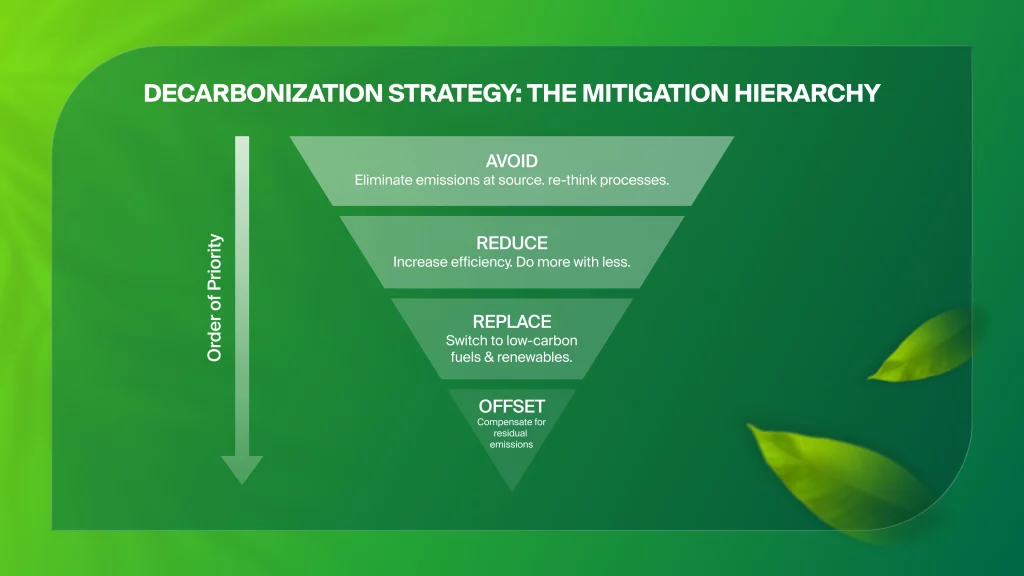
However, once you get into the granular detail provided by the platform, the commercial return on investment becomes glaringly obvious. You will quickly spot initiatives that save both emissions and money. Upgrading to LED lighting is the classic example, but once you start looking through the data, operational waste becomes highly visible.
The GreenFeet platform features a continuously growing library of reduction initiatives, crowdsourced and expanded through client input. While some require capital investment, like installing factory solar panels, the justification for these projects is now simultaneously financial and environmental. The system shows exactly where you are making progress, which inherently motivates operational teams to seek out further efficiencies.
Future-Proofing the Factory Floor
As laws change and the industry races toward 2030 targets, the key to success is adaptability. Publishing your data in a clear, concise reporting process shows your stakeholders your plan, your progress, and your successes.
The best way to start is to establish a baseline and agree on what is actually achievable from that starting point. Scope 1 and 2 emissions are usually straightforward. From there, the system helps you identify and tackle the “big” Scope 3 emissions using the data you already have: waste, water, transport, employee commuting, bills of material, and consumables.
Ultimately, even the most cynical professionals understand climate change, and the vast majority want to play a part in reducing emissions. By utilising a platform that scales with tightening regulations, you remain one step ahead of the law. Put the quarterly update reports up on a big board in the factory, make the progress visible, and watch your workforce unite behind a compliance strategy that actually drives the business forward.
Manufacturing & Engineering Magazine | The Home of Manufacturing Industry News