

Engineering teams are being asked to do two things that do not always sit comfortably together: develop products faster and reduce risk. Customers expect shorter development cycles, markets move more quickly, and the commercial window for new technologies can be narrow. Yet products are also becoming more complex, more software-dependent and, in many sectors, more heavily regulated.
Compressing a programme by simply doing the same work faster is rarely sustainable. The more interesting question is how engineering organisations can move learning, validation and decision-making earlier in the development process, when changes are easier and less expensive to make.
That is one reason simulation, digital twins, rapid prototyping and data-centric engineering have become so important. Used well, these tools do not remove engineering judgement. They allow teams to test more options before committing to physical hardware, explore interactions that would be difficult to reproduce experimentally and identify problems before they become manufacturing problems.
Jonathan Cooper of Williams Grand Prix Technologies points to the potential of physical machine learning, which he says can “span across pretty much any part of the engineering industry” and be applied to a very broad range of engineering problems. That breadth is significant. Machine learning is often discussed as if it sits separately from traditional engineering, when some of its most useful applications may be embedded directly into modelling, controls, optimisation and product development.
The shift is also visible in the products being designed. Abhijith Sreekumar of Lotus Engineering highlights the growing importance of software-defined vehicles, in which characteristics that once depended heavily on fixed mechanical choices can increasingly be altered through active systems and software. The commercial attraction is obvious: software can be updated and tuned far more quickly than a physical component can be redesigned, manufactured and integrated.
Charlie Robson of Motion Applied makes a related point in electrification. As core electric vehicle technologies become more widely understood and adopted, differentiation increasingly shifts toward software, controls, and system integration. That changes where engineering value is created and, in turn, changes the skills, tools and supplier relationships required during development.
None of this means the physical engineering becomes less important. In many cases, the opposite is true. Faster digital iteration only creates value if the resulting design can be manufactured, inspected, certified, maintained and supplied at the required cost and rate. Design for manufacture, therefore, has to begin earlier, not later. So does materials selection, quality planning and engagement with production teams.
This is where partnership across the wider engineering ecosystem becomes critical. A design team may understand the performance requirement, but a manufacturing specialist can identify a process limitation, a materials supplier is able to suggest a different route, and a test or certification partner can expose an assumption that would otherwise surface late in the programme. The fastest route to market is often the one that brings those voices into the process before the design has hardened.
Chaco van der Sijp, Innovation Lead at Innovate UK, argues that the UK should capitalise on areas where it already has genuine strength. That principle applies at the company level, too. Innovation does not always mean replacing an established capability with the newest tool. It can mean combining deep engineering knowledge with better modelling, more useful data, faster experimentation and stronger collaboration.
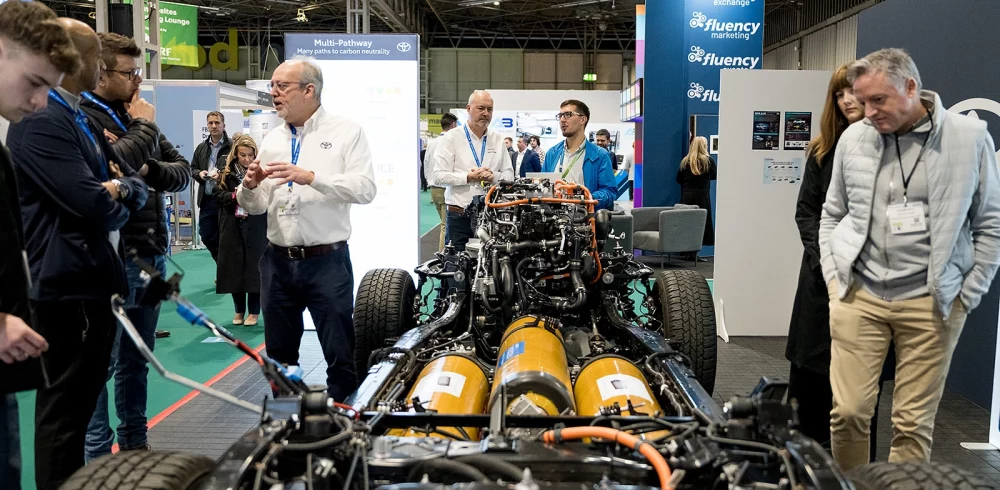
The R&D and Design Engineering track at Advanced Engineering 2026 is structured around the complete development journey, from concept, simulation, and materials selection through testing, validation, certification, and design for manufacture. The value lies in seeing those activities as part of one connected engineering process rather than a sequence of departmental handovers.
For organisations under pressure to shorten development times, the objective should not be speed at any cost. It should be faster learning, earlier evidence and better decisions. When those improve, development can move more quickly without simply pushing risk downstream into manufacturing, certification or the customer programme.
Advanced Engineering takes place at the NEC Birmingham on 4-5 November 2026, bringing together engineering, manufacturing, technology, and supply chain organisations from across the UK and beyond.
Registration is free for qualified engineering and manufacturing professionals. advancedengineeringuk.com.
Manufacturing & Engineering Magazine | The Home of Manufacturing Industry News