

A plastics manufacturing supply chain recalibration is taking place in Britain. Rather than relying solely on overseas offshoring or on total domestic production, UK OEMs are increasingly adopting a blend of the two. Broanmain Plastics explores why the rightshoring component-sourcing model is better for British businesses and how it is helping to enhance quality control.
For decades, offshoring to high-capacity industrial hubs like China served as the default global strategy for driving down manufacturing costs. However, the economic calculations that once justified sending processes like injection moulding overseas have fundamentally shifted. Escalating overseas wage costs, hidden management overheads, shipping and logistic delays, intellectual property risks and persistent quality control challenges have persuaded industrial OEMs to re-evaluate the traditional offshoring business case.
The solution unfolding across the UK industrial landscape is rightshoring says Broanmain’s Managing Director Jo Davis. “By blending localised agility, social innovation and advanced production models, British industry is redefining what it means to build a resilient supply chain.”
In the current economic climate, manufacturing analysts repeatably highlight that risk management, real-time responsiveness and supply continuity have superseded simple cost-per-unit metrics. As these macro-level pressures redefine global procurement standards, British OEMs are turning toward more sustainable sourcing frameworks that reconcile cost efficiencies with localised real time operational agility.
A practical demonstration of this model is seen in the longstanding collaboration between Broanmain Plastics and Bucher Municipal. Over the past decade, Broanmain has assisted Bucher to replace over 30 fabricated metal components on their road sweepers with, lighter, more fuel and cost efficient injection moulded plastic alternatives.
Local production trials combined with project managing the sourcing of tooling from a high quality Chinese-based specialist was integral to proving the viability of rightshoring. “Many OEMs value our ability to manage the high-capital toolmaking overseas where it remains cost-efficient, while bringing ongoing component moulding, finishing, assembly and inventory call-offs back to our Surrey-based manufacturing facility,” expands Jo.
Enhancing End-to-End Manufacturability
Rather than imposing a binary choice between total domestic reshoring and complete offshore dependency, rightshoring evaluates every link of the manufacturing lifecycle. “By decoupling tooling capital expenditure from ongoing component production, OEMs can have their tooling built in-house in the UK or benefit from the economic advantages of overseas tool fabrication all managed by UK engineering experts,” explains Broanmain’s Operations Director Thomas Catinat.
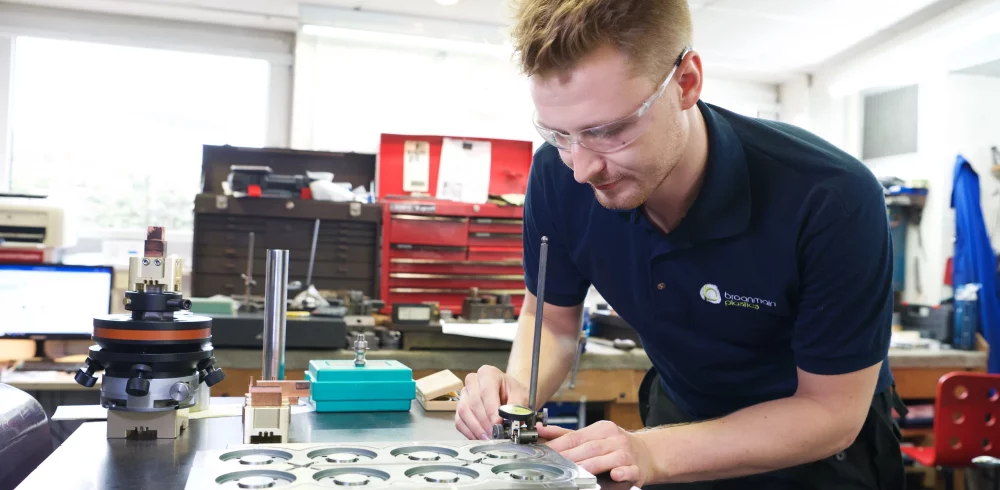
To ensure manufacturability, Broanmain engineering specialists collaborate directly with OEM design teams. This helps to address all the important design factors, including component geometry, gate placement, draft angles and the best polymer selection.
For Specac, this close, local collaboration on a recent spectrometry accessory project helped to ensure total product coherence while making it easier to maintain oversight of quality throughout the development process.
Additionally, Broanmain’s ISO 9001 accreditation ensured that regional compliance requirements and global quality expectations were incorporated from the earliest design stage.
“The shared time zone and easy access for site visits helped both teams resolve urgent queries promptly. Together, these advantages reduced the risk of delays that can arise when managing precision work from further afield,” explains Viet Bao, Digital Marketing Specialist at Specac.
All-Round Knowledge
Once a prototype tool design is stabilised and optimised for manufacturability, Broanmain runs full trials at its UK factory. “When tooling and moulding are under the same roof, design for manufacture reviews happen as part of the process. This allows us to spot problems before a tool is built and suggest modifications that will improve component quality. If sampling reveals an issue, changes can be made quickly,” explains Broanmain’s Engineering Manager Kamil Stec.
Describing the benefits of working with a small yet experienced British-based team, Chris Mawer from Platinum Stairlifts expands: “A lot of technology goes into making stairlifts and the operating mechanisms safe. Moulding precision is an integral part of this.”
Having access to a team with well-rounded technical processing, material and tooling knowledge helps to address any potential supply chain vulnerabilities, notes Chris.
Another critical advantage of having all this localised support and production knowledge on hand is the dramatic reduction in tool modification lead times. In an offshore-only model, adjusting mould dimensions or fixing wear and tear issues could stall production or product launches for months, cautions Kamil. This is when on-site engineering expertise is a real advantage.
“In most instances, Broanmain is able to complete modifications, bench trials and sample re-runs within 24 hours, completely eliminating international transit delays,” reports Kamil.
Increased Operational Agility
This agile framework enables OEMs across diverse technical sectors to flex production volume to real-time market demand.
By partnering with a UK-based toolmaker, Metway Electrical aims to improve communication, accelerate development and tooling modifications, reduce lead times and strengthen quality control.
John Mercer, Product Manager at Metway comments: “This approach also offers greater flexibility, reduces supply chain risk and supports UK engineering expertise, delivering long-term commercial benefits for Metway.”
Additionally, domestic production dramatically shortens freight transport distances which significantly reduces supply chain Scope 3 carbon emissions, highlights Jo Davis.
Jo concludes: “In high precision markets, the Made in Britain mark denotes trust. Sourcing technical plastic components from an established domestic partner is no longer a simple transactional procurement choice driven by initial unit price. As many OEMs are realising, it needs to balance all of the offshore factors against the responsiveness of local, domestic suppliers.”
Manufacturing & Engineering Magazine | The Home of Manufacturing Industry News