


From automotive accessories to consumer electronics, manufacturers are continually seeking innovative ways to minimise material usage and maximise product performance. It’s leading to more OEMs switching to lightweighting.
Prevalent across a wide range of industries, lightweighting can lead to significant reductions in energy consumption. For example, advanced materials adopted by car manufacturers have reduced vehicle weight by up to 15% in recent years, leading to improved fuel efficiency. Similarly, the use of lighter polymers in sports equipment has enabled the creation of stronger, more agile products for athletes.
This collective effort not only conserves resources but also contributes significantly to enhancing the sustainability profile of finished products. Drawing on his extensive experience in polymer materials, Thomas Catinat, Operations Director at Broanmain Plastics, explores the financial and performance aspects of reducing part weight and how this assists OEMs to lower the overall energy required during production, storage and transportation.
The savings extend beyond the factory floor and into storage and logistics. Lightweighting has the potential to reduce freight and warehouse costs between 10% and 20%. This is predominantly due to the reduced mass which allows more products to be transported per load.
Additionally, a lightweighting strategy can hedge against supply chain volatility. By using less volume, manufacturers can conserve inventories of expensive or harder to source materials. This can help to maintain production resilience and support responsible production practices
Metal substitution
Techniques for achieving plastic lightweighting are primarily centred on careful material selection, advanced manufacturing methods and considered design adaptations. This approach helps companies meet regulatory standards and eco-labelling schemes, while also contributing to the resilience of supply chains by reducing dependence on costly or scarce materials.
For instance, converting components from metal to plastic can result in weight reductions exceeding 50%. Current composite materials are even able to improve the structural integrity of components, which in turn can increase user safety. “Many of the mouldable materials used today are designed to absorb impacts and last longer than rigid structures,” emphasises Thomas.
Application advantages
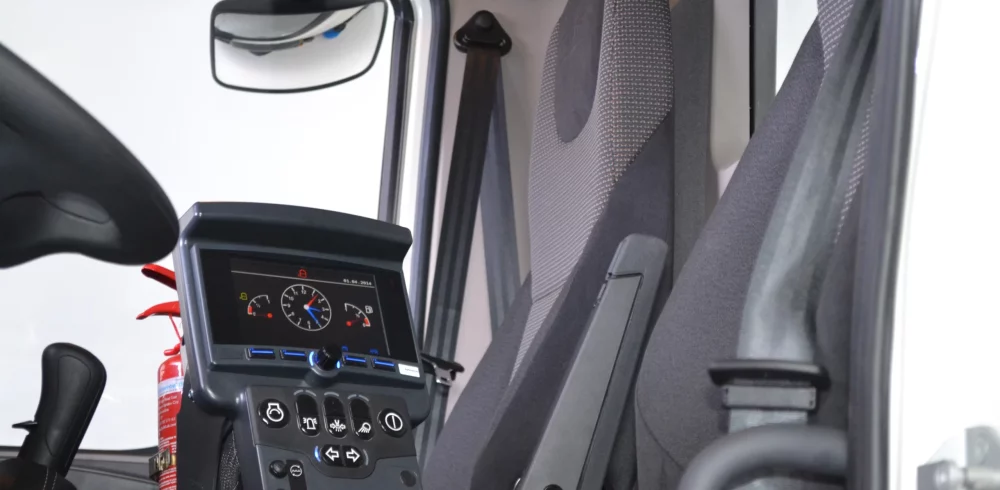
Broanmain Plastics has played a key role in supporting Bucher Municipal’s efforts to replace over 30 fabricated metal components with plastic alternatives for their road sweepers. This transition to lightweighting has become even more essential as Bucher Municipal moves towards all-electric vehicles.
The partnership between the two organisations involved a collaborative approach to ratify the investment in new tooling. The process started nearly a decade ago with the development of a plastic filler cap. Broanmain worked closely with Bucher’s internal design and purchasing teams to create an initial prototype and assess the strength and durability of the plastic materials through rigorous trials.
“One of the most exciting aspects of lightweighting is the design freedom it offers engineers. It enables OEMs and processors to move beyond the constraints of traditional materials by integrating diverse manufacturing techniques, including 3D printing, injection moulding and precision casting. For example, engineers can now combine additive manufacturing with advanced composites to produce parts that are both lighter and stronger. This leads to greater efficiency and cost-effectiveness across a wider range of applications,” ends Thomas.
Manufacturing & Engineering Magazine | The Home of Manufacturing Industry News