


Spotlighting those that first brought humanity to the moon during America’s 250th anniversary tour.
This month, the National Archives Freedom Plane, carrying documents foundational to American history, landed in Houston, Texas. On July 20, 1969, Neil Armstrong spoke the famous words “Houston, Tranquility Base here. The Eagle has landed”, to NASA’s mission control center, cementing the place of Apollo 11 in history. But the road to get there was a long one and for over a decade, the aerospace industry worked tirelessly to achieve the impossible. To honor the most recent Freedom Plane stop, we reflect on Boeing’s contributions to an iconic period of American history: the Space Race.
“The people working in aeronautics love it, but those who are working in space, why, they have stars in their eyes.” -James S. McDonnell, founder, McDonnell Aircraft Corp.
On Oct. 4, 1957, the Soviet Union launched Sputnik into space. The launch of the world’s first satellite shocked the United States and initiated a space race to demonstrate political superiority through technological advancement. NASA was created in 1958 to answer the Soviet challenge with a major goal to launch the first human into space. Project Mercury was created to design and build a spacecraft for this effort.
In St. Louis, Boeing heritage company McDonnell Aircraft Corp. invested in the future by starting studies into methods to launch humans into space before Sputnik. In late 1958, when NASA sent bids for a contractor to build the Mercury spacecraft, McDonnell was ready. NASA awarded the prime contract to design, test and build the Project Mercury manned spacecraft to McDonnell in February 1959.
On May 5, 1961, Alan Shepard became the first American to launch into space aboard a Rocketdyne-powered Redstone rocket. His Mercury capsule, Freedom 7, achieved an altitude of almost 117 miles. After a 15-minute automatic flight to test attitude control, Freedom 7 splashed down in the Atlantic 303 miles downrange from Cape Canaveral. Freedom 7 marked the first of six crewed Mercury launches from May 1961 to May 1963.
Though the United States had finally launched an astronaut into space, the Soviet Union was still ahead. Less than a month before Shepard’s flight, cosmonaut Yuri Gagarin became the first person in space in the Vostok 1 spacecraft. Yet Shepard’s successful flight gave President John F. Kennedy the confidence to be bold. On May 25 he declared before a joint session of Congress that America’s goal would now be to land astronauts on the moon and return them safely to Earth by the end of the decade. The finish line for the Space Race was now defined.
From Alan Shepard’s suborbital flight to John Glenn’s first orbits of the Earth to Gordon Cooper’s record of 34 hours in space, the impetus gained from the Mercury missions created a platform from which to launch the Gemini program.
In December 1961, NASA signed a contract with McDonnell as prime contractor for a second-generation manned spacecraft that could carry two people and bridge the gap between the Mercury and Apollo programs. Project Gemini had four main goals: test an astronaut’s ability to function in space for long periods of time, practice rendezvousing and docking with other spacecraft, master reentry and landing techniques, and study the effects that long-duration spaceflight had on astronauts.
With a spacecraft two times the size of the Mercury, designers integrated important improvements into the Gemini spacecraft. Two unmanned Gemini missions were flown to check out systems and the spacecraft’s heat shield that protected the astronauts during the fiery re-entry into Earth’s atmosphere. A total of 10 crewed Gemini flights were made in 1965 and 1966, paving the way for the Apollo missions to land on the moon.
Work on Apollo began in the early 1960s. Boeing heritage companies built every part of the Apollo spacecraft and the massive Saturn V rocket that carried it, with the exception of the lunar lander.
Southern California became a center of Project Apollo activity. North American Aviation assembled the Command and Service Modules (CSM) at its Downey plant, with astronauts dropping by to assist with component testing and the design of the cockpit. A separate North American facility at Seal Beach was used to manufacture the Saturn V launch vehicle’s second stage. In Canoga Park, North American’s Rocketdyne division worked on the engines for all three stages of the Saturn V, and near Santa Monica, Douglas manufactured the Saturn V third stage.
Boeing built the Saturn V’s first stage at NASA’s Michoud Assembly Facility near New Orleans. Parts for the booster were shipped to Michoud from the company’s Wichita plant, as well as from subcontractors around the country. Once completed, each booster was loaded onto a covered barge to begin a week-long trip around the Florida Keys to the Kennedy Space Center, where it was assembled with the other two stages.
Boeing heritage companies also made major contributions to identify lunar landing sites and knowledge of the moon’s surface before a manned spacecraft reached the moon. Surveyor 1, the first in a series of soft-landing lunar spacecraft designed and built by Hughes, successfully landed on the surface of the moon in June 1966. Five Boeing-built Lunar Orbiter spacecraft, beginning in August 1966, mapped 99 percent of the moon’s surface, more than 14 million square miles.
On January 27, 1967, tragedy struck the Apollo program. The crew of Apollo 1 – Gus Grissom, Ed White and Roger Chaffee – were conducting tests on the launch pad when fire broke out inside their spacecraft, killing all three astronauts. For nearly two years after the fire, Project Apollo was put on hold while major changes were made to ensure the safety of future astronauts. These included modifications to the escape hatch to allow quicker exits. The result was a much-improved spacecraft that performed successfully throughout 11 Apollo missions.
After the Apollo 1 tragedy, NASA gave Boeing a much broader role in Project Apollo. NASA awarded the company a “technical integration and evaluation” (TIE) contract to work with NASA and the contractors to certify that the Apollo spacecraft and its launch vehicle functioned together and were ready for flight.
On December 21, 1968, the first crewed Apollo mission – Apollo 8 – launched. Astronauts Frank Borman, James A. Lovell Jr. and William A. Anders journeyed to the moon to complete 10 orbits before returning to Earth. The crew became the first humans to fly atop the Saturn V; the first to leave Earth orbit; the first to fly through the Van Allen belt; the first to fly to the moon, to orbit the moon and to see the far side of the moon; and the first to see the Earth from a new perspective.
On July 20, 1969, Neil Armstrong and Buzz Aldrin landed the Lunar Module “Eagle” on the surface of the moon. Just four hours later, Armstrong became the first person to set foot on the lunar surface, followed closely by Aldrin. The third crewmember, Michael Collins, remained inside the Command Module “Columbia” as it continued to orbit the moon.
Armstrong, Aldrin and Collins – together with the thousands of NASA and industry team members who worked on the program – fulfilled the pledge made by President Kennedy to make the United States first to land a man on the moon and return him safely to Earth before the end of the decade.
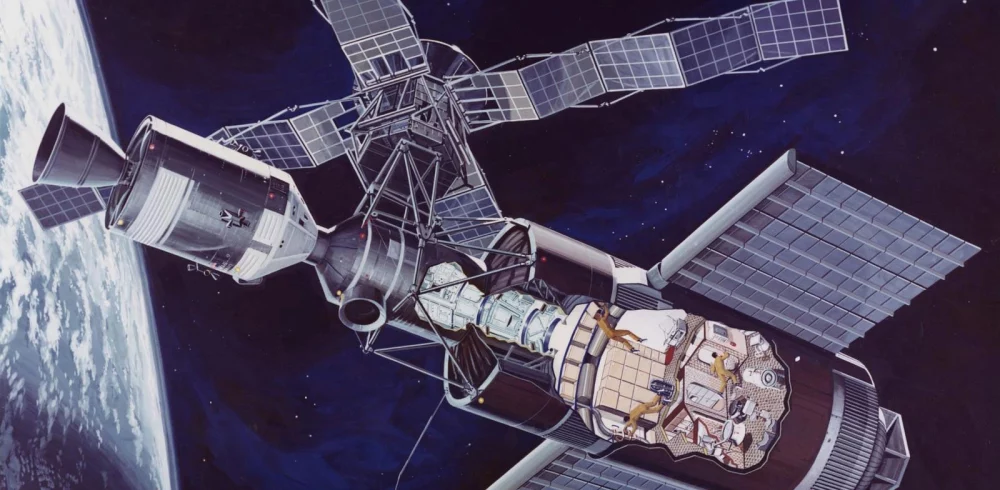
The last of six crewed missions to land on the moon, Apollo 17, splashed down on December 19, 1972. Technologies developed by Boeing and its heritage companies for Apollo lived on after the program ended. Skylab, the United States’ first space station, was constructed from a converted S-IVB third stage and was operated by three crews of astronauts between May 1973 and February 1974. In 1975, the Apollo-Soyuz program used Apollo hardware for a joint spaceflight with the Soviet Union, paving the way for future international cooperation in space.
In a span of less than two decades, humanity went from launching its first satellite to landing on the moon, living in low earth orbit for extended periods of time and coordinating international spaceflights. These advances in technology laid the groundwork for the exploration of space that Boeing still supports today.
By Allison Balderrama
Manufacturing & Engineering Magazine | The Home of Manufacturing Industry News