


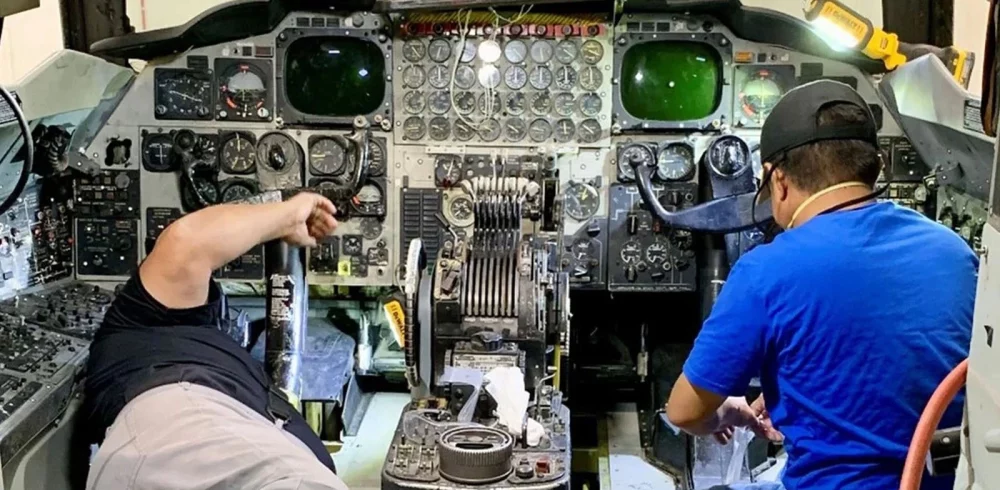
For most engineers working on platforms that are no longer in production, getting access to an actual aircraft means taking one out of fleet service. B-52 Commercial Engine Replacement Program (CERP) engineers do not have to do that thanks to the Oklahoma City B-52 High Bay Facility that allows them to apply data from an actual aircraft and place it into a digital engineering environment.
Hands-on learning
The High Bay Facility is home to Damage Inc. II, a full fuselage and wing of a decommissioned B-52 that serves as a test bed for the B-52 modernization effort. The aircraft helps CERP engineers better understand the complexities of replacing the current TF-33 Pratt & Whitney engines with modern, more efficient Rolls-Royce F-130 commercial engines that will help it fly to 2050 and beyond.
“We would not be able to learn and grow as a program without the B-52 High Bay,” said Jagbir Singh, B-52 CERP program director. “Being able to go and see a real B-52 gives engineers a better opportunity to understand the scope of the work without taking any current active aircraft away from the fleet, while helping us save an incredible amount of time — especially on a project like airspeed probes.”
Probing for improvements
The team’s engineers recently held a workshop at the facility to test a method of installing advanced airspeed probes on new locations of the aircraft. These probes will feed essential data to the cockpit, enabling pilots to monitor engine performance more effectively.
The installation faced significant technical complexities, including the need to avoid replacing skin panels and ensuring that modifications would not compromise the aircraft’s structural integrity. During the initial phase of testing, the team discovered discrepancies between the aircraft’s actual fastener patterns and the original engineering drawings.
“You have to know what you don’t know,” said Chris Tribou, B-52 CERP manufacturing engineer. “We found that the fastener holes in the skin common to the attach-stringer were not as per the drawings, which could have led to major repair issues.”
Values in action
The findings prompted teammates to take ownership of the issue by reassessing their approach and adapting the designs to accommodate the aircraft’s unique characteristics.
- Access to the aircraft allowed them to use variance techniques to further understand the challenge and be decisive in developing a solution.
- To gain better access to the cockpit for the installation, the team removed the pilot seats and emergency seats. This allowed engineers to analyze the human factors of the project, ensuring that all modifications could be executed with precision.
Demonstrating a people focus by collaborating respectfully, teammates from Boeing San Antonio Manufacturing, St. Louis Tooling and the Oklahoma City Advanced Visualizations and Immersive Development & Reverse Engineering and Prototyping Lab created tools and 3D-printed parts to quickly iterate on designs and make necessary adjustments.
- “This saved us hundreds of thousands of dollars and significantly reduced our timeline,” Tribou said. “We would have faced months of delays if we had to rely on traditional manufacturing methods.”
What’s next
The team is preparing for the next phase of its project that will introduce new engineering parts designed to fit the aircraft’s structural variances. This proactive approach aims to minimize rework and streamline the modification process.
Manufacturing & Engineering Magazine | The Home of Manufacturing Industry News