

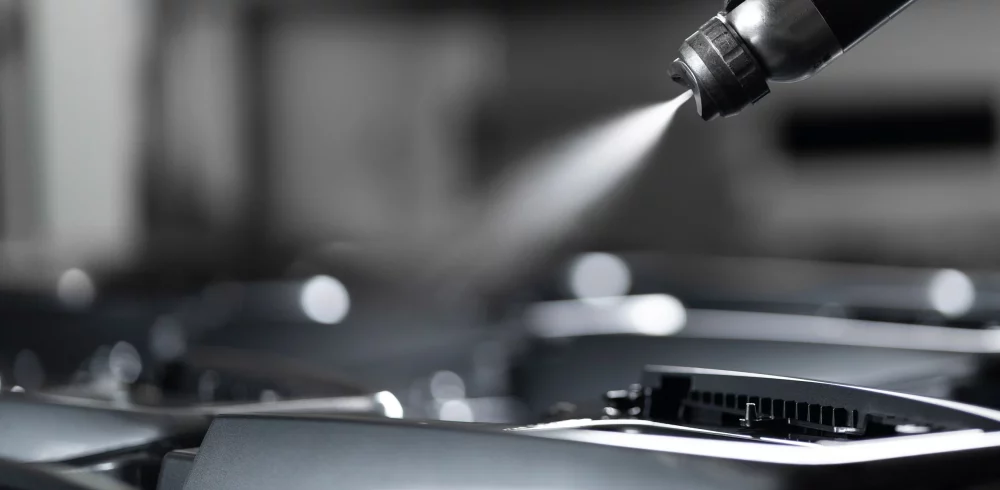
Snow-jet cleaning has established itself as the state of the art when it comes to coating plastic add-on parts. To improve cleaning quality and thus the paint finish, a company specialising in interior and exterior parts for the automotive industry has optimised the snow-jet cleaning machines that are integrated into its automated paint shops by replacing the standard nozzles with an innovative rotary system.
The takeover by Aequita SE & Co. KGaA around a year ago has set the course for the future of the long-standing KTX GmbH, as well as for further growth. Based in Weissenburg, Bavaria, with branches in Solingen, Serbia and the USA, the company specialises in innovative interior and exterior parts for the automotive industry, covering the entire production chain from design right through to final assembly. Its high-quality trim solutions are manufactured on injection molding machines with a clamping force of 80 to 3,200 tons. One of the company’s core competencies, which it also offers as a service at its headquarters, is subsequently painting the parts.
Focus on continuous process improvement
The parts are coated in paint shops from Venjakob Maschinenbau GmbH, which feature integrated CO2 snow-jet cleaning systems. “It is essential that surfaces are absolutely clean, especially if parts are to be painted with a high-gloss piano black finish. The tiniest dust particles or fibers are enough to cause surface irregularities and thus rejects,” explains David Heidrich, Head of Paint Shop at KTX in Weissenburg. “We are therefore always interested in solutions that allow us to further optimize our processes.” One such opportunity presented itself when the head of department met a former colleague from technical school. He was now working as an application engineer at acp systems AG, a global technology leader with its quattroClean snow-jet technology. The technology uses liquid, recycled carbon dioxide as a cleaning medium, which is guided through a wear-free, two-substance ring nozzle. The carbon dioxide expands on exiting the nozzle to form fine CO2 snow, which is then bundled by a separate jacket jet of compressed air and accelerated to supersonic speed. On impacting on the surface to be cleaned, the jet of snow and compressed air develops a combination of thermal, mechanical, solvent and sublimation effects. The interaction of these four mechanisms of action remove particulate contamination right down to the submicrometer range and also filmic contamination reliably and reproducibly. Since the crystalline carbon dioxide sublimates completely during the process, the cleaned surfaces are dry and free of residues.
Improved cleaning results proven in tests
In order to compare the performance of acp’s technology with that previously used, tests were arranged at KTX. Initially, an array equipped with six nozzles was implemented, which was manually guided over the parts outside the feed section of the paint shop. “The paint finish was definitely better on the parts cleaned manually with the nozzle array,” reports Thomas Leimeister, Head of Surface Development at KTX. “We therefore decided to work with acp to further develop this solution for integration into our paint shop.” It was important to maintain the reliability of the existing cleaning module from Venjakob and to integrate the new cleaning unit into the paint shop’s existing control system, which was made possible by the excellent cooperation between the companies involved.
Rotating nozzle as a solution
The new rotating system developed by acp proved to be the ideal solution for the task at KTX. This nozzle technology makes it possible to remove loose, particulate contaminants from surfaces effectively with lower carbon dioxide and compressed air consumption. The nozzles are available with a fixed 45° spray angle, and an adjustable spray angle via adapters. The rotary unit can be fitted with different wings. “Through trials with a manually guided jet unit featuring three rotating nozzles, acp has demonstrated that equally good or even better cleaning results can be achieved,” notes David Heidrich.
Integration of a unit with three rotary nozzles
The unit was integrated into the KTX cleaning module using a four-wing rotary unit equipped with three nozzles. The spray angle can be adjusted to suit the specific part. The rotary unit is mounted on the linear system of the cleaning module, which required some minor conversion work at the time. “We brought Venjakob on board to synchronize the control technology of the new jet unit with the paint shop, “ explains Thomas Leimeister. “The cooperation between the two companies and with us was excellent and characterized by a spirit of partnership. All the challenges that arose during the changeover were mastered smoothly,” reports his colleague. During the conversion, which was carried out as a pilot project, some optimizations and fine-tuning of the spray angles were necessary after commissioning in order to achieve optimum cleaning results.
Technical and economic success
KTX has been using the new cleaning solution in series production since August 2024. The company is extremely satisfied with the results and plans to equip further paint shops with the cleaning solution. “Technically, we have been able to significantly improve our production process, including process stability. We are also gaining added value from a commercial perspective,” notes David Heidrich. “And last but not least, we have learned a lot from this project, which means that further conversions can be carried out with less effort,” adds Thomas Leimeister.
acp systems AG will be presenting these and other cost- and resource-saving, dry quattroClean cleaning solutions from 14 to 17 April 2026 at PaintExpo in Karlsruhe (Germany) in Hall 3, Stand 3521.
Manufacturing & Engineering Magazine | The Home of Manufacturing Industry News