

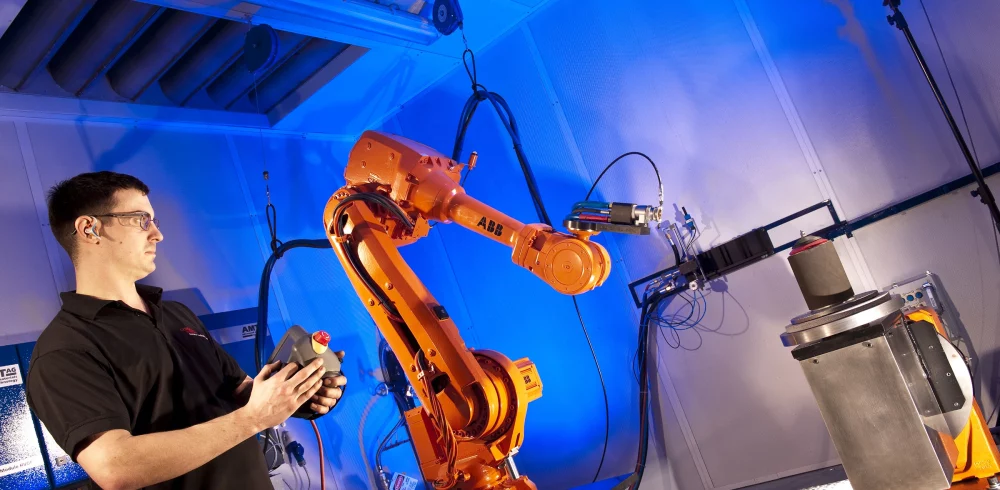
Ask any engineer where a component fails and the honest answer is nearly always the same: at the surface. Fatigue cracks, corrosion, fretting and wear all begin at or near the surface of a part. Control that surface and you control the life of the component. That, in a sentence, is what Curtiss-Wright Surface Technologies (CWST) does.
The timing has rarely mattered more. Industry analysts put the commercial aircraft order backlog at around 17,000 aircraft, more than a decade of production at today’s rates, while operators keep mature fleets flying harder and longer than planned. Every airframe, engine and landing gear in that system depends on engineered surfaces to reach its design life.
Who we are
CWST is the surface treatment division of Curtiss-Wright Corporation, a company built on the unique heritage of Glenn Curtiss and the Wright brothers, the pioneers of powered flight itself. Formed under the ‘One Curtiss-Wright’ initiative, we bring together trusted industry leaders in controlled material surface treatments: Metal Improvement Company, Component Coating and Repair Services, E/M Coating Services, Everlube Products, FW Gartner Thermal Spraying, Para Tech Coating, IMR Test Labs, Bolt’s Metallizing, Ytstruktur Arboga and Keronite.
For our customers that means a single source and a single point of contact for controlled shot peening, laser peening, peen forming, thermal spray coatings, liquid and engineered coatings, dry film lubricants, parylene conformal coatings, Keronite PEO, materials testing and component coating and repair. With over 65 worldwide facilities and on-site field teams that can be mobilised at short notice, we support customers across the whole life of a component, from design and new manufacture through to in-service maintenance, repair and overhaul, reducing turnaround times and costs along the way.
Problems we solve
Above all, we solve problems. We protect components against premature failure from fatigue, corrosion, stress corrosion cracking, fretting, friction, galling, erosion and thermal variation. And because aerospace demands proof rather than promises, our peening and coating facilities are accredited to current industry and customer standards including Nadcap, AS9100 Rev D and ISO 9001:2015, while active research and development keeps us at the forefront of new materials and coating technology.
Peening: strength engineered beneath the surface
Metal fatigue is aerospace’s oldest adversary. Under repeated loading, microscopic cracks form at the surface, grow with every cycle and, left unchecked, end the life of the part. Peening defeats this by inducing beneficial compressive residual stress in the surface layers, making it far harder for cracks to start or spread.
Controlled shot peening is the workhorse. Small spherical media bombard the component in a precisely controlled cold working process, with media, intensity and coverage all specified and repeatable. Applied to landing gear, gear shafts, springs, structural members and turbine blades, it significantly extends fatigue life and improves resistance to stress corrosion cracking. Just as importantly, it allows designers to specify thinner, lighter sections without compromising strength, which pays back in fuel burn and emissions on every flight. Its sister process, shot peen forming, curves large wing skin panels to precise aerodynamic profiles without hard tooling.
Deeper by design
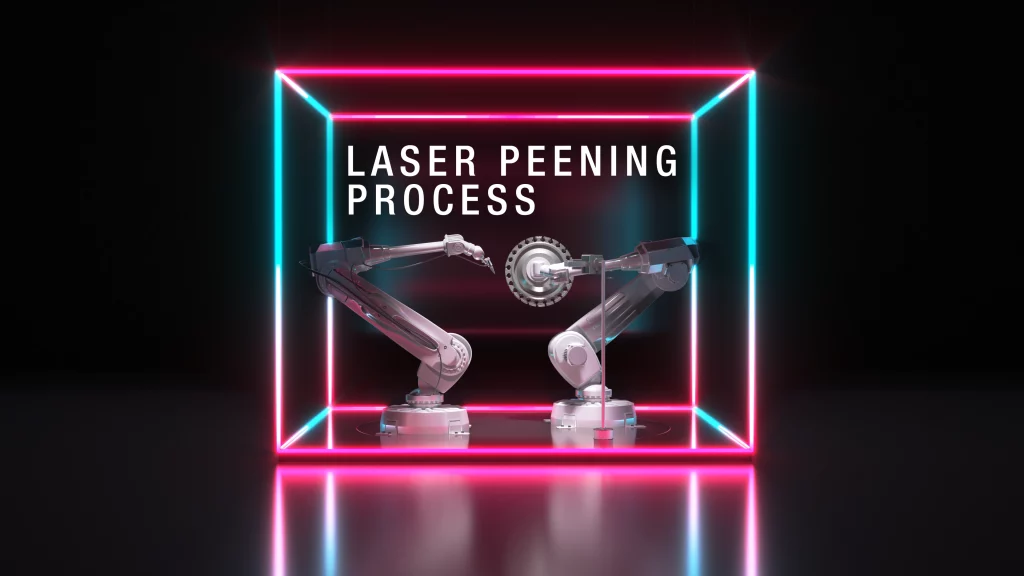
Laser peening takes the same principle much deeper. A high energy laser pulse, fired through a thin stream of flowing water that acts as a confining layer, creates a plasma at pressures of around 100,000 atmospheres on the component surface. The resulting shock wave drives compressive stress from 1mm to as much as 10mm below the surface, many times deeper than conventional shot peening and with minimal cold work. That makes it the treatment of choice for the most highly loaded critical parts: turbine engine blades and discs, landing gear and primary aircraft structure.
Proven on the F-35B and 747-8
This technology is production proven at the highest level. Laser peening has been successfully verified on the Lockheed Martin F-35B, strengthening the airframe to extend service life and boost fleet readiness, while laser peen forming helped shape the integrally stiffened wing panels of the Boeing 747-8, reducing fasteners and weight. Our finite element modelling allows us to peen a component virtually before we ever fire a laser, predicting the improvement in fatigue strength node by node. And for parts too large to ship, our mobile laser peening systems have deployed to customer sites on several continents.
For tomorrow’s hotter engines and additively manufactured parts, our laser peening plus thermal microstructure engineering technique (LP+TME), developed with leading US universities, keeps that protection stable at temperatures where conventional treatments fade.
Coatings that fly: from dry film lubricants to plasma ceramics
If peening strengthens a part from within, coatings defend it from the outside, and CWST offers one of the broadest engineered coating portfolios in aerospace.
Thermal spray coatings, including HVOF and plasma sprayed systems, apply dense, tightly bonded protective layers that resist heat, wear, erosion and corrosion on turbine and compressor components, seals and other hard working surfaces. They protect new parts and restore worn ones, often returning to service components that would otherwise be scrapped.
Lubrication without oil
Where oils and greases cannot survive, our solid dry film lubricants take over. Pioneered by E/M Coating Services across more than 40 years and built on the Everlube product range trusted by industry for over half a century, these coatings use crystalline lattice lubricants such as molybdenum disulphide, tungsten disulphide and graphite, alongside PTFE fluoropolymers, to deliver ultra low friction through temperature extremes, vacuum and contamination. They prevent the galling, fretting and seizing that plague fasteners, hydraulic fittings, valve components and actuation mechanisms. Complementary liquid coating systems, including sacrificial aluminium coatings such as Ipcote, shield turbine blades, rotors, shafts and landing gear against corrosion and oxidation at high temperature. Many of our coatings are qualified to aerospace and defence specifications, REACH compliant options are available and Everlube has achieved PFAS compliance across its range, launching a fluoropolymer-free dry film lubricant ahead of the regulatory curve.
Application matters as much as chemistry. Automated spray lines, dip spin and tumble coating deliver consistent, repeatable films from the smallest fastener to large fabricated assemblies, our in-house chemists develop bespoke formulations to individual specifications and pre-treatments including titanium anodising are handled under the same roof.
Ceramic strength for light alloys
The newest addition is Keronite, the world leader in plasma electrolytic oxidation (PEO), acquired by Curtiss-Wright to extend our portfolio into advanced light alloy protection. PEO transforms the surface of aluminium, magnesium and titanium into a hard, dense ceramic layer with extreme hardness, outstanding wear and corrosion resistance, high fatigue performance and high dielectric strength. It allows lightweight alloys to perform well beyond their normal operating limits, exactly what airframe, engine and space systems designers need when every kilogramme counts. Keronite already coats more than 120,000 parts a year and holds Nadcap accreditation for chemical processing.
Keeping fleets flying: repair, overhaul and what comes next
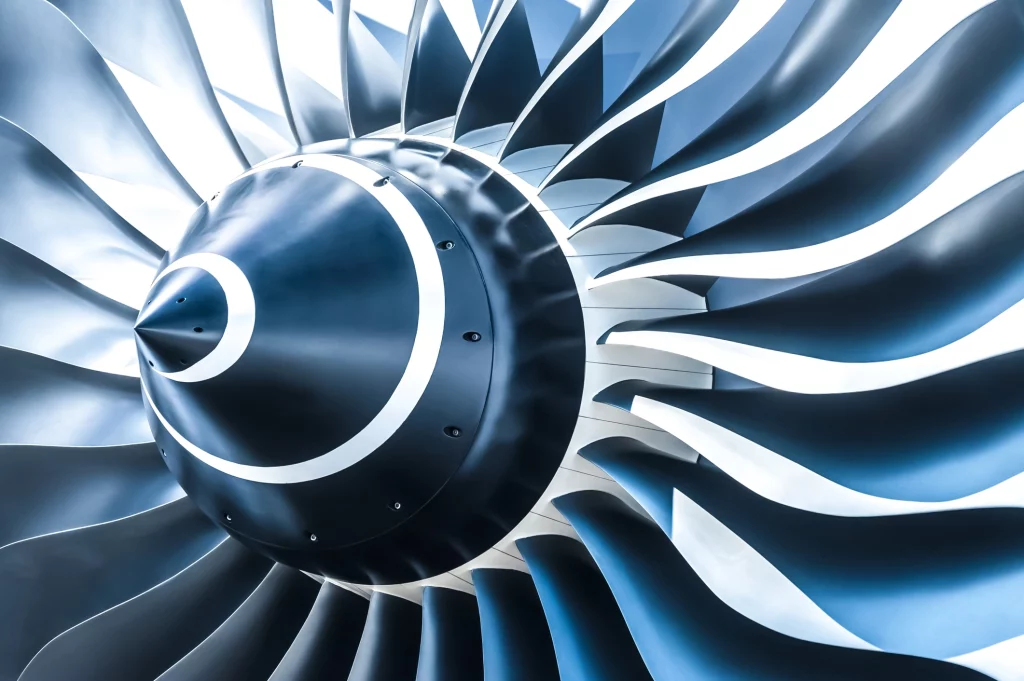
With new aircraft in short supply, the world’s fleets are working harder for longer, and maintenance, repair and overhaul demand is at record levels, driven above all by engines. Repairing a critical component rather than replacing it saves cost, lead time and material, and that is exactly where our Component Coating and Repair Services (CCRS) business comes into its own.
From facilities in Alfreton Derbyshire, CCRS specialises in coatings and repair for both new manufacture and overhaul of gas turbine and aerospace components, for customers including Rolls-Royce, Siemens and GE. Typical work spans flame tubes and combustion chambers, turbine blades, nozzle guide vanes, honeycomb seal replacement and the dressing and blending of compressor and turbine blades, supported by vacuum brazing, diffusion and sacrificial coatings, HVOF and plasma thermal spray, TIG welding, machining, heat treatment, CMM inspection and NDT. Our engineers even write the repair schemes, carrying the technical burden as well as the workload.
At your site, at short notice
Some components cannot come to us, so we go to them. Our on-site teams deploy worldwide at short notice, working to the same stringent quality approvals as our processing facilities and cutting downtime, logistics and shipping costs for oversized or fixed equipment.
Behind every process sits the evidence. Through IMR Test Labs we provide independent materials testing and analysis, supporting alloy selection, coating validation and failure investigation, so engineering decisions rest on data rather than assumption.
Keeping pace with aerospace
Aerospace never stands still and neither do we. As additive manufacturing moves towards serial production, our post-processing treatments, from peening to C.A.S.E. isotropic superfinishing, give printed parts the surface integrity that flight demands. As engines run hotter, LP+TME keeps fatigue protection stable. And because every treatment extends component life, reduces waste and enables lighter designs, surface engineering is quietly one of aerospace’s most effective sustainability tools.
One conversation with CWST puts all of this at your disposal: over 65 facilities, decades of accumulated expertise and a single accountable partner for every critical surface.
For more information visit www.cwst.co.uk, call 01635 279621 or email eurosales@cwst.com.
Manufacturing & Engineering Magazine | The Home of Manufacturing Industry News