


A Boeing team’s personal connections and experiences are improving air travel for people with reduced mobility.
Mitchell Mellor has always had a passion for accessibility. A close friend, who is quadriplegic, inspired him to find creative solutions for daily problems ranging from home automation to creating a wheelchair lift on a monster truck.
As an engineer and Boeing Associate Technical Fellow who works in door design, Mellor saw an opportunity to combine his passions when a challenge emerged loading wheelchairs into 737 cargo holds.
When approached by the accessibility team – “I dove right in,” said Mellor.
737 cargo doors fold into the cargo hold when open, limiting the size of the opening and the type of wheelchair that fits. This can sometimes require travelers to leave preferred mobility equipment behind during flights, or not be able to fly at all. Changing the doors would require a major redesign and expensive certification. Mellor connected with Boeing Associate Technical Fellow Doug Brown, who had worked on 737 cargo container concepts, to develop a new solution.
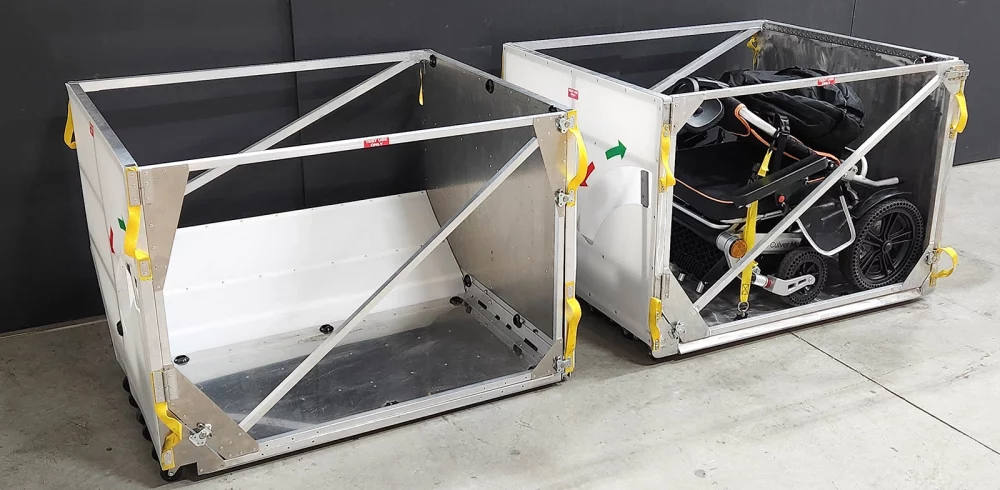
Since 737 does not use standard cargo containers, also known as unit load devices, in the cargo holds, the new wheelchair container was a unique design.
Together Brown and Mellor designed and built prototype cargo containers to protect wheelchairs and make them easier for airport workers to handle.
“This allows workers to load a wheelchair just as they would an oversized item, keeping critical and fragile parts of the wheelchair protected in transport,” Brown said.
Beyond making air travel more accessible, they realized these containers have uses for other valuable cargo and named the design the High-Value Cargo Container (HVCC). Brown and Mellor’s container received a U.S. patent in October 2025, and work continues to refine it.
The effort also sparked a larger push within Boeing for iterative engineering and rapid prototyping to find accessibility solutions. Brown now supports several accessibility projects, including improved seats for people who use wheelchairs and ways to secure wheelchairs on the airplane.
Mellor continues to advocate for future airplane designs that are more inclusive of passengers with mobility needs. He credits Bill Harkness, head of Inclusive Systems Engineering & Accessibility Architecture, for supporting the project and driving accessibility initiatives like this across Boeing.
“It is a blessing to work on accessibility at Boeing, because from low vision or blindness to those who are hard of hearing or deaf, most of us have loved ones with some form of a disability,” Mellor said. “So I continue to advocate for it.”
Manufacturing & Engineering Magazine | The Home of Manufacturing Industry News