

~ Why innovation and collaboration are key to overcoming barriers ~
David Walker, ABS Vice President, Government Business Development

Four megatrends are pushing the data center industry toward a fundamental rethink: AI power demand is rapidly increasing, existing grids cannot absorb it, communities are pushing back against land-based facilities and small modular reactor technology is maturing to offer a potential alternative. Floating nuclear-powered data centers represent a significant opportunity, but unlocking it will require unprecedented collaboration across the nuclear, maritime and digital infrastructure sectors.
Nuclear energy is re-emerging as a serious option for large-scale power demand, with offshore hyperscale data centers among the applications now drawing real attention.
Four megatrends and driving this growing interest. The first is the unprecedented electricity demand of AI training clusters and high-performance computing facilities. These require hundreds of megawatts of continuous power that variable renewable energy sources alone cannot reliably provide. The second megatrend is the constraints of the current grid, caused by decades of limited investment and lengthy permitting processes. Third, community resistance to terrestrial data center development is growing, driven by concerns over power consumption, water use and noise, alongside a perception that large-scale facilities deliver limited local economic benefit. Finally, advances in nuclear technology, particularly lower-risk small modular reactors, have the potential to help make commercial offshore and maritime applications more viable.
Why combine nuclear and data centers offshore?
Co-locating energy-intensive computing close to generation reduces transmission losses. If the SMR can float, so can the data center. There are also inherent benefits to being offshore. Access to seawater means the massive cooling requirements of both data centers and nuclear reactors can be met by using the water as an efficient heat sink. Floating facilities avoid land-use conflicts and the associated permitting challenges and delays while a shipyard’s factory-style production of barges and SMR modules could enable faster deployment. This matters because the power demands of AI are increasingly urgent.
Finally, there are strategic drivers to deploy offshore. In a volatile world, it’s imperative to develop energy sovereignty – especially for critical digital infrastructure – and to be able to flex that sovereignty to respond to changing situations: as deployable assets, floating SMR-powered data centers can relocate as needed.
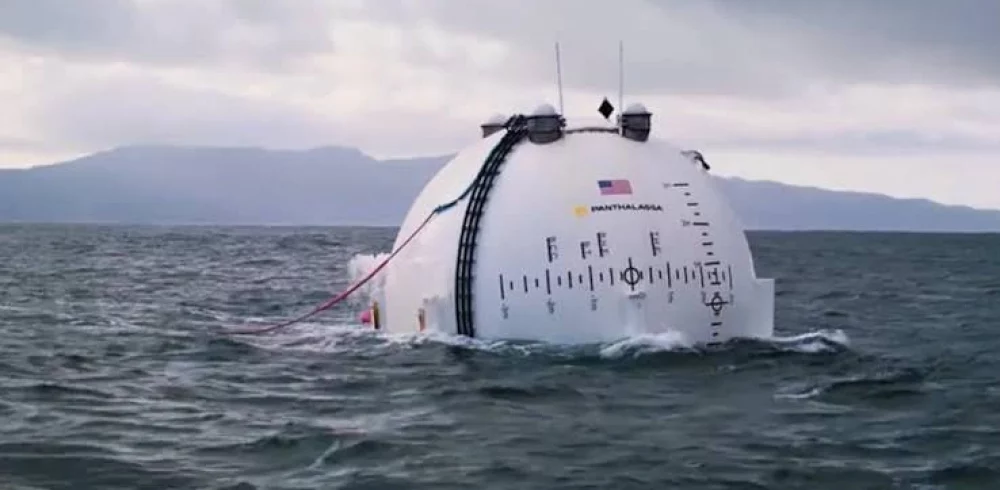
What does it look like? (include graphic)
A floating SMR data center would combine a marine platform (such as a barge or converted offshore structure), an SMR providing continuous baseload power and hyperscale computing modules located on the same or adjacent structures. The SMR can either be dedicated to the onboard data center or can export surplus baseload power to shore for use by the grid. Seawater cooling loops would be needed to remove both reactor and data center heat while subsea power and fiber links connect to shore.
The barriers between concept and commercial reality
The concept sounds compelling: the technologies, the demand and the knowhow all support it. But many barriers sit between concept and commercial operation, the most significant of which is the regulatory and licensing complexity. The nuclear systems need a license from an approved nuclear regulator such as the Nuclear Regulatory Commission, while the floating platform and marine systems would need classification and compliance with all IMO codes.
Currently the global, legal, and regulatory rulebooks needed to safely govern, permit and insure ship-based or barge-mounted nuclear reactors are either non-existent or still in early development. These currently immature frameworks are matched by the as-yet unanswered questions about liabilities and how maritime insurance will apply to an asset with an onboard nuclear reactor. The industry must also establish financial models, ownership structures, fuel supply arrangements, waste management responsibilities and decommissioning frameworks.
And while engineers and naval architects from multiple disciplines will be able to resolve the technical issues, such as marinizing SMR technologies or the impacts of radiological shielding and collision protection on vessel stability, it will take a co-ordinated effort to develop the skilled multi-disciplinary workforce to safely operate these facilities and allay public fears around security, environmental hazards and proliferation risks.
Why governments will need to lead
This is not a concept that any one company can progress. It will take high level engagement and coordination at intergovernmental and interagency level to progress the regulatory framework and insurance initiatives that will be key to unlocking solutions. Interested stakeholders should engage with the IMO, IACS and other intergovernmental, government and NGO initiatives to help ensure regulation frameworks are workable. We know from past experience that simulated regulatory approval exercises are particularly helpful to stress test processes and identify pain points and potential jurisdictional friction.
The appetite for this kind of truly ground-breaking innovation requires government leadership to forge the way ahead. The U.S. military already has special status under the Atomic Energy Act that permits it to regulate its own nuclear activities and those of its contractors, bypassing the civilian licensing process of the Nuclear Regulatory Commission. This is now being pursued through the Janus Program, which is designed to expedite the deployment of advanced nuclear technologies outside of NRC licensing. When it comes to floating nuclear power plants, the U.S. Navy is already evaluating a concept to use its largest nuclear-powered aircraft carrier, the USS Gerald R Ford, to supply electricity from its propulsion plant to shore-side power grids during port stays.
Maritime Prosperity Zones focused on nuclear development could further support the advancement of SMRs for floating data centers. These localized economic hubs are designed to attract private investment and revitalize domestic waterfront communities and shipyards.
In parallel with the maturation of the regulatory frameworks, it will be essential to explore innovative financial models between government and industry to support development of the new technology and associated infrastructure.
Collaboration will determine the pace
True innovation rarely happens in isolation. Collaboration across sectors, across disciplines and across borders will be essential to overcome technical, commercial and regulatory issues. Class societies are well-placed to facilitate and co-ordinate these efforts. ABS has been involved at all levels, working with both military and civilian developers to progress the research, safety cases and design work that’s required to move from power point to prototype to first power. Last year, for example, ABS granted approval in principle to HD Hyundai Heavy Industries (HHI) and HD Korea Shipbuilding & Offshore Engineering (HD KSOE) for a conceptual design of a floating SMR-powered module. This was the latest step in a long running collaboration with ABS on nuclear technologies, including another power barge design and a groundbreaking 15k TEU nuclear propelled containership.
The U.S. Center for Maritime Innovation (USCMI) is advancing research for the maritime applications of advanced nuclear technology. ABS serves as secretariat and encourages engagement from research partners and maritime stakeholders across industry and government. This work is connecting the nuclear and maritime industries with government and other stakeholders in unique ways to enable transformative innovation in the marine transportation system. Projects include exercises to test regulatory approval processes, developing maritime test beds, building port and shipyard readiness for supporting these types of assets, and other initiatives to accelerate progress of development across the industry.
These are early days in the development of floating nuclear-powered data centers, an innovation that sits at the intersection between next-generation nuclear and rapidly advancing AI capabilities. This intersection represents a substantial opportunity for the industry and we urge all stakeholders to join us today in shaping the regulatory, commercial and technical frameworks that will underpin the clean energy and AI capabilities of tomorrow.
Manufacturing & Engineering Magazine | The Home of Manufacturing Industry News