

The Fritzmeier Group has evolved from a saddlery workshop 100 years ago into an internationally renowned specialist in metalworking and plastics processing today. Based in the German town of Großhelfendorf, the family-owned business is a respected name on the global stage. It is particularly well known as a systems supplier to manufacturers of off-highway and commercial vehicles with complete cabs, system assemblies, and trim parts made of metal and plastic. While the broad product range may be a commercial strength, it is also a welding challenge. Over 200 different welded assemblies need to be managed, each produced to the highest quality standards. Fortunately, WeldCube Navigator from Fronius guarantees the reliable results that Fritzmeier demands.
A wide range of tasks—consistently high standards
Across its three business divisions of CABS, COMPOSITE, and TECHNOLOGY, Fritzmeier provides customized development and manufacturing services to customers around the world with a workforce of more than 2,200 employees. This Bavarian metal and plastics specialist focuses primarily on driver cabs for industrial trucks, agricultural machinery, and construction equipment. Fritzmeier has also established itself in the field of sports equipment, as demonstrated by its partnership with EGYM, a manufacturer of smart fitness equipment. This alone shows what the greatest challenge in production, particularly for welding technology, really is: the sheer variety of products and assemblies. While each weld seam on its own is no problem for a skilled professional, the difficulty lies in integrating them all into the manufacturing process in a way that ensures consistent quality across the entire product portfolio. The solution is WeldCube Navigator from Fronius.
Fritzmeier primarily welds steel grades such as DC01, S235, S355, and fine-grained structural steel like S700MC. Sheet thicknesses vary widely, ranging from 1 to 16 mm for stiffening and reinforcing plates. Due to the complex structure of the cabs, parts of varying thickness frequently have to be joined to each other (profiles to sheet metal, curved elements to flat surfaces, and much more besides). This above all makes the heat input requirements particularly challenging, as the welding parameters have to be constantly adjusted for the same component and every joint needs to be properly prepared. Even experienced welders can become overwhelmed with having to familiarize themselves with several hundred different welded assemblies.
Welding processes also vary depending on the specific application. While Fritzmeier does occasionally use the standard pulsed arc for manual welding, it mostly turns to PMC (Pulse Multi Control) and LSC (Low Spatter Control). The latter is primarily reserved for thin sheets at the Großhelfendorf production facility, as it produces significantly less spatter than conventional dip transfer arcs. The process is based on detecting short-circuit events early to enable a soft reignition of the arc at a low current level. The arc stability, which is already very high, can be further enhanced with the penetration stabilizer, which adjusts the wire speed instead of the welding current to ensure constant penetration. Fritzmeier uses the PMC process for visible seams as well as vertical-up and vertical-down seams. PMC is a further development of the pulsed arc, which is characterized above all by its finely controlled and low-spatter droplet detachment.
The CMT arc is also used on robots and cobots because it offers a high deposition rate combined with a low heat input, making it ideal for light gauge metal sheets. The characteristic back-and-forth movement of the wire promotes droplet detachment and shortens the short-circuit phase, resulting in a virtually spatter-free material transfer (as the arc transfers very little heat to the material). Because of its outstanding visual results, this process is also the preferred choice for visible seams.
Korbinian Eberl is a veteran of the Fritzmeier plant in Großhelfendorf and is responsible for welding supervision at the company. “If we take a cab as an example, we can see a wide variety of different seam geometries coming together. There are many different types of fillet welds alone, including corner welds, butt welds, single bevel tee-butt welds, and more. The biggest challenge here is ensuring that everything is produced to a consistent quality standard. We have about 200 welded assemblies, each of which consists of 50 to 250 individual welds, so every process has to be perfectly synchronized with the other,” he explains.
The “digital co-pilot” for welding
Fritzmeier first deployed WeldCube Navigator in 2025, having been attracted by its ability to address precisely these challenges. The software solution from Fronius allows the company to guide its welding specialists step-by-step through complex weld geometries and the necessary settings. It covers two areas of application, starting with creating the guides themselves in the Editor. Detailed instructions can be defined on everything from material preparation and the insertion sequence for robotic applications, to fixed welding parameters from which no deviations are permitted.
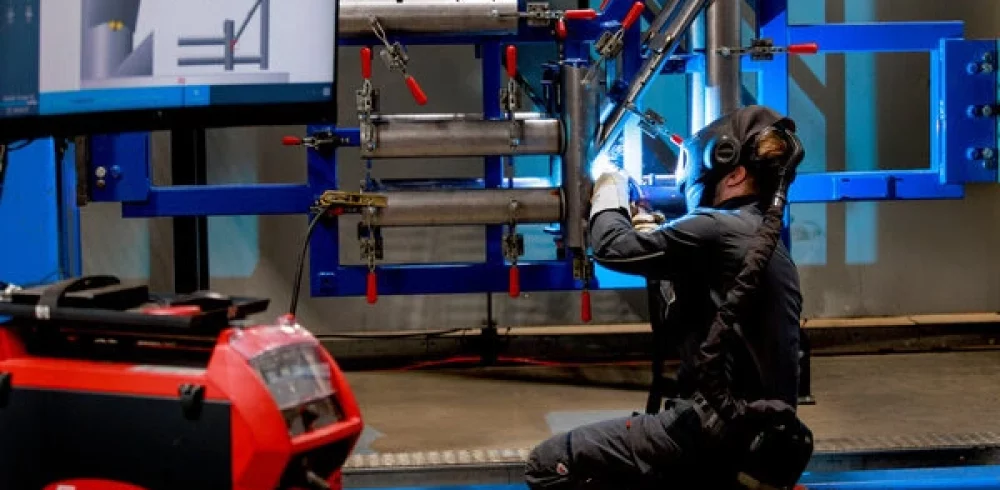
The second part of the application—the Sequencer—is used on the shop floor and guides the welder through the entire welding process for a component. This is achieved through the software on the welding machine itself (which makes sure the settings are correct) and an external monitor that clearly displays the individual steps. Not only does WeldCube Navigator ensure that no seams are overlooked, but enormous time savings are unlocked on the production line.
“The Sequencer is an essential tool for many components. Thanks to the specified parameters and the defined sequence, we can guarantee consistent quality. The Navigator is ideal for preparing the welding process in the office and seamlessly handing it off to the factory floor. This allows us to consider in advance which arc types and settings will yield the best results, and then apply them immediately without any further delay,” explains Eberl.
Changes are always tricky at the start—or are they?
Whenever a new technology is introduced, there’s always a question of how readily the workforce will adopt it in their workflows. Software solutions such as WeldCube Navigator are no exception; however, the advantages at Fritzmeier were evident right from the start. Any concerns that staff may have had were soon put to rest by features such as the centralized user management system, which allows welders to log in using an NFC card and instantly switches the machine interface to the user’s preferred language. Since not every welder will be a native speaker of the same language, this is particularly important to prevent misunderstandings of technical terminology and make daily tasks easier.
Careful planning and execution of the rollout also contributed to the quick adoption of WeldCube Navigator after it was introduced. “It was important to us to get the welders on board from day one, to thoroughly introduce them to the system, and to gather their feedback and suggestions for improvement. When a welder then actively chose a welding machine equipped with WeldCube Navigator over one without when being trained on a new product, we knew that the software had become an established part of our operations and all our efforts had paid off,” reports Korbinian Eberl on the successful implementation phase.
In addition to the Sequencer, the Editor is a fundamental component of WeldCube Navigator. Instructions for the individual welded assemblies can be created in the Editor and then sent to the welders to follow. Korbinian Eberl and a colleague create these instructions at Fritzmeier, each contributing their own ideas as part of an effective team: “It was challenging at first. We wanted to start with a smaller welded assembly involving no more than ten steps. In fact, the first set of instructions we completed was for a more complex cab—and it was 89 pages long. Looking back, though, we’re glad we started out with such a big project. It helped us to make rapid progress in using the system.”
Shorter training period for humans and robots
The training period for welding a Fritzmeier cab varies depending on the model. It usually takes about a week, though more complex body constructions may well take up to two weeks. Thanks to WeldCube Navigator, these periods have been significantly shortened and, in some cases, last only a few hours. The new system has brought advantages for employees throughout the company: “Of course we wanted to address the increasingly acute shortage of skilled workers, but experienced welders also benefit. Now colleagues can easily cover for one another in the event of vacations or sickness, while also being able to work on a wide variety of assemblies in general. This makes production planning more flexible and, at the same time, adds variety to the daily work of our welders,” explains Eberl.
The driver’s cabs, which account for a large portion of production in Großhelfendorf, are welded partly by hand and partly by automated processes. A completely different product group—albeit one that is becoming increasingly important for Fritzmeier—is fitness equipment manufactured for the company EGYM. Primarily welded by robot, these products are intended for the premium segment, so functionality and impeccable aesthetics are both critical quality criteria. Using the CMT process from Fronius, the visible welds are welded to the highest standards in terms of both quality and appearance with the help of a welding robot. WeldCube Navigator assists here too, with Fritzmeier demonstrating how the software can showcase its strengths even when combined with robotic welding.
“The software allows us to provide the operator with an insertion and tacking sequence along with preset welding parameters. Not only can we ensure that no components are overlooked, but we can also guarantee that the initial robot setup is always the same. Here too the focus is once again on reproducible quality,” explains Korbinian Eberl, detailing why the company also uses WeldCube Navigator for robotic welding.
The digital journey continues
There are already plans to equip additional welding machines with WeldCube Navigator. However, the Großhelfendorf plant will not be the only one where the Fronius system will be supporting day-to-day welding operations. In 2026, the software will also be implemented at the Vyškov site near Brno in the Czech Republic. According to Korbinian Eberl, however, this does not mean that the digitalization of welding processes at Fritzmeier is anywhere near complete: “We are currently working with our IT department to implement WeldCube Premium throughout the company so that we can realize the software’s full potential. Our goal is for welders to scan the subassemblies as the components are being inserted, so that we can build a complete digital record containing all the welding parameters and any imperfections.”
With WeldCube Navigator, Fritzmeier has found a digital companion that not only meets the growing demands of an increasingly complex manufacturing process, but also reduces the workload on its own workforce and helps them gain new skills. The software combines experience with efficiency, creates transparency throughout the entire process chain, and opens up new opportunities for innovation. For Fritzmeier, the Navigator is therefore much more than just another tool: it’s a crucial step toward future-proof, repeatable, state-of-the-art welding production; at every plant and for whatever challenges lie ahead.
Manufacturing & Engineering Magazine | The Home of Manufacturing Industry News