


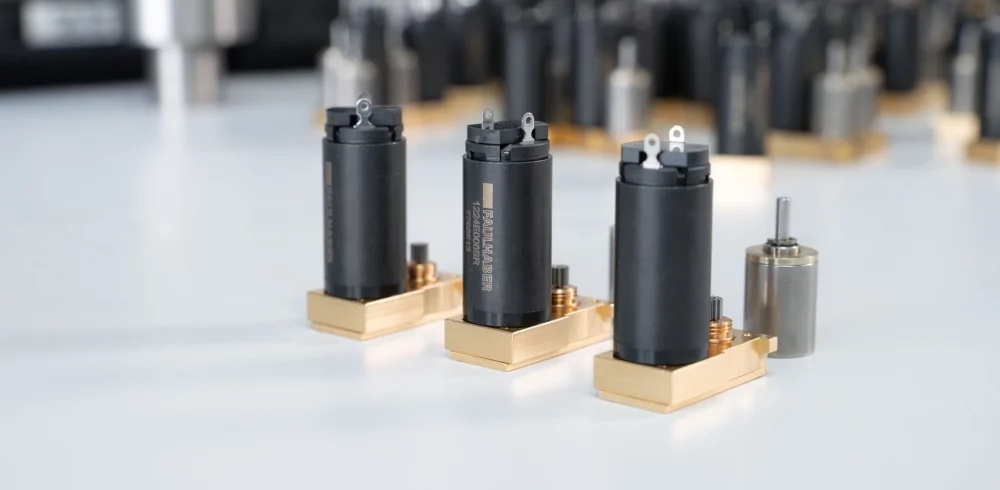
Whether it’s the whisper-quiet precision needed in medical devices or the durability required in aerospace applications, engineers face the challenge of finding drive solutions that meet exacting performance demands. The answer often lies not in compromise, but in fully customised gearbox design and manufacturing. Here, Chris Handcock, design lead at micro motorsupplier and custom gearbox manufacturer (EMS), deep dives into what it takes to create a custom gearbox solution.
When standard gearboxes aren’t enough
A fully custom gearbox is typically specified when the compromises associated with off-the-shelf products become unacceptable. Constraints around space, weight or cost often mean standard gearboxes meet individual requirements but fail to optimise overall system performance, particularly in compact or high-demand applications.
According to the Worldwide Industrial Single-stage Gearbox Market Research Report 2026, Forecast to 2032, from PW Consulting, “Over 60 per cent of end-users expressed a preference for customizable options that meet their unique operational requirements.”
Custom solutions are also required when applications demand materials or features not available in standard, off-the-shelf products. Harsh or specialised environments may require enhanced ingress protection, non-outgassing materials or application-specific lubricants. In many cases, customisation also enables functional integration, allowing multiple components to be consolidated into a single gearbox to simplify procurement, assembly and system design.
These requirements are crucial in sectors such as medical technology, where gearboxes must use non-corrosive materials, feature smooth, cleanable surfaces and minimise weight — particularly in handheld devices.
In response, customers rarely present with a fully defined specification. Instead, custom design begins by developing a system-level understanding of the application, using physical modelling and theoretical calculations to define key parameters such as loads, speeds, duty cycles and service life.
Where an existing solution is in place, it’s possible to reverse engineer and analyse real-world performance, often identifying quality or reliability issues caused by off-the-shelf gearboxes operating beyond their datasheet limits. By instrumenting systems with sensors and capturing operating data, we can develop an accurate specification within the constraints of the available space and system behaviour, enabling a robust, fit-for-purpose gearbox design.
Balancing compromise
Custom gearbox development is defined by a few recurring trade-offs — most commonly performance versus cost, and performance versus size or weight. Customers often seek high torque density, compact packaging and long service life, while also expecting it to remain at a competitive price. Managing these competing demands is a central part of the design process.
In Servo Gearbox Secrets 2025, author Mike Guilliford emphasised the growing importance of precision in modern gearbox technology, in which he said, “The demand for higher accuracy, efficiency, and reliability in components across industries is increasing — and gearbox selection is often underestimated.”
From a performance perspective, the gearbox must meet clearly defined requirements for load, speed and duty cycle. But achieving these targets has direct cost implications, particularly when bespoke components or high-end materials are required.
To manage this, EMS may look to reduce component count, limit the use of fully bespoke parts, or introduce proven proprietary components where appropriate. In some cases, functionality may be simplified to achieve a better balance between cost and performance.
This is where motor selection becomes a clear contributor to these trade-offs. High-performance motors can deliver the required power within tight spatial constraints, but their cost must be considered alongside the gearbox design. The final solution is often a system-level compromise rather than a gearbox-only decision.
Addressing design complexity
Constraints around size and weight create further complexity. Where the available envelope is fixed, maintaining performance may require adjustments elsewhere, such as reducing safety factors or optimising material selection. It’s possible to balance this through detailed verification calculations, ensuring that critical components such as gear teeth and bearings remain robust even when space is limited.
Safety factors are applied to account for real-world uncertainties that cannot be fully simulated, such as load variation, thermal effects and manufacturing tolerances. Gear teeth and bearings are typically designed with margins of 1.5 to 2 times the expected operating load, ensuring that stresses remain well below material yield limits. These margins are reviewed and refined during prototyping and testing, where designs can be reinforced if required.
Material choice also plays a key role in this balance. While commercial-grade steels are cost-effective and well understood, medical and aerospace applications often require lighter, corrosion-resistant or higher strength-to-weight materials, such as stainless steels or titanium alloys. These materials enable compact, lightweight designs but are more challenging to verify and manufacture, meaning that prototyping is used to confirm performance.
Validating performance
Simulation, prototyping and testing all play an important role in validating a custom gearbox design, but their effectiveness depends on how well the operating conditions are understood. Computational simulation can be valuable for analysing individual components or simplified load cases, such as gear tooth stresses or housing strength under known loads.
However, many applications involve complex duty cycles, shock loading, thermal variation and environmental factors that are difficult to model accurately. As a result, simulation outputs are only as reliable as the input data, something that is not always available at the early stages of development.
For this reason, production-representative prototyping and real-world validation are critical. Specifically, EMS focuses on developing prototypes intended to operate as they would in service, rather than proof-of-concept models optimised purely in software. By validating gearboxes within the customer’s actual application, issues can be identified that would be extremely difficult to predict through simulation alone. Take for example failures that occur only under specific environmental or operational scenarios.
Testing is often accelerated to condense years of operation into shorter timeframes, using representative loads, speeds and control electronics. This approach allows the performance, durability and failure modes to be assessed realistically, while accounting for many of the variables present in real use. Depending on the programme, EMS may validate defined aspects of the specification internally, while customers carry out broader system-level testing.
This aligns closely with our goal of designing the gearbox as part of a complete drive system, rather than treating the gearbox in isolation. Custom drive solutions allow the gearbox to be matched precisely to the motor’s operating characteristics, whether the customer’s priority is maximum power density, high efficiency or long lifecycle.
For instance, a motor may be capable of delivering high power within a small envelope, but achieving long life may require operating it at a lower speed and selecting a gearbox ratio that shifts the operating point accordingly. This means that bearing arrangements, lubrication strategy and housing design are all selected to support these operating conditions.
At the mechanical interface level, custom housings can be designed to integrate directly with the customer’s subsystem, eliminating the need for adaptor plates or secondary fixtures often required with off-the-shelf gearboxes. This consolidation improves alignment, reduces assembly complexity and enhances overall system robustness to produce a gearbox that works seamlessly in the required application.
As with many high-performance applications, the challenge lies not in meeting one requirement, but in balancing many. The trade-offs between performance, size and cost demand careful system-level decision-making, rather than isolated component optimisation. When managed correctly, this complexity becomes the key to achieving reliable, application-specific performance from concept to completion.
To discuss your gearbox requirements with a member of the team, visit the website to contact us.
Manufacturing & Engineering Magazine | The Home of Manufacturing Industry News