

Small and medium-sized manufacturing companies are facing increasing demands: components are becoming more complex, product variants are on the rise, delivery times remain tight, and skilled workers must be deployed in ways that maximise value creation. As part of Machining Transformation (MX), DMG MORI combines process integration and automation into a practical approach for greater productivity and flexibility in CNC manufacturing—from the complete machining of varying components to holistic automation. The key to success lies not solely in the individual machine, but in a holistic view of the process chain. Wherever components must be re-clamped or manually moved between staging, and the machine, this results in time losses and quality risks. Personnel expenses are also higher. Process-integrated machining reduces these process interruptions in the workspace. Automation solutions such as the MATRIS WPH reduce repetitive manual interventions around the work area.
MATRIS WPH: Flexible automation solution for varying orders
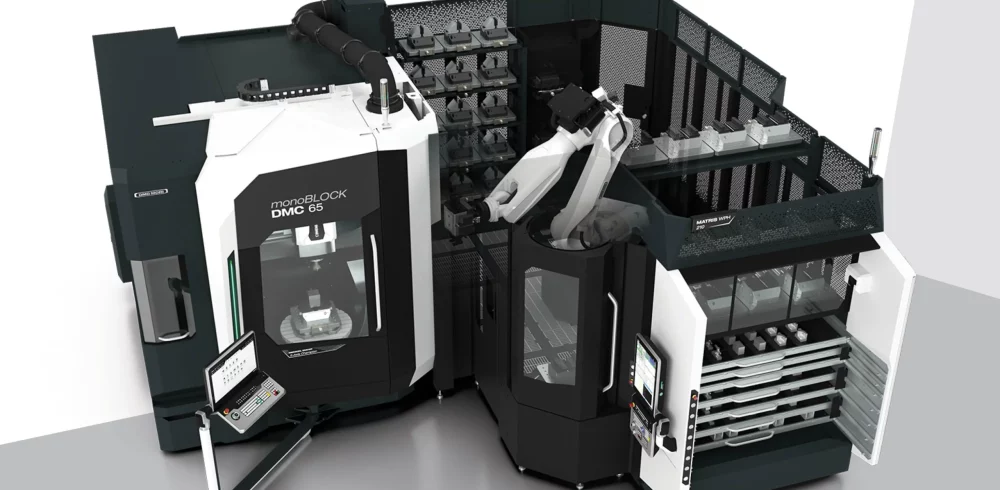
For many small and medium-sized businesses, automated workpiece and pallet handling is a realistic first step toward achieving optimal machine utilization especially when machine uptime and material supply need to be better coordinated. The question of whether the focus should be on workpieces or pallets is often determined by the order situation. If order volumes vary significantly, the automation system must also be flexible. This is where the MATRIS WPH from DMG MORI comes into play, as it integrates both workpieces and pallets into a single system. This makes it particularly suitable for production environments with varying product variants and batch sizes: workpieces and pallets can be flexibly fed, stored, and integrated into the machining process.
The MATRIS WPH models can be installed, for example, on machines designed for 5-axis machining, such as the DMU 50 3. Generation, the DMU 60 eVo 2. Generation, and the DMC 65 / 75 monoBLOCK 2. Generation. They are also compatible with the vertical machines of the NVX and CMX V series. The current models, the MATRIS WPH 70 and MATRIS WPH 210, are designed for different transfer weights, workpiece sizes, and pallet configurations: The smaller model has a transfer weight of up to 35 kg and a maximum pallet size of 400 x 400 mm. The MATRIS WPH 210 handles up to 135 kg and pallets measuring 500 x 500 mm. For small and medium-sized businesses, the key factor is not maximum interconnection, but a scalable automation path: from manual setup through automated workpiece and pallet handling to flexible material supply.
Manufacturing & Engineering Magazine | The Home of Manufacturing Industry News