


Manufacturers understand what it takes in materials, labour and overhead to make what they sell. Depending on the product and manufacturing cycle, that is a simple one-off calculation or a running total tracked by a costing system. Not knowing your cost per unit shipped can mean nasty surprises in the year-end accounts. GreenFeet, powered by calQrisk, explain more.
Parallel to the manufacturing process runs a carbon emissions cycle: the inputs generating CO2e are the same as the other, more tangible inputs. Visualise your product surrounded by a cloud — the size of that cloud in greenhouse gases is carbon accounting, and in many ways it mirrors financial accounting.
Two lenses on the same product: the inputs, process and output are shared, only the unit of measurement changes.
Knowing the numbers matters: once you have them, you can look for ways to reduce them. General operations emissions are easy to calculate; it gets tougher with Scope 3, the product itself. Each item in the bill of materials has an emission factor — the CO2e it emits per unit of measure. Multiply the emission factor by weight or quantity for the material emissions, and total every material to get the product’s overall emissions factor.
Carbon accounting is becoming as important as fiscal accounting.
A UNEP report confirms the world will miss the 1.5°C limit agreed at the Paris COP in 2014, with 1.8°C now the likely peak. It calls for refocussing to “limit the overshoot” and, eventually, begin lowering it — effectively an acknowledgement that efforts so far are not enough.
Carbon accounting is becoming as important as fiscal accounting, and the pressure on manufacturers to know their numbers — and to reduce, eliminate or offset them — is now firmly on the horizon.
Reduction, elimination or offsetting are decisions you can make once you have informed data. We work with businesses at every stage of net zero or carbon neutral planning, from initial baseline through to offset purchase.
With good data you can establish an intensity metric for your production, just as you would for costs. There are several options, but the benefit is being able to measure the impact of your carbon management decisions over time.
Example: virgin vs. recycled PET
- Virgin PET (vPET) is made from petroleum feedstock, carrying the full upstream burden of oil/gas extraction, refining, and polymerisation. Cradle-to-resin emission factors are typically cited around 2.0–2.5 kg CO₂e/kg resin, varying by region, energy mix, and study.
- Recycled PET (rPET), especially mechanically recycled, skips most of that upstream chemistry — mainly collection, sorting, washing, and reprocessing. Emission factors are typically much lower, often around 0.3–1.0 kg CO₂e/kg, depending on the recycling process and how collection and transport are allocated.
For 10 tonnes (10,000 kg) of resin, the same emission-factor ranges work out as follows:
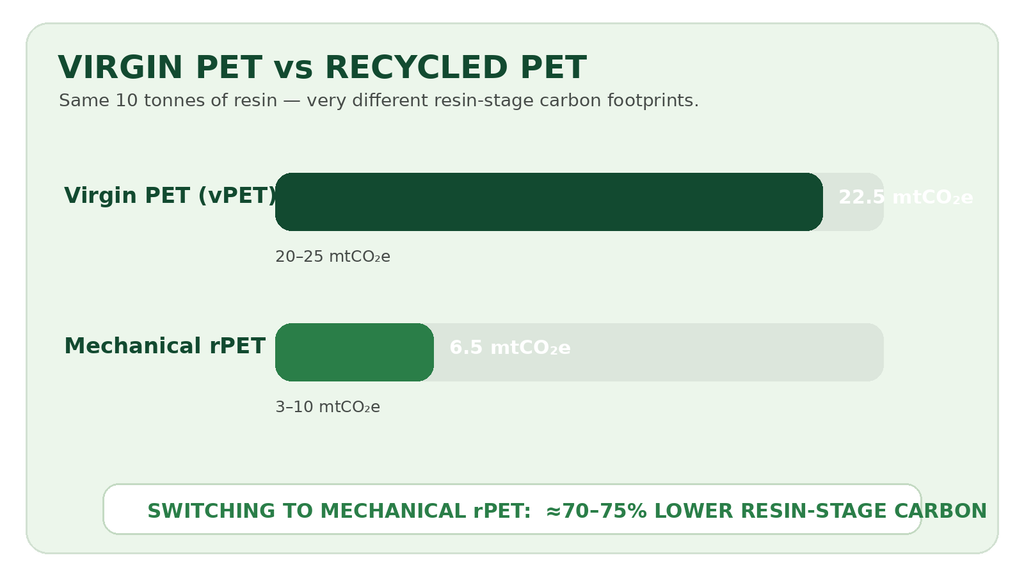
Illustrative resin-stage comparison for 10 tonnes of PET, using the emission-factor ranges stated in the article.
| Resin type | Factor (kg CO₂e/kg) | Total (10 t resin) | Midpoint |
| Virgin PET (vPET) | 2.0–2.5 | 20–25 mtCO₂e | 22.5 mtCO₂e |
| Recycled PET – mechanical | 0.3–1.0 | 3–10 mtCO₂e | 6.5 mtCO₂e |
The headline number: for the same 10 tonnes of resin, switching from virgin to mechanically recycled PET cuts the resin-stage carbon footprint by roughly 70–75% — from an estimated 22.5 mtCO₂e down to about 6.5 mtCO₂e, a saving of around 16 mtCO₂e. The same principle applies everywhere: multiply an emission factor by a quantity, and one sourcing decision can move your whole product’s Scope 3 number.
In short: know your numbers, know where the biggest carbon — and cost — trade-offs sit, as the PET example shows, and build a practical plan to reduce, eliminate, or offset what’s left. It’s the same discipline as fiscal accounting, just measured in CO₂e instead of currency.
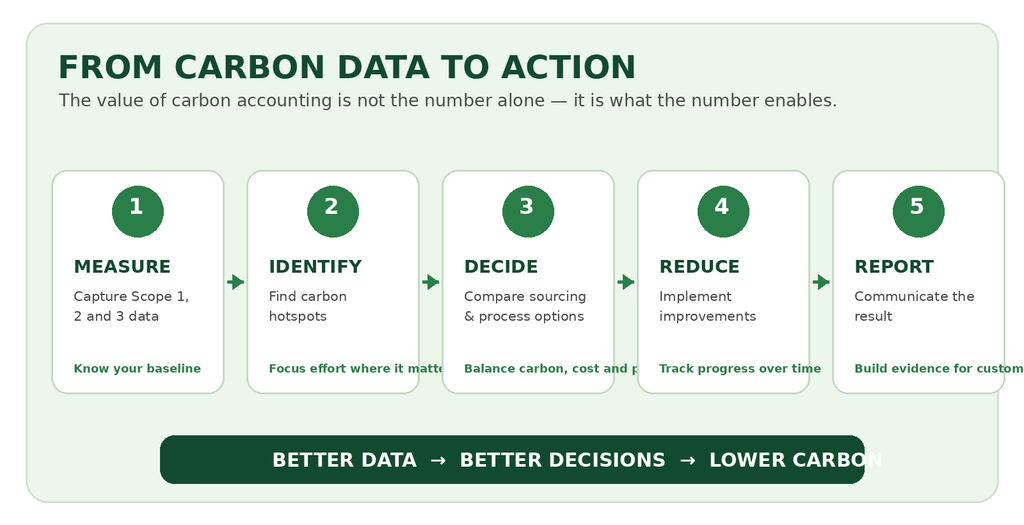
From measurement to action: the practical carbon-management cycle.
GreenFeet offers manufacturers a practical, ongoing framework for managing and reducing carbon emissions across their operations. The engagement begins with measuring and monitoring emissions — capturing Scope 1 and 2 data directly within the GreenFeet platform, while Scope 3 emissions across the supply chain are tracked through structured data collection. A core part of the service is completing product-level Life Cycle Assessments (LCAs), which help identify carbon hotspots across raw materials, product design and manufacturing.
To learn more about what we do, or to sign up for our services, please scan the QR code below, or visit our website at: https://www.calqrisk.com/platform/ use-cases/esg-climate-sustainability
Manufacturing & Engineering Magazine | The Home of Manufacturing Industry News