

When GS Yuasa Battery Europe Ltd opened its UK base in Swindon in 1981, the company’s logistics operation reflected the needs of a much smaller business. Two separate warehouses, located several miles apart, handled industrial and automotive battery products independently. Over time, however, demand surged across both sectors and the limitations of the split-site arrangement became impossible to ignore.
Today, GS Yuasa is Europe’s leading manufacturer and supplier of automotive and industrial batteries and accessories, supported by a state-of-the-art manufacturing facility in Ebbw Vale and distribution hubs in Milan, Lyon, Madrid, Düsseldorf and Swindon. As volumes increased, the company needed more than extra space – it needed a warehouse operation designed for speed, accuracy, safety and long-term scalability.
Building for the future
After a comprehensive review of its operational needs, GS Yuasa made a decisive move: consolidate the two Swindon warehouses into a single purpose-built facility capable of supporting future growth for years to come.
Finding suitable modern warehouse space in Wiltshire proved difficult, so the company opted to commission an entirely new building tailored to its exact requirements. Construction began in 2022, and the result is a 180,000 sq ft logistics hub designed from the ground up around high-density storage and advanced automation.
But a large building alone was not enough. The challenge was to maximise every square foot while dramatically improving throughput and inventory accuracy.
Toyota’s automation solution
To achieve this, GS Yuasa partnered with Toyota Material Handling UK Ltd, awarding the company the contract to design and implement a complete intralogistics solution.
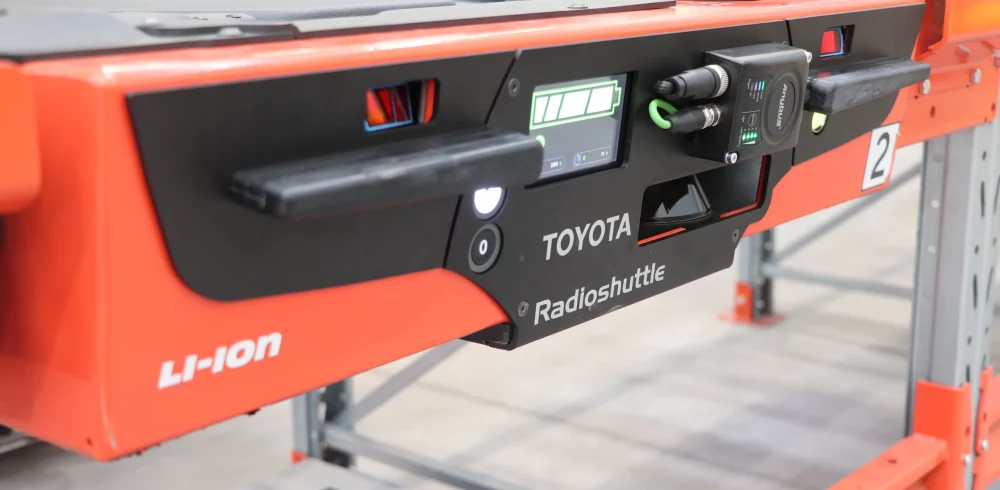
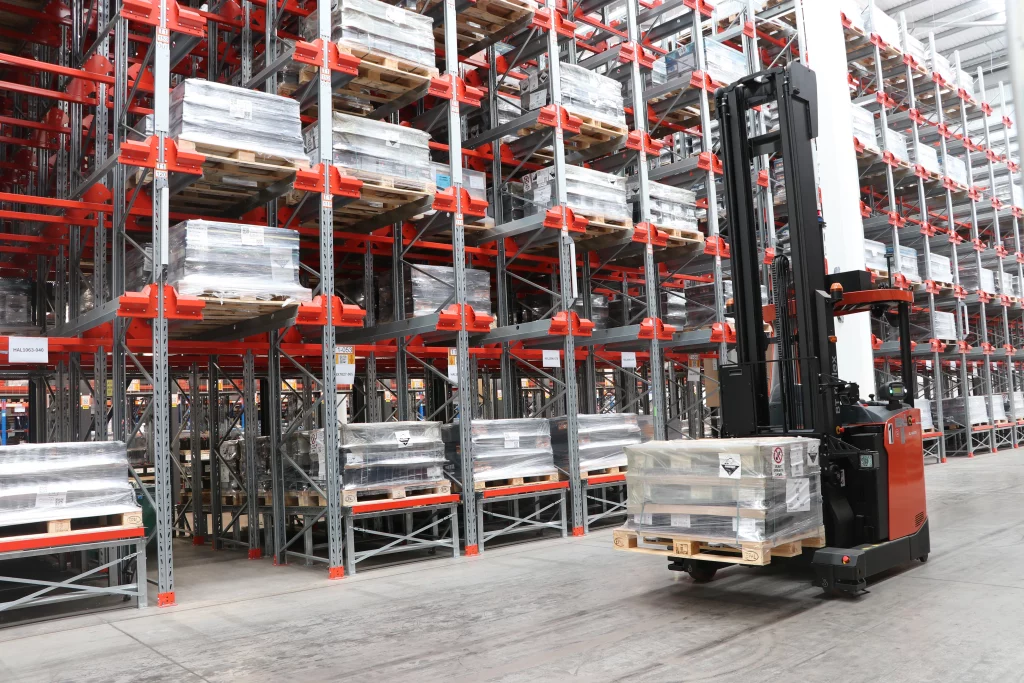
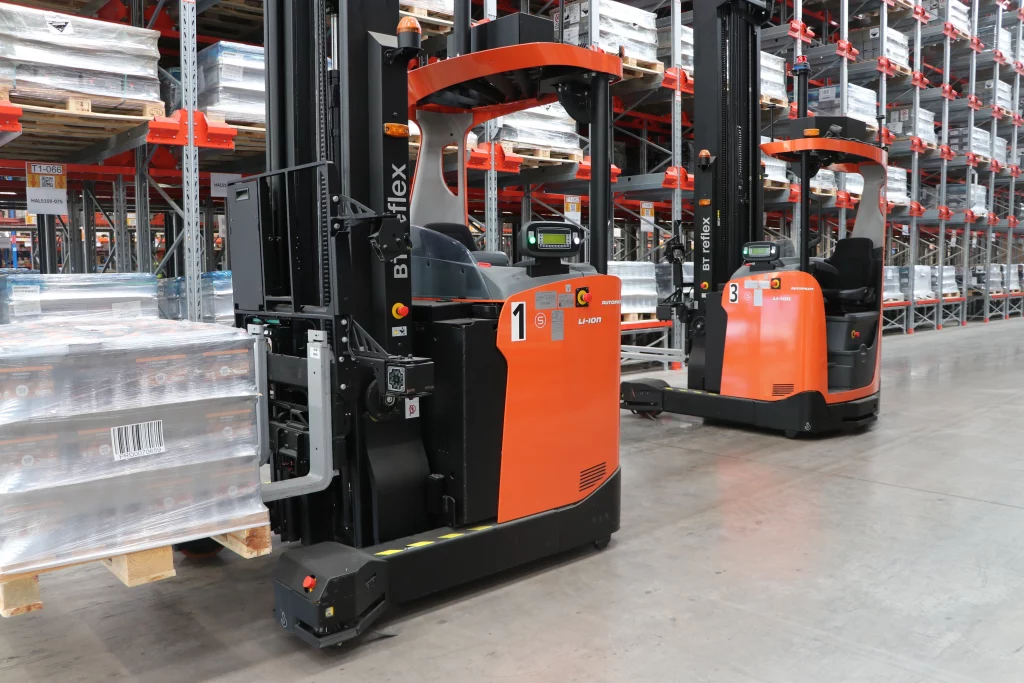
Toyota proposed a system centred on two key technologies: high-density pallet racking served by RadioShuttle pallet transfer technology, and automated reach trucks (AGVs).
The combination has fundamentally transformed pallet storage and retrieval. What was once a labour-intensive forklift operation is now a highly automated process that is faster, safer and significantly more cost-efficient.
The bespoke racking system installed by Toyota’s automated project division provides storage capacity for an extraordinary 900,000 batteries. Automated reach trucks move pallets to and from the racking system, while RadioShuttles transfer pallets deep into storage lanes with precision and consistency.
For GS Yuasa, the impact has been immediate.
“We are storing more batteries than we have ever stored,” says Danny Sturgeon, Yuasa’s Production & Automation Manager. “The level of capacity Toyota has achieved means we now have 100 percent stock availability, so our customer service offering is even better than it ever has been.”
A safer, smarter picking operation
The new warehouse has also simplified day-to-day operations for staff. Previously, pickers travelled long distances between locations in different zones. Now, all order picking takes place within a single ground-level area known as the “picking tunnel.”
Because the tunnel is designated for pedestrians only, lift trucks are excluded from the area, creating a much safer working environment. At the same time, shorter travel distances have improved picking efficiency and reduced operator fatigue.
“The new storage solution has not only maximised our capacity, it has also provided a far more straightforward picking process,” explains Sturgeon. “Our warehouse staff no longer have to walk long distances between pick locations, and the order-picking function has become much safer.”
Automation has delivered workforce benefits too. Automated reach trucks can operate continuously without breaks or stoppages, allowing GS Yuasa to redeploy forklift operators into other areas of the business. In addition, accidental stock damage during pallet put-away and retrieval has been virtually eliminated.
High-volume performance
The scale of the operation is striking. The warehouse is capable of picking, packing and dispatching 50,000 batteries per day, equivalent to roughly 15 to 20 full lorry loads.
The system currently uses six RadioShuttles and six automated reach trucks to manage replenishment and pallet movement throughout the storage system. It is the first project of its kind to combine both technologies in a single integrated operation.
Designed for long-term growth
For GS Yuasa, the investment was not simply about solving today’s capacity issues. The new facility was designed to support continued expansion well into the future.
“We are absolutely delighted with everything the project has given us,” says Sturgeon. “We have increased productivity massively. Having the capacity to store 900,000 batteries and the ability to ship 50,000 batteries a day is absolutely incredible and means we can meet the daily demands of our customers. And, what’s more, we’ve got enough room to support the business as it grows for at least another 15 years.”
The partnership between Toyota Material Handling and GS Yuasa demonstrates how automation can do more than improve efficiency. When designed around operational goals, it can reshape workflows, enhance safety, strengthen customer service and create the headroom needed for sustained growth.
Manufacturing & Engineering Magazine | The Home of Manufacturing Industry News