

Manufacturing has long had a hierarchy problem. It tends to celebrate the dramatic moments (the cut, the cast, the mould, the print, the assembly) while sometimes treating polishing and grinding as something that happens afterwards, somewhere downstream, in the realm of tidying up. That is less true today in well-planned conventional production environments, particularly in larger organisations, but it still surfaces often enough, especially where finishing is treated as a standard follow-on step rather than a strategic process in its own right.
Because in many industries today, the surface is not cosmetic. It is functional. It governs friction, sealing, cleanliness, coating adhesion, fatigue behaviour, corrosion resistance, biocompatibility, and perceived quality. A part can be dimensionally “made” and still be commercially or technically unfinished. In that sense, polishing and grinding are not secondary processes at all. They are where manufacturing proves itself.
That is the perspective companies such as Rösler bring to the discussion. The company’s positioning has long been grounded in the reality that surface finishing is not a niche activity but a cross-industry production discipline, with applications ranging from aerospace and medical technology to automotive, tooling, and jewellery. Rösler’s own description of mass finishing reflects this breadth, deburring, descaling, rust removal and polishing across metals, plastics, ceramics and other materials, with what we describe as more than 1,000 surface-finishing options.
That breadth matters because the conversation around polishing and grinding is changing. In conventional manufacturing, most serious producers already understand that surface finishing is necessary. The greater challenge now is not proving that finishing matters, but proving why the right finishing technology, process route, and partner deliver a measurably better outcome than alternative approaches. The new reality is that they increasingly sit at the intersection of productivity, sustainability, part performance and process control.
One of the most important shifts in industry is that surface quality is no longer judged only by eye. It is judged by what it enables.
In medical applications, for example, preferred finishing methods include deburring, surface grinding, smoothing, polishing, and surface texturing because these affect cleanliness, wear behaviour and functional performance. In defence and aerospace, surface smoothing and polishing are tied directly to fatigue resistance, corrosion behaviour, and coating performance. In tooling and transmission components, edge radiusing, polishing, and controlled grinding influence friction, durability, and dimensional consistency.
This is why polishing and grinding have become more strategic, not less. For many manufacturers they have long been recognised as necessary, but the more advanced view is to see them not simply as required process steps, but as levers for improving quality, throughput, consistency, and total manufacturing performance. They are no longer processes you bolt on when the part is already complete. Increasingly, they are part of how the part is engineered to succeed in service.
That shift also explains why more manufacturers are moving away from loosely controlled manual finishing. Manual grinding and polishing will always have their place, particularly in repair, prototyping, and one-off work. But as quality standards tighten and labour becomes both scarcer and more expensive, the limitations of manual methods become more obvious, including inconsistency, high operator dependency, variable cycle times, and difficulty scaling.
The most dynamic trend in polishing and grinding is not simply “better machines.” It is the push toward repeatability.
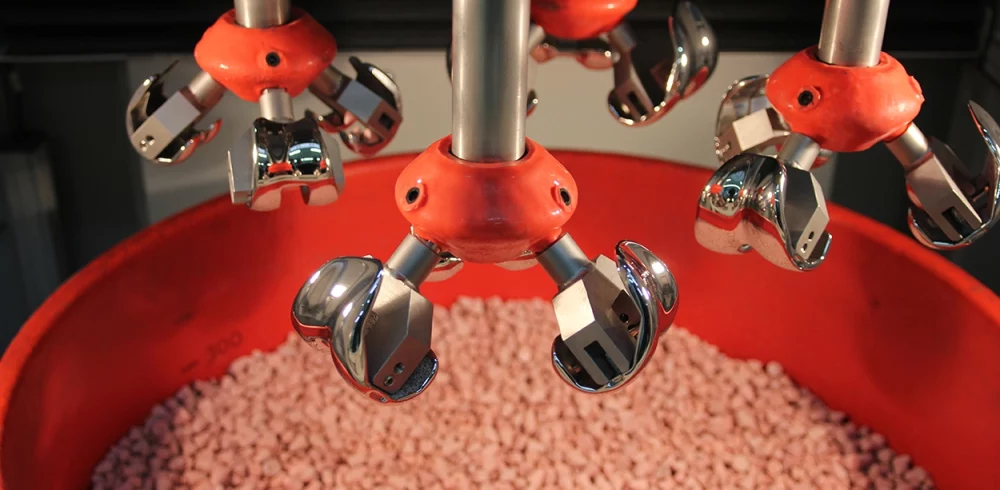
Rösler’s drag finishing systems, for instance, are positioned for high-value, delicate and geometrically intricate components where parts must not touch each other during processing, and where precise, targeted surface finishes are required. We maintain that drag finishing can achieve up to 40 times higher processing intensity than traditional mass finishing, which points to a broader industrial reality, finishing must now deliver both precision and productivity.
The same applies to high-energy disc systems, which are suitable for deburring, edge radiusing, surface grinding, and polishing of stampings, castings, forgings and machined parts. The attraction here is not novelty for its own sake. It is the ability to compress process times while maintaining predictable results , exactly the kind of capability modern manufacturers increasingly demand.
Continuous-flow systems point in the same direction. These systems are highly productive, cost-efficient, and automatable, suitable for continuous deburring, ball burnishing, grinding and polishing. That is not just a machine story, it is a manufacturing story. When surface finishing can be integrated into a flow production environment rather than treated as an isolated batch bottleneck, it changes the economics of the whole line.
This is one of the biggest trends likely to shape the future, polishing and grinding becoming more deeply integrated into automated and semi-automated production systems, rather than being left as artisanal islands of manual intervention.
Another major shift is environmental pressure. Surface finishing has historically carried a reputation for high media use, water consumption, and messy process by-products. That reputation is one reason some manufacturers still underestimate how far the field has evolved.
Rösler’s own materials place strong emphasis on process-water cleaning and recycling, particularly via centrifuge systems that can clean and recycle industrial liquids and reduce water consumption by up to 90%. That is significant not only from a sustainability perspective but from a cost and uptime perspective too. The future of polishing and grinding will belong increasingly to processes that can prove they are resource-efficient as well as technically effective.
This matters because sustainability in finishing is rarely about grand claims. It is about practical things like less media wear, closed-loop water systems, lower rework rates, fewer rejected parts, shorter cycle times, and less operator exposure to dirty or unstable processes. In other words, the greener process is often also the more disciplined one.
This is where partner choice becomes critical , and where the pitfalls of working with the wrong supplier become more serious than many buyers realise. The issue is not whether finishing is important, most manufacturers know that it is. The real issue is whether they are working with a partner capable of delivering a better, more robust, and more economical result than the alternatives.
The wrong finishing partner may be able to sell a machine. That is not the same as delivering a process. If media, compounds, water treatment, part presentation, automation logic, and application knowledge are not aligned, the result is often predictable, unstable quality, excessive wear, high consumable costs, avoidable rework, over-processing of edges or surfaces, and a finishing stage that becomes a permanent source of frustration rather than competitive advantage.
Rösler’s long-standing argument (implicit across its machine, consumables and systems) is that surface finishing works best when equipment, media, compounds and process engineering are treated as one ecosystem, not separate purchases. We have a consumables portfolio of around 15,000 products, including ceramic and plastic grinding and polishing media, compounds and process-water cleaners, which underlines an important truth, the finishing result is rarely determined by the machine alone.
This is also why pedigree matters. A company with decades of finishing experience is more likely to recognise where a surface requirement is being over-specified, where a process can be simplified, where throughput is being lost, or where a different combination of media and chemistry will solve a problem faster than brute-force machine changes. Experience here is not a marketing flourish. It is risk reduction.
Colin Spellacy, Head of Sales, Rösler UK
For more information, visit: www.rosler.com
Manufacturing & Engineering Magazine | The Home of Manufacturing Industry News