

Global infrastructure is under increasing strain. Systems are aging, climate stress is growing, and demands keep rising. The problem is that infrastructure deterioration is often slow and rarely shows up all at once and is not always obvious. Problems build over time through ground movement, environmental exposure, operational load, or encroachment.
The financial stakes are huge. The World Bank puts the cost of inaction in the trillions and says every dollar invested in resilience can return four in avoided losses. In the UK, the Institution of Civil Engineers says precursor events should not be ignored, with early warning signs often missed until failure forces attention. With the UK moving ahead with its £725 billion infrastructure plan, monitoring investment on that scale must not be dependent on infrequent periodic checks alone.
This gap is showing up globally – assets are rarely monitored as often as they should be. The American Society of Civil Engineers, for instance, in its 2025 Infrastructure Report Card, warned that aging systems are increasingly “vulnerable to natural disasters and extreme weather events,” creating avoidable risks to the economy. A primary driver of this is the “unreliable or unavailable data on key performance indicators” across the sector. Without this data to quantify “signs of significant deterioration,” investment is delayed and problems become exponentially more expensive to fix.
The Shift to Satellite Observation
Inspection cycles, field visits, and sensor networks remain important, but for large and distributed infrastructure, they are both hard to do and not enough. Assets cannot be inspected continuously from the ground and manual methods are harder to sustain as networks become larger
Satellite-based observation helps fill those gaps. Operators can monitor dispersed infrastructure more regularly without depending on physical access every time.
As a result, satellite data is becoming a more useful operational input for infrastructure monitoring, especially where access on the ground is challenging.
From Observation to Measurement
Infrastructure monitoring can now feed predictive models, automated systems, and AI-based workflows. In such systems, a simple snapshot is not enough; data must be frequent and accurate.
Imagery alone has limits and it would be wrong not to recognise that. Observations of the same location can and do vary from one pass to the next. Acquisition time, viewing angles and atmospheric conditions all vary; and sensor response is not identical. These differences will show up in the data even when nothing has actually changed on the ground. A human analyst may be able to interpret around them, but automated systems may not, although, as more and more data is obtained systems can be trained. To aid interpretation, data should be cleaned, aligned, and corrected to be consistent enough to compare over time.
Across large monitoring programs, post collection analysis can consume a lot of resource but quality data will help mitigate the problem
Measurement Depends on Persistence
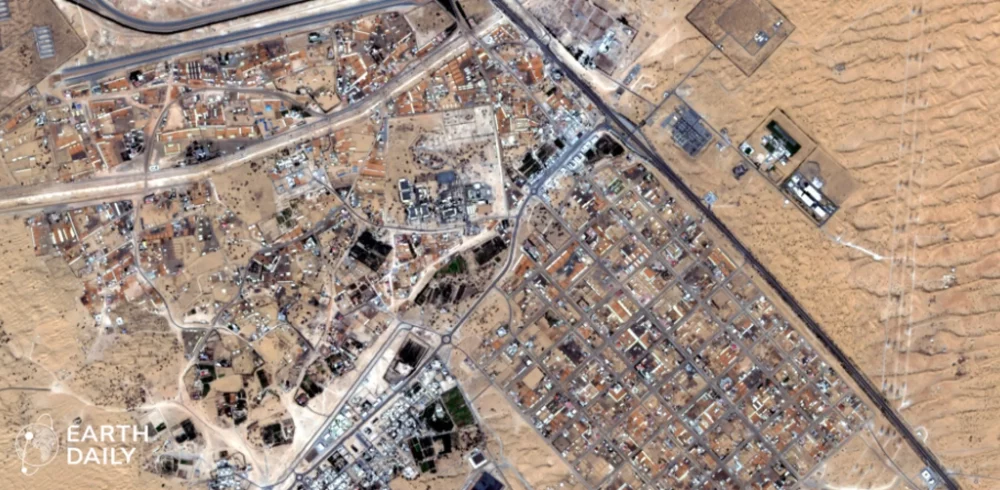
Infrastructure rarely fails without warning. The signals are almost always there: small shifts in ground conditions, gradual vegetation growth, thermal variation, early-stage encroachment. They are easy to miss when observations are irregular or hard to compare but Persistent observation makes those signals easier to detect. The EarthDaily constellation is built around delivering the kind of data continuity that makes it easy to catch change early, before failure is normally visible and well before the next inspection cycle comes around.
Satellite data is no longer sitting on the sidelines. It becomes part of how operators track asset condition, risk, and maintenance across large networks.
Author bio
Peter Round is Head of Europe and Global Vice President, Business Development – Defence & Intelligence at EarthDaily. A retired senior officer of the UK Armed Forces, he served for 33 years, including postings in the United States and Brussels. He represented the UK at NATO Supreme Allied Command Transformation in Norfolk, Virginia, and later served as Capability Director at the European Defence Agency, leading more than 100 multinational capability and research programmes. He is a Fellow and Chair of Trustees of the Royal Aeronautical Society and a Consulting Senior Fellow at the International Institute for Strategic Studies.
Manufacturing & Engineering Magazine | The Home of Manufacturing Industry News