


~ How geopolymers alleviate pressure from contractors working on road maintenance ~
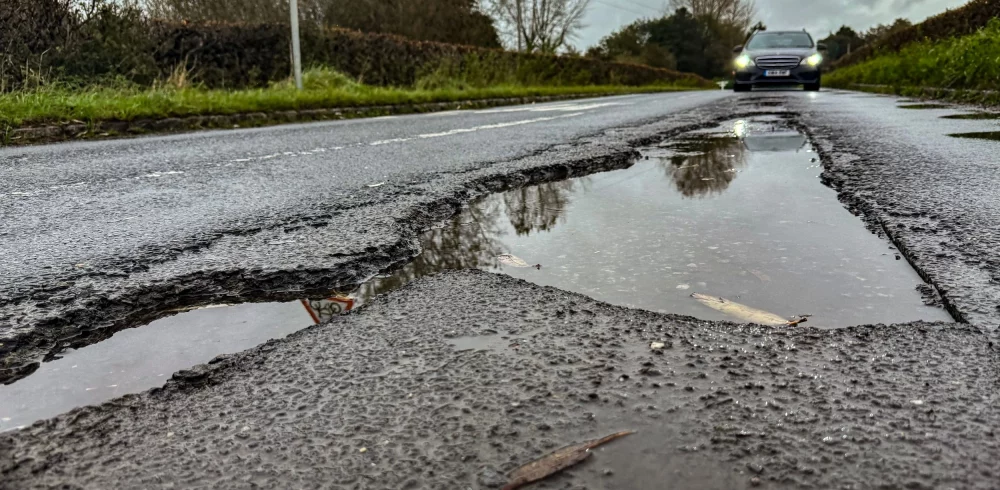
The estimated cost of a one-off repair of all potholes rose by £1.8 billion since the start of 2025, contributing to vehicle damage to UK drivers. Contractors are routinely under pressure to tackle the backlog while managing traffic management systems and limited budgets. Here, Adam Thomas, infrastructure engineering manager at geotechnical expert Geobear, explores how geopolymer ground remediation can help address the 12 year maintenance backlog without increasing delays for commutators and businesses.
The maintenance backlog lengthens journey times for commuters and businesses across the country. In 2025, the AA reported that major road arteries in England are becoming increasingly clogged with the average delay reaching 11.6 seconds per vehicle per mile. The delay has risen 5.5 per cent from 2024, highlighting a growing concern for everyday commuters.
The trend in rising annual delays adds significant pressure on contractors, who are tasked with closing the maintenance backlog while facing routine criticism for disruption to major road networks.
Are traditional methods causing more harm?
Road maintenance is traditionally addressed with deep engineering treatments involving cement, concrete and steel. Typically, these methods require large-scale excavation and complete reconstruction with sizeable on-site teams and long project timelines.
Cement and concrete techniques introduce significant delays to live road environments as excavation makes lane closures unavoidable. Traffic management systems are required in many cases, and projects are often phased to maintain some level of access for road users.
For contractors, phased works stretch project timelines, adding to the complexity and duration of remediation. Delays quickly accumulate during this time, slowing any efforts to address wider maintenance backlogs.
Reclaiming time with alternative methods
As pressure to close the maintenance backlog grows, contractors are pushed to find alternative options to reduce project duration without compromising reliability. Geopolymer remediation offers an alternative solution that addresses many pain points of traditional methods. A small team of technicians drill into targeted points from the surface to inject a specialised resin, which expands to fill underground voids and stabilise foundations.
No excavation or heavy machinery is required prior to injections, allowing contractors to keep lanes active while works take place. For contractors, this means fewer lane closures and simpler traffic management, alleviating disruption and allowing for a more streamlined project delivery.
Geopolymer resin also hardens immediately once injected, reaching maximum strength and remediating ground issues faster than concrete techniques. Roads can be reopened sooner as no cooling-off period is required, enabling contractors to shorten overall project timelines.
Cutting project timelines: M11 case study
Routine inspections and ground investigations highlighted embankment issues at the M11 overbridge and voiding beneath the carriageway. If left untreated, the defects could have caused severe settlement or even collapse, threatening usability and safety of the motorway.
As one of the busiest corridors in the East of England, road closures would have affected the M11, A14, and A428, disrupting commuters and freight movement to Stansted and surrounding ports. A non-intrusive ground engineering technique was required to minimise disruption and keep traffic flowing.
Geobear injected resin beneath the carriageway, rapidly restoring stability across the area. The works were completed two days ahead of schedule, within budget, and with no safety incidents. By avoiding excavation, the project saved at least five weeks of disruption and cut carbon emissions by 45 per cent compared to cementitious alternatives.
Karl Brooks, project sponsor from Highways England highlighted the success of the project: “Geopolymer injections provided an innovative response to voiding, and the delivery outperformed comparative methods.”
Innovative ground engineering techniques such as geopolymer offer contractors the opportunity to shorten project timelines, decrease road closures and delays and tackle the maintenance backlog.
To discover more about how Geobear can assist road maintenance issues, read more on its website here.
Manufacturing & Engineering Magazine | The Home of Manufacturing Industry News