



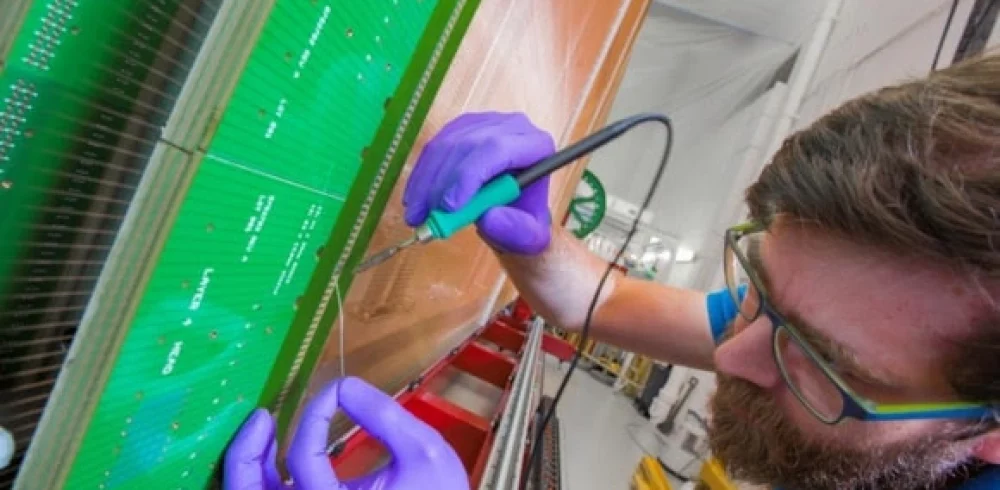
Crucial components built by engineers at STFC’s Daresbury Laboratory, have arrived at Fermilab in the United States, marking the first direct shipment of these detector components from the UK to the international DUNE experiment.
The anode plane assemblies (APAs) are being produced at the Science and Technology Facilities Council’s (STFC) Daresbury Laboratory as part of the Deep Underground Neutrino Experiment (DUNE).
DUNE is a major international science project under construction in the United States. It will will send a beam of neutrinos 1,300 kilometres across the country in a mission to explain why the universe is made of matter rather than antimatter.
The arrival of the first four APAs at Fermi National Accelerator Laboratory (Fermilab) represents a key milestone for the UK’s contribution to the experiment.
UK production milestone
The shipment comes as Daresbury Laboratory, at Sci-Tech Daresbury in the Liverpool City Region, reaches a significant production target.
Teams at the site have now completed 50 APAs out of the 137 that the UK is responsible for delivering to the project, which requires 150 APAs to function.
Each APA is a large rectangular detector frame measuring approximately 6.3 metres tall by 2.3 metres wide. Around 24 kilometres of ultra-fine copper-beryllium wire is wound across each frame in multiple directions. The wires, about the width of a human hair, are tensioned and then secured with thousands of hand-soldered connections.
These assemblies form the sensitive detection planes inside DUNE’s liquid-argon detectors, where they will record the electrical signals produced when neutrinos interact with the detector.
Big detectors, big logistics
The scale of the APAs presents significant challenges for storage and transport. Each unit is comparable in height to a two-storey building and must be handled with extreme care to protect the delicate wire planes.
For the transatlantic journey, over 6,000km in total, the four APAs were mounted inside two specially designed shipping frames. These protective structures keep the large, fragile assemblies rigid and secure during transport. They equipped with 16 sensors between them, measuring shock, vibration, tilt, temperature, humidity, and location.
Because of their size, the frames must be carried on a dedicated 60-foot transport platform when shipped by sea. Even this relatively small shipment required a full-length maritime transport unit to move the components safely across the Atlantic.
First direct shipment to the US
While earlier APAs were transported to CERN for testing and trial shipments, this is the first time completed units have been sent directly from the UK to Fermilab.
Once at Fermilab, they will undergo testing before being prepared for installation in the DUNE Far Detector 1 at the Sandford Underground Research Facility in South Dakota.
A global experiment to answer fundamental questions
DUNE is one of the most ambitious particle-physics experiments ever constructed. It will send a beam of neutrinos from Fermilab in Illinois to a detector complex located 1,300 km away at the Sanford Underground Research Facility in South Dakota.
By comparing the properties of the neutrinos at the source and at the far detector, scientists hope to answer some of the most fundamental questions in physics. The experiment aims to explore why matter dominates over antimatter in the universe, study the behaviour of neutrinos, and observe signals from supernovae.
The detectors will contain tens of thousands of tonnes of liquid argon, with the APAs acting as the sensitive readout planes that capture the faint electrical signals produced by neutrino interactions.
A proud milestone
Ian Lazarus, Head of Technology at STFC’s Daresbury Laboratory, said:
“The arrival of the four APAs at Fermilab in the US represents a key milestone for the UK’s contribution to the Deep Underground Neutrino Experiment. These components will now undergo testing at Fermilab before being installed in the enormous underground detectors that form the heart of DUNE.”
“The arrival of the UK-built anode plane assemblies at Fermilab in the USA is not only a source of pride amongst the DUNE team at Daresbury, it is an exciting example of international collaboration in action. This now opens the way for the UK’s continued delivery of detector planes to the United States, underlining the strength of our engineering expertise and our important role in the development of one of the most ambitious physics experiments ever constructed.”
Planning, precision and coordination
Dr Radosav Pantelic, Lead Engineer for the DUNE project at STFC’s Daresbury Laboratory, said:
“Reaching this point is the result of meticulous planning, precision engineering and close coordination with our partners in the United States.
“Designing and preparing detector components of this scale and sensitivity for their journey overseas has required extraordinary care and teamwork, and I’m immensely proud of the dedication and expertise shown by our engineers and technicians at Daresbury Laboratory.
“This first direct shipment marks the start of many shipments for DUNE, with many more APAs set to follow in the months ahead.”
UK role in DUNE
The UK is responsible for building the majority of the APAs required for the experiment. In addition to the detector planes, UK teams are also contributing to other major components of the DUNE and Long-Baseline Neutrino Facility infrastructure.
Manufacturing & Engineering Magazine | The Home of Manufacturing Industry News