

Workplace safety has never been more under the microscope at the executive level, with increasing levels of legislative scrutiny. Supporting leaders and managers across the production or manufacturing floor, the arrival of smart automation provides a step-up in insight and coverage.
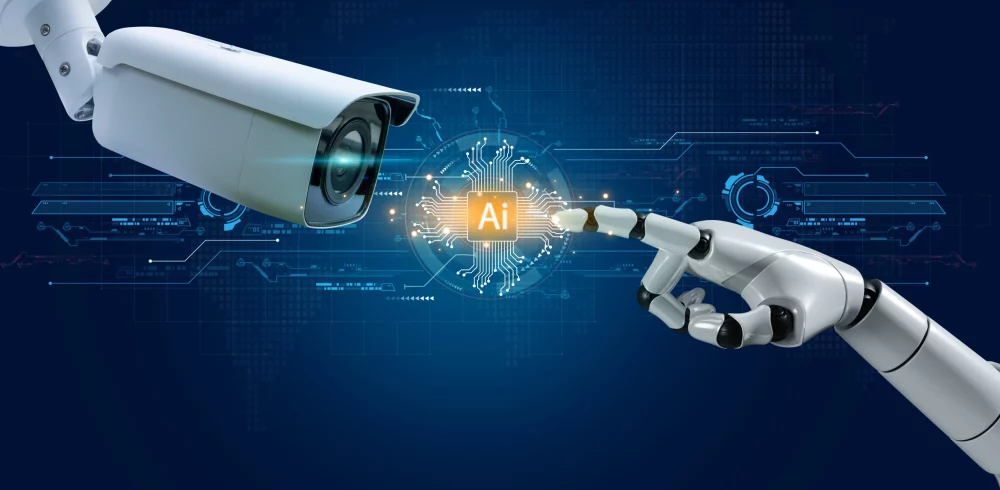
Today’s Smart AI cameras can improve standards and safety by tracking workforce movements, how they use equipment and components, and their approach to health and safety. These connected systems can automatically report any infractions, unusual or out-of-bounds behaviour and other activity.
Integrated with personnel access control, vehicle identification and other systems, an AI-powered system makes physical security operations more efficient, smarter and increases visibility, making for a more secure facility.
The AI system can categorise behaviours, alert appropriate managers and create analytics based on business goals and health and safety needs. All of which help to create a more efficient, safer and productive environment.
Automating Production, Safety and Security
From factories and warehouses to quarries, all types of workplace face the challenge of safer working as the need to economise and increase productivity is an ever-present. And modern security AI cameras can operate in outdoor and extreme weather environments, covering long distances across super-factories or extensive construction sites.
Workplace automation aligned with smart security ensures that operators, either human or robotic, are performing as expected, and can provide visual oversight of complex or large-scale processes.
Within any business, these technologies need to be explained to the workforce before and during implementation to create an understanding of their use, and to address trust, privacy and transparency questions.
In operation, AI‑enabled camera security addresses the need for safety, analytics, and behavioural insight. From access control to occupancy, space usage to realtime movement, they can track workers, stock and processes.
With AI enhanced images producing clarity where needed, and providing security teams with a clear overview and all the information they need to best respond to any situation. And at the HQ or back office, cloud analytics systems can deliver 24/7 alerts. While building up patterns of movement, use and behaviour that would have been invisible or incalculable with previous types of systems.
Protecting the Business and Workers
From the practical and immediate benefits, like notifying workers not wearing the appropriate PPE or high-visibility wear to long-term productivity insights, AI security systems and their cloud applications, potentially linking to supply chain and other platforms, create a unified insight into activities.
And when it comes to planning for operational changes or expansion of the insights from AI, camera systems can identify opportunities for production efficiencies and ways to improve physical security. AI systems also scale easily, with new cameras, security features and other assets all integrating seamlessly into the overall control system.
Also, as new AI features are added to the control platform, these add further value to the business without the need for infrastructure upgrades. Features could include advanced behavourial analysis, features like natural language video search to identify specific items or people within huge data sets, and the integration of drone systems.
Drones can extend the security footprint beyond static cameras, with aerial or ground drones following high-value or high-risk production processes. They can bolster manual security patrols with routes across sparsely populated areas or typically inaccessible zones like roofs, masts, and remote sites.
And for security, the AI-led approach reduces operator fatigue at consoles, reduces the callouts to false alarms for security or health teams. And through links to predictive maintenance or hazard applications, can reduce the risk of failure by supporting root-cause analysis with relevant video evidence.
Summary
AI‑enabled security systems installed across offices, supply chain systems and factories deliver measurable gains for business, security and engineering teams.
They streamline existing operational processes, improve security operations and add valuable insights across the business, from detecting hazards and encouraging improved operational behaviour that leads to improved uptime and reduced stoppages.
Going beyond typical security applications, further use of smart AI-powered cameras can provide automated visual inspection to improve quality control, catching operator errors or defects earlier and.
Together, these systems strengthen security and safety, improve operational continuity, and create more efficient production workflows across complex or flexible environments as robotic systems take over and people are used for higher-value tasks.
Manufacturing & Engineering Magazine | The Home of Manufacturing Industry News