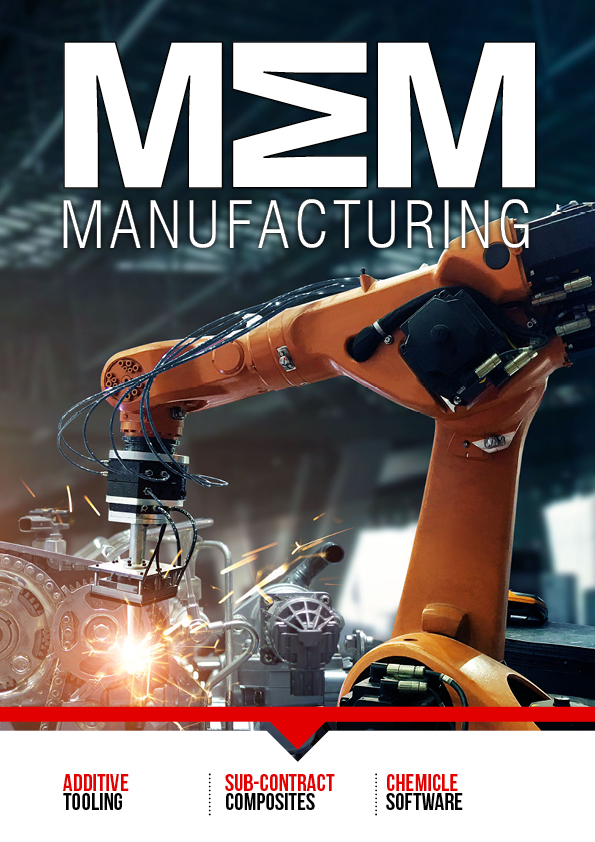


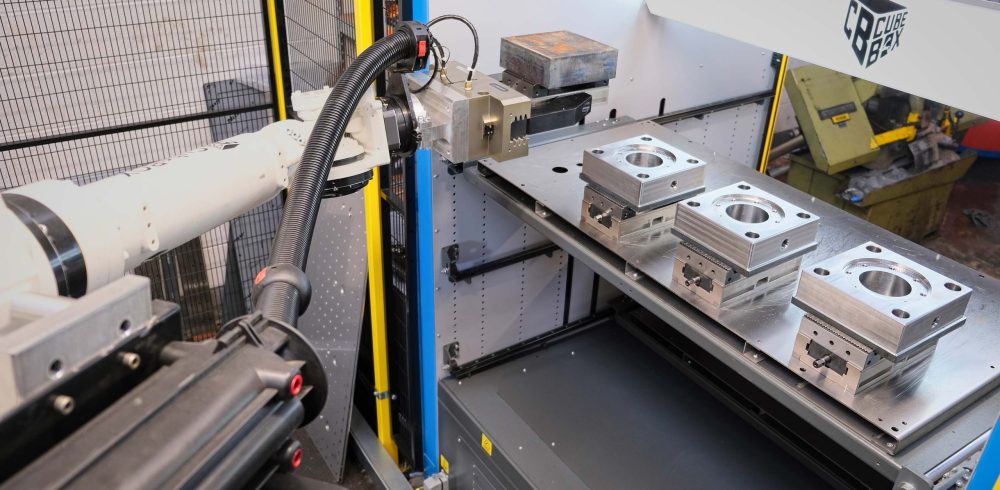
A bespoke robotic handling cell has been retrofitted to a DMG Mori 5-axis vertical machining centre (VMC) at the Redditch factory of Optimal Manufacturing, a contract machining company that was established in December 2022. Supplied by Whitehouse Machine Tools, the Tezmaksan CubeBOX is unusual for a 6-axis robot cell in that it is designed to exchange components mounted in vices on pallets, rather than the billets, castings or forgings themselves.
Joint owners and directors of Optimal, Will Cooper and Tom Slimm, decided to adopt this manner of automation, which requires a robot of 70 kg capacity, due to the frequent need to hold tolerances of less than 10 microns. In their opinion, it would not be possible to achieve the required level of repeatability if the individual components were to be handled, especially if they need to visit a turnover station prior to a second operation.
Instead, workpieces need to be fixtured in vices mounted on zero-point pallets that locate into a pneumatically actuated clamping station on the table of the DMG Mori CMX 70 U machining centre, one of two 5-axis models on site. In this instance, the workholding and location equipment was sourced from Ceratizit.
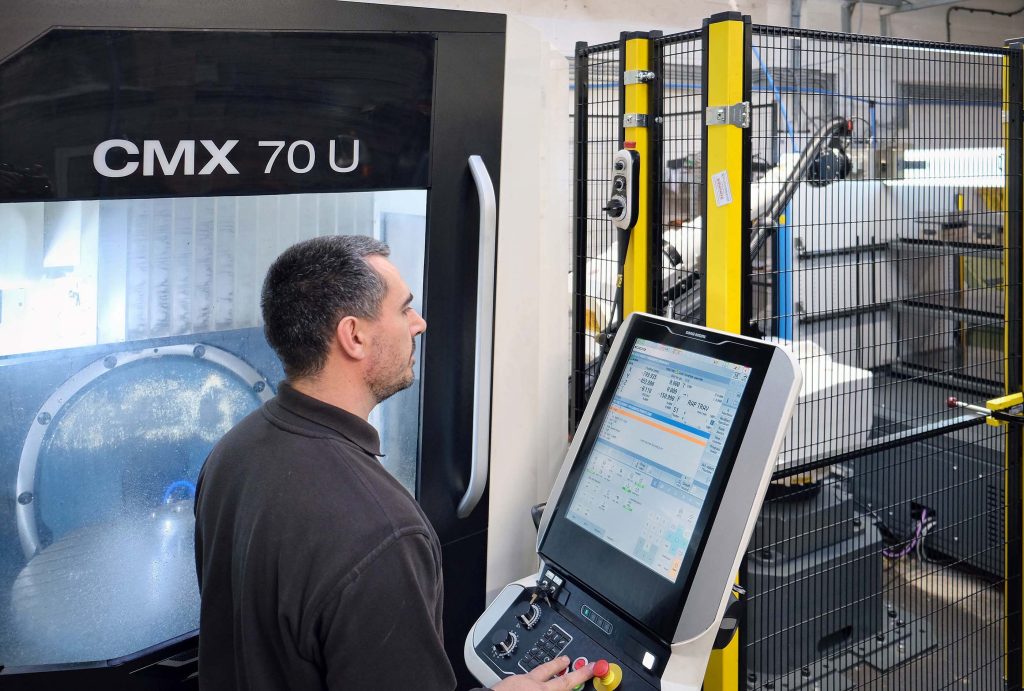
Tezmaksan, the Turkish manufacturer of the robotic machine tending cell, undertook major adjustments to the CubeBOX Blues DR MAX, one of the more heavy-duty plug-and-play configurations in its product portfolio. The three storage shelves, which would normally be stationary and holding unclamped workpieces, were fitted with motors and actuators so that they are able to slide horizontally towards the robot, and back again to facilitate manual loading and unloading of fixtured parts, four of which are stored on each shelf.
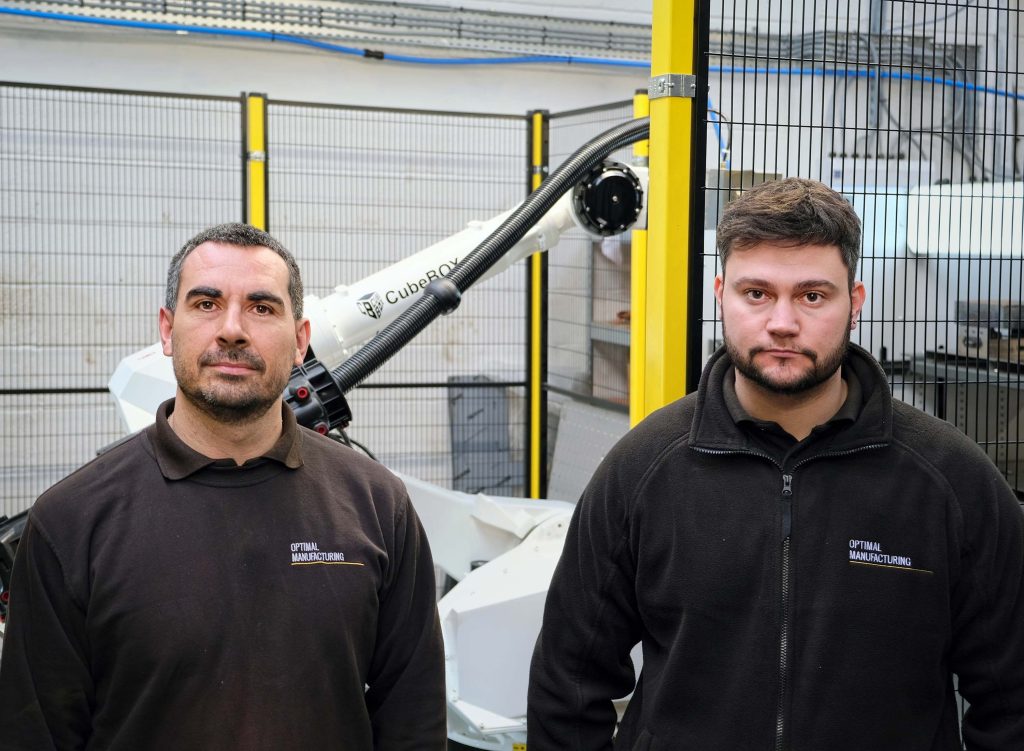
If the drawers were not able to move, the robot gripper would not have enough space to gain access to the two lower shelves to pick up any of the four vice-mounted billets, or return machined component afterwards. It is because the shelf separation is small relative to the nominal 300 mm cube profile of the payload.
The machine tending cell was commissioned in August 2025. Six months later, Mr Cooper commented, “Robot handling has enabled us to automate the production of high-precision prismatic components to match the way our bar-fed lathe allows unattended, around-the-clock turn-milling of rotational parts up to 80 mm diameter.
“Shortly after Brown & Holmes Automation had finished configuring the turnkey installation on behalf of Whitehouse, we received an order for a large quantity of stainless-steel valve manifolds from one of our oil and gas industry customers.
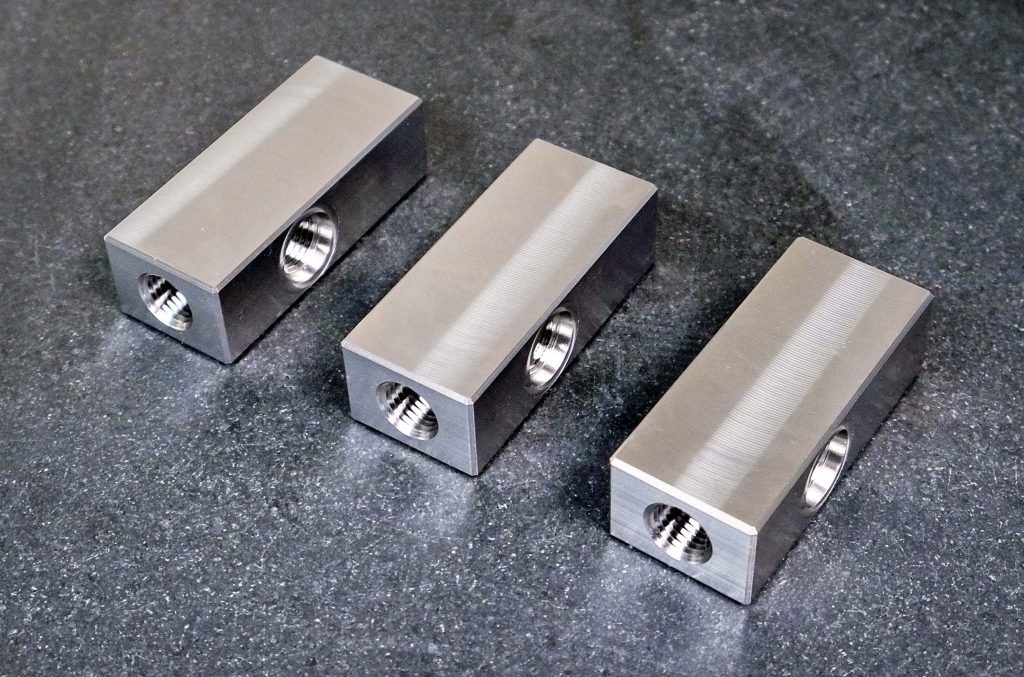
“It was ideal for automation and we ran the cell 24/7 for three months including over Christmas, unattended every night, allowing us to produce the parts economically while at the same time enhancing our reputation for short lead-time deliveries.”
Choice of the Tezmaksan handling solution was down to system flexibility and price, as well as the directors’ confidence in Whitehouse as a machine tool and production equipment supplier. During the time they previously worked together at an engineering firm in Birmingham, Whitehouse delivered a Brother 30-taper machining centre, which proved to be a significant asset on the shop floor and one that received exemplary service backup. Then, after starting Optimal, they purchased a Taiwanese Leadwell 5-axis VMC with compound rotary table from the same source in February 2024, an experience that also proved seamless.
For more open-tolerance machining, they decided six months after inauguration of the automated prismatic machining cell that it would be expedient to load and unload some raw material individually, rather than in the zero-point pallet-mounted vices. For this purpose, three thin plates were machined in-house and permanently mounted on each shelf. Large holes in the plates accommodate the zero-point locations and a grid of small holes drilled at 50 mm centres facilitate fixturing multiple components, typically up to 36 or perhaps even more.
As with all CubeBOX installations, the Blues DR MAX was supplied with Tezmaksan’s RoboCAM intelligent automation software, so there is no need for expensive third-party robot integrators. The system allows an operator without any robot programming experience to set up a new part in two to three minutes.
It is possible to load a DXF file directly, from which the software reads the part geometry and automatically calculates grip points and the positioning cycle. The system also tracks where workpieces are in real-time, enabling built-in collision protection. The software calculates and reports on cycle duration to establish production efficiency, including during lights-out manufacturing.
In addition to serving the oil and gas industry, Optimal regularly supplies OEMs in the automotive, aerospace and medical sectors, as well as elsewhere, keen to diversify its client portfolio as much as possible. Prototyping to high-volume production is catered for, although generally batch size is in the 20- to 50-off range.
Mr Slimm concluded, “With some machining cycles lasting well in excess of two hours and our ability to gain 14 hours’ production overnight virtually for free, we are not chasing small reductions in cycle times. The over-riding need here is for high levels of machining accuracy and the bespoke Tezmaksan cell supplied by Whitehouse meets that need precisely.
“Particularly in view of its simplicity of integration, compatibility with any brand of machining centre and the difficulty in finding and recruiting skilled shop floor staff, this type of easy-to-use automation is a big asset for any manufacturing organisation, and particularly for subcontractors.”
Manufacturing & Engineering Magazine | The Home of Manufacturing Industry News