


Russia launches Syria bombardment from carrier in Mediterranean
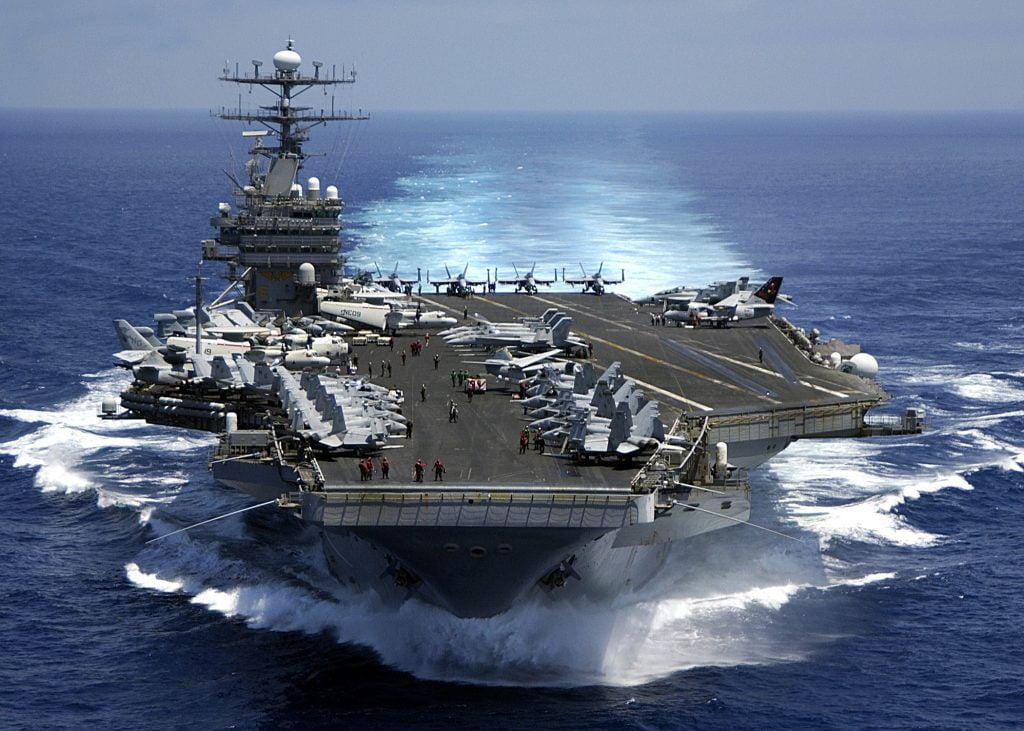
Russia has launched a major air offensive in Syria as part of a joint operation with Bashar al Assad’s regime. Jets have taken off from the Admiral Kuznetsov aircraft carrier and hit targets in Idlib and Homs, while the Syrian military has attacked rebel groups inside east Aleppo. Russian defence minister Sergei Shoigu said the main targets include Islamic State (IS) and al Nusra ammunition depots, as well as plants producing weapons. According to the minister, operations launched from the country’s sole aircraft carrier, which arrived on the Syrian coast at the weekend, are targeting IS operations in the two areas. This is the first time the aircraft carrier, the flagship of the Russian Navy, has taken part in a military operation. Another ship in the flotilla, the frigate Admiral Grigorovich also fired cruise missiles at Syrian targets, the minister said. Mr Shoigu said terrorists have developed “factories” for producing weapons and claimed this is the reason for the fresh attacks. He also said the Russian military had thoroughly assessed the targets before striking them. He said: “You are aware that we have sent a large group of our radiation, chemical and biological protection troops to determine the toxic substances which are used by terrorists. “Within the past week they used them twice – in one case, 27 people were hospitalized and three died, in the other case 30 people were hospitalised – I mean the Syrian Army soldiers.” To the west of Aleppo, heavy strikes have been reported in the opposition-controlled countryside and three hospitals have been bombed in the last two days. At present, 275,000 people are said to be trapped by regime troops inside the besieged city.
Groundbreaking Robot Hand Draws Attention From The World’s Military

Prepare for artificial intelligence running our lives. Well, actually, it’s already here. But the ramifications of advanced computer technology thinking for itself – as seen in post-apocalyptic Hollywood movies – are hopefully a distant nightmare away. Certainly, those robots make today’s current crop look decidedly primitive. That said, Japan, the purveyor of all things technologically super-advanced, has seen Tokyo University open a can of worms it wasn’t expecting. The dilemma comes as the country’s prime minister threatens to rewrite Japan’s constitution to eradicate seven decades of pacifism and allow new robotic technology to be exploited to build weapons. The antagonist at the centre of all this is a newly developed robotic hand that can beat any human challenger at the game of rock, paper, scissors. You’d think this was a harmless little breakthrough that, while being impressive, wouldn’t bring much to 21st century weaponary. But you’d be wrong. Critics claim the robot hand could be used to deploy missiles, bullet-dodging drones, or even droids armed to tackle the battlefield. Tokyo University, like the other seven major higher education institutions in the country, has banned research into technology that could be used to serve military policy and tactics. The prime minister, who has already changed legislation to allow for military exports, now seems eager to remove barriers within academia too. It’s clear to see why the robot hand would benefit military power. It essentially works by cheating, utilising image sensors that are able to read the human response and interpret its reply – in this case a hand gesture – faster than the human eye. Therefore, it never loses. Its creator Masatoshi Ishikawa is not eager to see the hand become part of the military. The university professor said that he has had significant interest from military manufacturers and governments who want to discuss the potential of the robot hand but he has so far dismissed them saying he is not interested.