
Land Rover Engineers Developing 3D-Printed Glove
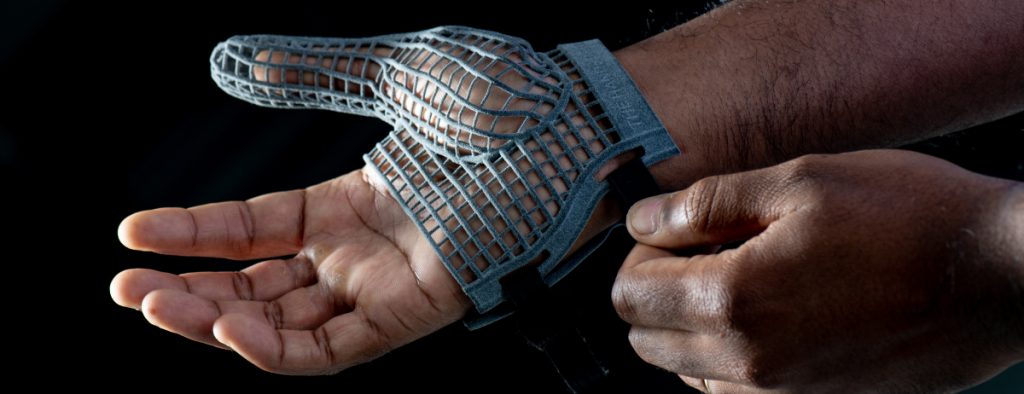
Land Rover Engineers Developing 3D-Printed Glove : Engineers from Jaguar Land Rover are working on a lightweight 3D-printed glove that could help better protect employees from the threat of a musculoskeletal disorder. The glove is designed for people working on the production line, such as those required to fit clips or fasteners into the chassis during assembly of JLR’s luxury vehicles. “The health and wellbeing of our workforce remains our priority across all factories and facilities. Technologies like the 3D-printed glove allow us to use the world-leading expertise and equipment we have in-house to protect the hands of our makers, developing equipment that will make Jaguar Land Rover a great place to work, now and in the future,” said additive manufacturing strategic engineer Chris Noble. Engineers at JLR’s Gaydon site, which is home to one of the largest 3D printing facilities in the UK, are using the company’s advanced manufacturing expertise to design and 3D print a lattice-style structure which would provide support to reduce muscle fatigue, but also be flexible and comfortable enough to wear during an eight-hour shift. In the short term the gloves will support workers across JLR’s facilities, helping to protect against musculoskeletal disorders. Manufacturing & Engineering Magazine | The Home of Manufacturing Industry News Manufacturing & Engineering Magazine (MEM), is a the leading UK based monthly print & digital publication focused on promoting innovation in manufacturing and engineering available here in the UK. We cover : SUSTAINABILITY (Waste & Water Management, Recycling, Energy); INMOTION (Rail, Marine, Aerospace, Automotive, Defence); INFRASTRUCTURE (Oil & Gas, Nuclear, Construction); Healthcare (Medical), TECHNOLOGY(Printed, Connected, Software, Composite); MANUFACTURING (Chemical, Metals, Plastics, Electronics, Electrical); CONSUMER GOODS(Furniture, Electrical, Electronics, Food) to name but a few. We have over 50,000 views of each issue of MEM on average in 2022 and go to print monthly and also publish in our newsletter, (each issue is available free for 12 months digitally). Our focus is aligned across the next 12 months with our global media partnerships around Trade Events and also contains original content.
The New Land Rover Defender Has Been Launched

The Defender 110 and Defender 90 have been revealed which Jaguar Land Rover has said “reimagines” the range for the 21st century. Land Rover chief design officer Gerry McGovern said: “The new Defender is respectful of its past but is not harnessed by it. This is a new Defender for a new age. “Its unique personality is accentuated by its distinctive silhouette and optimum proportions, which make it both highly desirable and seriously capable – a visually compelling 4×4 that wears its design and engineering integrity with uncompromised commitment.” The Defender 110 starts from £45,240 and is available immediately while the Defender 90 will cost about £40,000 and delivery dates are expected to be confirmed later in the year. JLR’s executive director, product engineering, Nick Rogers added: “We’ve embraced Defender’s stunning capability and minimalistic, functional interior to reinvent the icon for the 21st century. “New Defender gives us the licence to do things differently, to push the boundaries and do the unthinkable, without ever losing the character and authenticity of the original. “From the start we had an absolute obsession with functionality beneath the skin, from choosing the right materials through to state of the art connectivity. “The result is not only the most capable Land Rover ever made, but also a truly comfortable, modern vehicle that people will love to drive.” Chief commercial officer Felix Bräutigam said: “New Defender will be available in 128 global markets and meets or exceeds the toughest emissions and safety requirements in the world. “Using advanced technology to deliver the toughness and character you can only find in a Defender, our new 4×4 has been developed for adventurous hearts and curious minds.” Manufacturing & Engineering Magazine | The Home of Manufacturing Industry News
Jobs Under Threat at Coleshill Manufacturer

Coleshill-based manufacturer Auria Solutions has announced that a quarter of its workforce is expected to lose their jobs in the latest blow to the region’s automotive sector. In total, 80 jobs are under threat at the company which supplies parts for the inside of cars, such as liners, trims and flooring. “Auria Solutions is going through a consultation process before finalising a necessary reduction in workforce for the company’s Coleshill plant,” said in a statement Auria Solutions. “As a global supplier of vehicle interior components, Auria must continually make adjustments to its operations and workforce to mirror the production schedules and manufacturing footprint of its OEM customers around the globe.” The factory’s main OEM customer is Jaguar Land Rover, which has recently announced it will be cutting 4,500 staff. Earlier this week Coventry-based taxi manufacturer London Electric Vehicle Company revealed it was cutting 70 jobs as it prepared for “a challenging year” for the industry. The Society of Motor Manufacturers and Traders (SMMT) yesterday said “UK Automotive is on red alert” ahead of a feared no-deal Brexit which would put “thousands of jobs on the line”. Its data showed UK car production hit a five-year low in 2018, with 150,000 fewer cars manufactured than in the previous year. Trade union Unite, which represents around 60% of the workforce at Auria’s Coleshill site, said the latest job cuts were “a bitter blow” to staff and the regional economy. “The challenges facing JLR and other car manufacturers are well-documented – the slowdown in the Chinese market; the issues relating to the change from diesel to electric cars; and the growing uncertainty generated by Brexit,” said Unite regional officer Jason Richards. Manufacturing & Engineering Magazine | The Home of Manufacturing Industry News
The success of Jaguar Land Rover (JLR)

India’s Tata Motors bought out Jaguar and Land Rover (JLR) in 2008 and since then it has become a global success story. Tata’s strategy was to invest heavily in growth at a time when other multinationals were retrenching following the worldwide financial crash. JLR boosted the output to a record 621,109 vehicles sold in 130 countries in 2017 and created thousands of jobs. The losses of the first few years have been turned into global profits, which are invested back into the business. Now they offer hundreds of models and specification derivatives – highly relevant, desirable products at the forefront of technology thanks to the £22 billion invested over the past decade. Moreover, the company is one of the biggest investors in research and development in the UK, with a further £4.2 billion being invested in 2017/18 FY. “Change has been a constant feature of life at Solihull,” said director of operations, Nigel Blenkinsop. “We have succeeded through having clarity of purpose at all levels, developing the systems to support performance, coaching into teams and encouraging talents to be used for the common good.” Simplification and standardisation of systems have undoubtedly helped Solihull’s 10,000-strong workforce to deliver JLR’s strategy and adopt continuous change. More than 60 KPIs (key performance indicators) have been refined into 18 KPIs that drive operations across all three JLR sites and the four technology areas at Solihull (body, paint, trim and logistics). In addition to this, JLR has also invested in voluntary schemes to maximise employee engagement and support for personal development. The ‘Pulse’ programme in the paint facility, for example, benchmarks employee engagement and stimulates management action, while the feedback from the workers is channelled through ‘Development Role’ volunteers. Perhaps the most progressive and inspiring of these schemes is the Team Improvement Circle, or TIC programme, in which employees are encouraged to put forward their ideas for improvements of any kind, and supported with problem solving techniques to turn them into real solutions. JLR’s success story has not only been about innovative technologies, but about engaging all of its employees into its mission. Manufacturing & Engineering Magazine | The Home of Manufacturing Industry News
Jaguar Land Rover to Invest £100m in Castle Bromwich Site

Leading vehicle manufacturer Jaguar Land Rover is set to invest £100 million into its Castle Bromwich plant. The move will see production of the XE saloon gradually shipped across from the companyâs nearby Solihull plant. It is hoped that the move will free up capacity on the XE production line at Lode Lane for the new F-Pace crossover model, which has replaced the XE as Jaguarâs fastest selling model. The move comes only 18 months after the company started producing the XE at Solihull, which it announced with a fanfare including a parade of famous models around the Lode Lane plant. The decision to switch the production of the ZE shows how flexible the firmâs manufacturing process is and also underlines the renaissance of the Castle Bromwich site, which only eight years ago was threatened with closure. JLR said that the investment, which rose to £500 million over the last two years, followed the significant customer demand for the latest two models produced by Jaguar. The company said that the move would be a gradual process and would see investment in new body shops, press lines and final assembly halls. It also marks the return of all Jaguar sports and saloon car manufacturing to the plant in Birmingham, which employs nearly 3,000 people and currently produces the F-Type, XJ and XF. Wolfgang Stadler, JLRâs Executive Director of Manufacturing, said: The significant investment to create two centres of excellence in aluminium vehicle manufacturing, utilising shared technologies, was deliberate. It gives us the flexibility to quickly respond to consumer demand for our growing range of products. Nicolas Guibert, Castle Bromwich Operations Director, said the decision would see Castle Bromwich undergo a significant increase in production volumes. In order to increase capacity, the company has been slowly collecting parcels of land around the facility.